Vercel

Search documents
Claude Code“隐形技术栈”被扒出来了,2430次测试揭秘工具偏好清单
3 6 Ke· 2026-02-27 09:27
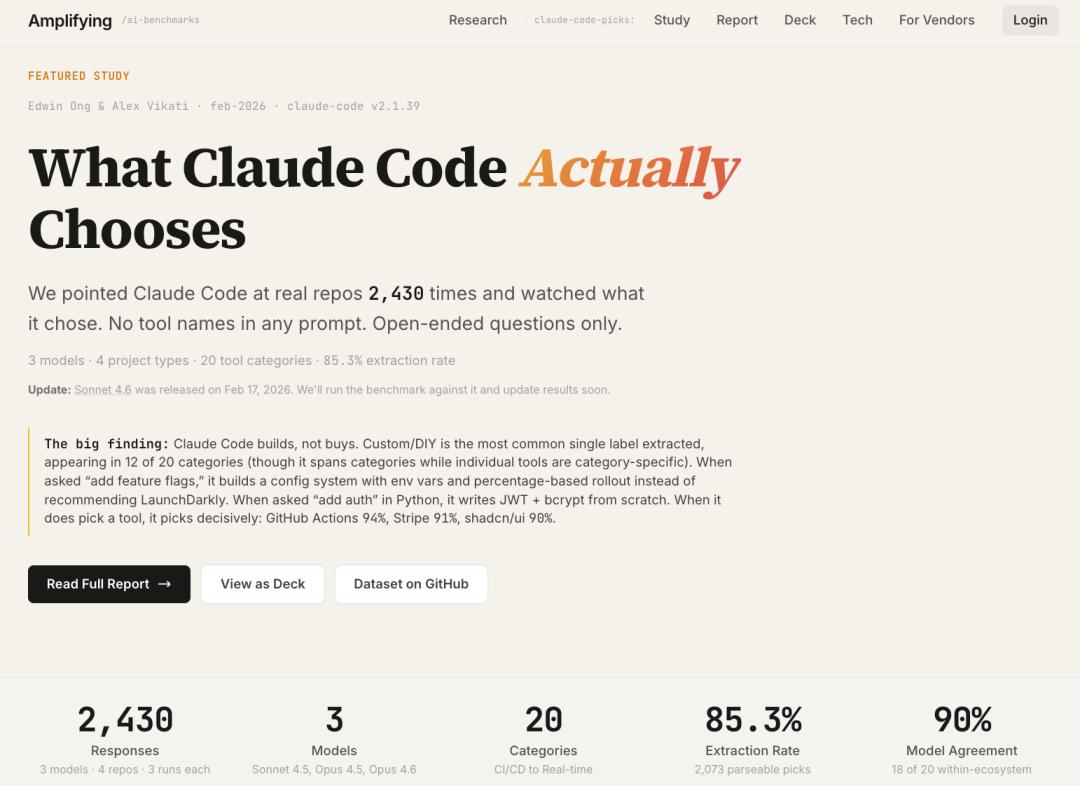
Core Insights - The study conducted by Amplifying.ai reveals Claude Code's preference for building custom solutions over recommending third-party tools, with 12% of all major selections being self-built solutions [5][27] - A default technology stack has emerged, with Claude Code favoring specific third-party tools such as Vercel, PostgreSQL, and Stripe [6][30] - Certain tool categories have become dominated by single tools, with GitHub Actions, Stripe, and shadcn/ui capturing 94%, 91%, and 90% of their respective categories [7][31] - Consistency in tool selection is high among different models within the same technology ecosystem, with 90% agreement on preferred tools across 20 categories [8][49] Experiment Setup - The research covered three models and involved 4 project types and 20 tool categories, analyzing a total of 2,430 tool selection behaviors [2][11] - Open-ended prompts were used throughout the experiment, ensuring no specific tool names were mentioned [4][13] - The study included a clean code environment for each test run to ensure unbiased results [11] Key Findings - Claude Code shows a strong inclination towards self-built solutions, particularly in feature flags and authentication, where it frequently opts for custom implementations [27][28] - The study identified a high extraction rate of 85.3%, indicating a strong ability to identify primary tool recommendations from responses [19] - The models demonstrated varying preferences, with Opus 4.6 showing a tendency to recommend newer tools and custom solutions compared to its predecessors [56] Tool Selection Preferences - GitHub Actions, Stripe, and shadcn/ui are the most frequently recommended tools, dominating their respective categories with high selection rates [30][31] - The study highlights that project context significantly influences tool selection, with different models showing consistent preferences within the same technology ecosystem [9][62] - The research indicates a trend towards custom solutions, particularly in areas like feature flags and authentication, where models prefer building from scratch rather than using established services [47][39] Model Comparison - The three models (Sonnet 4.5, Opus 4.5, Opus 4.6) showed high agreement on tool preferences, with only a few categories exhibiting real divergence [49][50] - The study emphasizes that the choice of tools is heavily influenced by the specific programming ecosystem, with distinct preferences emerging for JavaScript and Python projects [61][62] - The models' recommendations reflect a shift towards a new technology stack shaped by AI-assisted development, indicating a potential change in industry standards [62]

不写一行代码,和AI聊了两天,我居然上线了一个软件?
虎嗅APP· 2026-02-16 02:42
Core Viewpoint - The article emphasizes the accessibility of AI tools for non-technical individuals to create software products, demonstrating that even those without coding knowledge can successfully develop functional applications with minimal investment and time [5][6]. Group 1: Motivation and Initial Steps - The motivation for creating a software tool stemmed from the author's frustration with video cover images and the high costs associated with existing AI image generation tools [7][11]. - The author suggests that before diving into development, it is crucial to clearly define the project requirements, as vague ideas can lead to ineffective outcomes [12][14]. Group 2: Development Process - After clarifying the requirements, the author utilized Google AI Studio to create a basic webpage layout using natural language, which allowed for quick iterations and adjustments [19][23]. - For more complex functionalities like user registration and payment processing, the author transitioned to using Claude Code, which provided a more robust solution compared to other tools [28][29]. Group 3: Implementation and Learning - The development process involved a collaborative approach with AI, where the author provided input and received detailed plans for implementation, including database setup and payment integration [34][35]. - The author highlighted the importance of hands-on learning, as interacting with AI during the coding process not only facilitated project completion but also enhanced understanding of the underlying concepts [43][44]. Group 4: Finalization and Deployment - Once the coding was complete, the author deployed the application to a cloud server and purchased a domain name to make the software accessible to users [46][49]. - The article concludes with two key recommendations: clearly define project goals and start by solving personal problems, which can lead to the development of useful tools [54][56].

扎克伯格急了,Meta内部文件曝光:宁用竞品,也要废掉祖传系统
3 6 Ke· 2025-10-21 02:26
Core Insights - Meta's CEO Mark Zuckerberg views time as the only enemy in the AI race, investing hundreds of billions and offering nine-figure salaries to attract top talent, while accelerating internal engineering processes from hours to minutes to close the gap with competitors like OpenAI and Google [1][3][6] Group 1: Investment and Talent Acquisition - Meta has made significant investments in AI, including restructuring its AI team and offering salaries as high as $250 million to attract top talent [5][3] - The company has established the Meta Superintelligence Lab (MSL) to centralize all AI operations and expedite development [3][1] Group 2: Internal Revolution and Infrastructure Changes - MSL is pushing for a deep internal revolution to adopt faster engineering tools and accelerate AI development [1][9] - Meta is transitioning from its slow legacy systems to more agile platforms like Vercel and GitHub to enhance productivity and reduce deployment times from 99 minutes to under 2 minutes [12][14] Group 3: AI Usage and Employee Engagement - Meta has implemented various measures to enforce AI usage among employees, including tracking AI usage rates and setting specific targets for different departments [2][17] - The company has gamified AI adoption through a project called "Level Up," rewarding employees for completing tasks that involve AI tools [21][23] Group 4: Leadership and Strategic Direction - Nat Friedman, former CEO of GitHub, is leading the product and application research team at Meta, emphasizing the urgency to adopt faster development practices [7][9] - Zuckerberg has expressed a willingness to incur losses in the short term to avoid missing out on the potential of AI, highlighting the critical nature of rapid action in this technological race [6][1]


Meta's Superintelligence Labs Turns To Vercel, GitHub To Speed Up AI Prototyping: Report - Meta Platforms (NASDAQ:META)
Benzinga· 2025-10-03 10:01
Core Insights - Meta Platforms Inc. is shifting its AI prototyping work to external developer platforms to enhance development speed as part of its new Meta Superintelligence Labs initiative [1][3][8] Group 1: Development Strategy - The integration of tools like Vercel and GitHub aims to improve deployment times, reducing them from 99 minutes to under 2 minutes [6] - Meta's internal memos indicate that the current deployment process is inefficient, taking "hours vs. minutes" [3] - The company is adopting a dual-track approach, relying on Vercel for immediate deployment speed while developing an internal platform called "Nest" [4][5] Group 2: Strategic Partnerships and Investments - Meta is exploring collaborations with Google and AI startups like Scale AI to bolster its AI infrastructure [2] - Vercel recently raised $300 million, achieving a valuation of $9.3 billion, with notable investors including Meta's AI chief and other prominent firms [7] - The partnership with Vercel and GitHub is part of a broader strategy to remain competitive against rivals like OpenAI and Google [6][8] Group 3: Internal Challenges and Adjustments - Meta's Product and Applied Research group is steering engineers away from slower home-grown systems due to performance limitations [3] - Despite significant investments in its own AI models, Meta has faced challenges, including reliance on external tools like Anthropic's Claude and Midjourney for specific tasks [8][9]