拟剧论

Search documents
汤永隆:“拟社交”情感代餐,填不饱真实需求
Huan Qiu Wang Zi Xun· 2025-11-30 23:01
Core Perspective - The term "parasocial" has been recognized as the 2025 word of the year by the Cambridge Dictionary, describing a one-sided emotional connection individuals feel towards celebrities, fictional characters, or AI chatbots, reflecting the emotional characteristics of the digital age [1] Group 1: Definition and Origin - The concept of "parasocial" originated in 1956 by sociologists Donald Horton and Richard Wohl, who observed that television audiences develop imaginary interpersonal interactions with broadcasters and celebrities [1] - It specifically refers to the one-sided and enduring emotional ties people form with fictional characters or online public figures, such as fans supporting their idols or gamers expressing feelings towards game characters [1] Group 2: Theoretical Frameworks - Attachment theory suggests that when real-life relationships are uncertain, "parasocial" figures serve as ideal emotional refuges due to their constant availability and lack of rejection [2] - The uses and gratifications theory emphasizes that users actively engage with "parasocial" relationships to fulfill needs for belonging, self-identity, and escapism [2] - Social exchange theory indicates that for socially anxious individuals, "parasocial" relationships offer low-investment, high-reward emotional exchanges compared to real-life relationships [2] - Dramaturgical theory posits that carefully crafted public personas can serve as perfect canvases for fans to project their ideal selves [2] Group 3: Positive and Negative Impacts - "Parasocial" relationships provide emotional support for socially vulnerable groups, alleviate loneliness, and foster personal growth through positive role models [3] - However, prolonged engagement in "parasocial" interactions may weaken real-life social skills, leading to a cycle of increased loneliness, particularly among AI companion users, where the risk of depression and loneliness nearly doubles [3] - Users accustomed to frictionless relationships with AI may struggle with real-life relationships, facing challenges in tolerance for conflict and compromise [3] - The phenomenon may also create information bubbles, leading to cognitive biases and a loss of independent thinking, while widespread emotional displacement could accelerate social atomization and weaken traditional community bonds [3] Group 4: Recommendations for Balance - To address the trend of "parasocial" relationships, individuals should maintain awareness of their one-sided and designed nature, setting clear boundaries for time and emotional investment [4] - Online interactions should be viewed as gateways to offline communication, encouraging the cultivation of real-life interests and social connections [4] - Society should enhance media literacy education across all age groups, promoting rational public discourse and critical thinking about online content [4] - Building offline community spaces and organizing activities can create more opportunities for real interpersonal interactions [4] - Ultimately, while "parasocial" relationships can provide temporary comfort, they cannot replace the depth of real-life connections, emphasizing the importance of genuine human interactions [4]
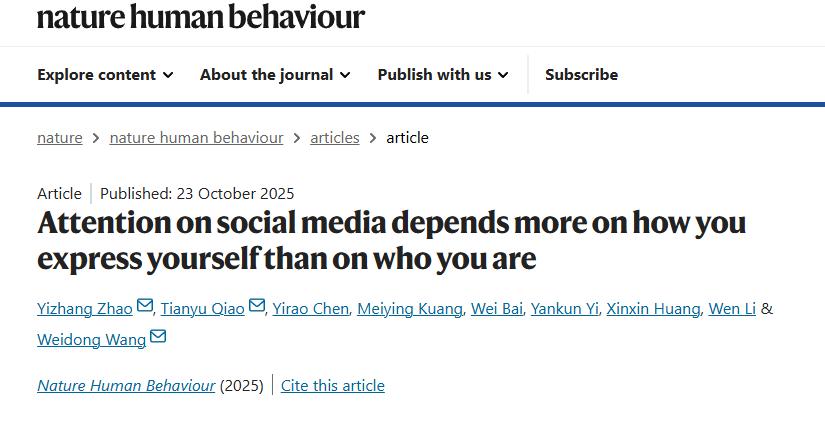
《自然》最新研究:Z世代不看“人设”,只看“疯”度
3 6 Ke· 2025-11-06 03:06
Core Insights - The study reveals that for Generation Z, creating a personal brand on social media is less effective than using diverse emotional expressions and memes to gain attention [3][4][12] Group 1: Social Media Behavior - The research involved over 10,000 individuals born in 2000-2001, analyzing 2.1 million social media posts and interactions from 2018 to 2021 [3][4] - The findings contradict traditional views on social media impression management, indicating that emotional expression and the use of memes are more significant than wealth or status in gaining visibility [3][4][10] Group 2: Emotional Expression and Engagement - To stand out on social media, users should utilize a variety of memes and express a range of emotions, moving away from monotonous expressions [4][12] - The study emphasizes that emotional diversity and the use of emojis enhance user attractiveness and engagement, regardless of individual characteristics like gender or education level [12][13] Group 3: Attention Economy Dynamics - The research highlights the dynamic nature of attention capital, showing that user engagement can fluctuate significantly over time, with a notable percentage of users shifting between high and low engagement groups [15][18] - It suggests that maintaining attention on social media requires continuous and varied emotional expression, as past popularity does not guarantee future visibility [18][20] Group 4: Empathy and Social Connections - The study posits that empathy mechanisms apply broadly across social connections, indicating that emotional expressions can foster connections even among acquaintances [21][23] - It argues that diverse emotional expressions signal reliability and depth, which are crucial for maintaining long-term social relationships in a digital context [24][25] Group 5: Implications for Social Media Platforms - The findings suggest that social media platforms should consider the dynamics of attention capital and emotional engagement in their algorithms to promote user well-being and social connections [26]