掏空台湾

Search documents
央视披露:美对台超110亿美元军售包括“海马斯”火箭炮、自杀无人机、反坦克导弹、自行榴弹炮;专家:美国“出兵协防”可能性越来越小
Mei Ri Jing Ji Xin Wen· 2025-12-25 00:51
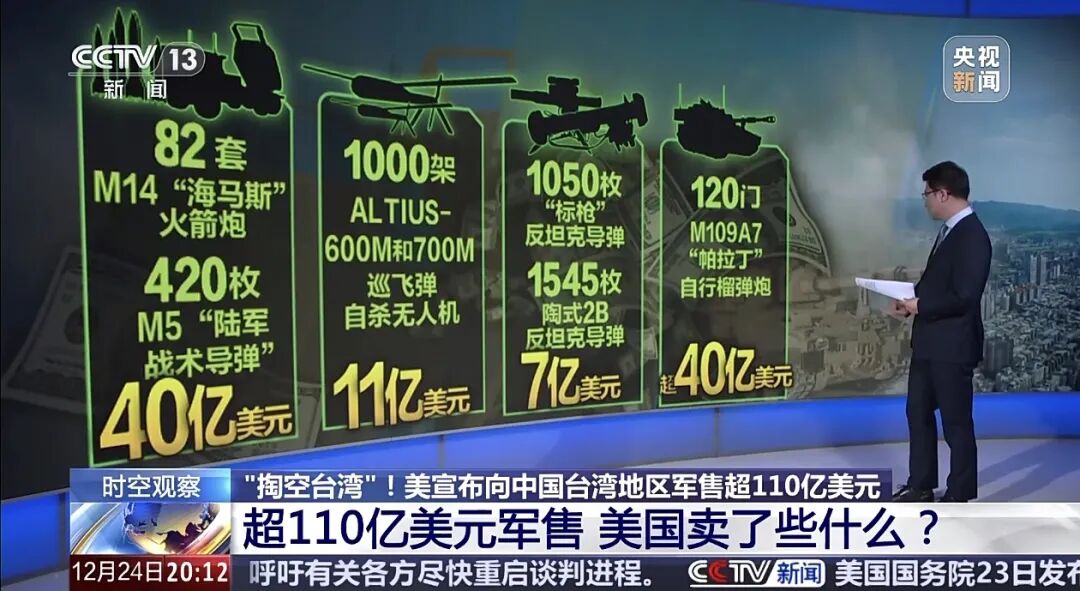
Group 1 - The core point of the article is the announcement of a record-breaking arms sale from the United States to Taiwan, totaling over $11 billion, which is the largest in history for such transactions [1][10]. - The arms sale includes four main components: 82 sets of M142 "HIMARS" rocket systems and 420 M57 "Army Tactical Missiles" valued at $4 billion, 1,000 ALTIUS-600M and 700M suicide drones worth $1.1 billion, 1,050 "Javelin" anti-tank missiles and 1,545 TOW 2B anti-tank missiles totaling $700 million, and 120 M109A7 "Paladin" self-propelled howitzers valued at over $4 billion [3][5][4]. Group 2 - The military analyst Shao Yongling noted that the choice of these specific weapons aims to enhance Taiwan's defense capabilities, particularly against potential land invasions [3][7]. - The article highlights concerns within Taiwan regarding the financial implications of such a large military expenditure, with fears that it may deplete Taiwan's economic resources and impact social welfare and education budgets [10][12]. - There is a prevailing sentiment among Taiwanese scholars that the arms sale may ultimately be detrimental to Taiwan, as it positions the island as a pawn in U.S. strategic interests without direct military support from the U.S. [12][14]. Group 3 - The article discusses the broader implications of U.S. actions on Taiwan's economy, including increased military spending that could lead to a significant portion of Taiwan's budget being allocated to defense, thereby affecting other sectors [16][18]. - The ongoing U.S. strategy is perceived as a method to extract economic value from Taiwan, particularly in the semiconductor industry, which is crucial for Taiwan's competitive edge [13][14]. - The potential for increased economic disparity in Taiwan, referred to as "Taiwan disease," is highlighted, suggesting that the arms sale and related economic policies could exacerbate existing inequalities [18].

美最新一次对台军售超110亿美元 专家:“出兵协防”可能性越来越小
Chang Sha Wan Bao· 2025-12-25 00:13
Summary of Key Points Core Viewpoint - The recent announcement of over $11 billion in military sales from the U.S. to Taiwan marks the largest arms deal in history between the two, with a focus on enhancing Taiwan's defense capabilities against potential threats from mainland China [1][9]. Group 1: Details of the Military Sales - The military sales include 82 M142 "HIMARS" rocket systems and 420 M57 "Army Tactical Missiles," valued at $4 billion [1]. - The deal also encompasses 1,000 ALTIUS-600M and 700M suicide drones, with a total value of $1.1 billion, capable of targeting armored land vehicles and surface ships [3]. - Additionally, it includes 1,050 "Javelin" anti-tank missiles and 1,545 TOW 2B anti-tank missiles, valued at $700 million, designed to combat heavily armored targets [5]. - Lastly, the package features 120 M109A7 "Paladin" self-propelled howitzers, valued at over $4 billion, which are intended to complement the HIMARS systems [5]. Group 2: Implications and Reactions - Experts suggest that the U.S. is increasingly unlikely to deploy troops to assist Taiwan directly, instead opting to arm Taiwan to increase the costs for China in any potential unification efforts [7]. - There is significant concern within Taiwan regarding the financial implications of such a large military expenditure, with fears that it may deplete resources for social welfare and economic development [9][11]. - The Taiwanese public expresses skepticism about the effectiveness of these arms sales, viewing them as potentially harmful and a means for the U.S. to exploit Taiwan for its own strategic interests [10][11].