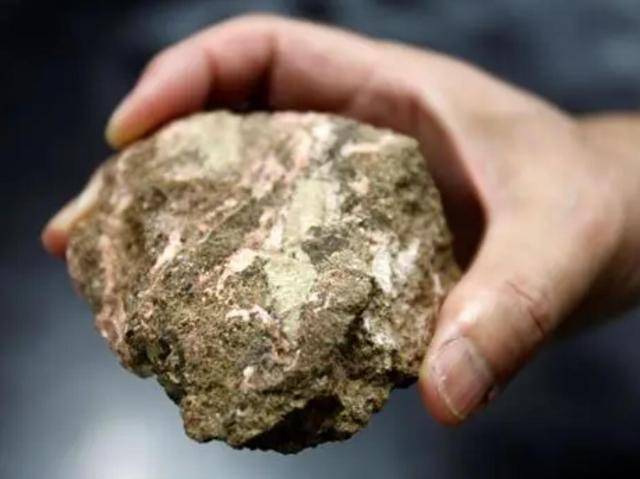
陆军战术导弹

Search documents
军情时间到丨我军在台岛周边联合演练阵容显著升级
Yang Shi Xin Wen Ke Hu Duan· 2026-01-03 13:21
Core Viewpoint - The recent military exercises conducted by the Chinese People's Liberation Army (PLA) around Taiwan demonstrate a significant enhancement in operational capabilities and readiness to defend national sovereignty and territorial integrity [1][10]. Group 1: Military Exercises Overview - The "Justice Mission-2025" exercise began on December 29, 2025, involving multiple branches of the military, including land, sea, air, and rocket forces, focusing on combat readiness and joint operational capabilities [1]. - Since the establishment of the Eastern Theater Command in February 2016, the PLA has been responsible for military readiness and realistic training exercises around Taiwan [1]. - In August 2022, the Eastern Theater Command conducted a series of joint military actions, marking the first time multiple military branches engaged in integrated operations around Taiwan [3]. Group 2: Recent Exercises and Developments - From April 8 to 10, 2023, the Eastern Theater Command organized the "Joint Sword" exercise, which included the participation of the Shandong aircraft carrier for the first time, focusing on regional air dominance and maritime strike operations [5]. - In May and October 2024, the "Joint Sword-2024A" and "Joint Sword-2024B" exercises emphasized joint battlefield control and precision strikes on critical targets, with the Liaoning aircraft carrier participating for the first time [7]. - In April 2025, the "Strait Thunder-2025A" exercise featured the army's long-range firepower conducting live precision strikes on simulated critical targets in the East China Sea [9]. Group 3: Enhanced Capabilities and Strategies - The joint exercises have seen a significant upgrade in the participating forces and equipment, showcasing improved coordination and operational effectiveness among different military branches [10]. - The integration of advanced aircraft like the J-20 and J-16 has demonstrated enhanced offensive capabilities, allowing for effective joint training and operational readiness in close proximity to Taiwan [11][13]. - The exercises have been designed with increased specificity, with some training locations being less than nine kilometers from Taiwan's coastline, enhancing deterrent effects and operational readiness [15]. Group 4: Intelligence and Coordination Improvements - The PLA has improved firepower coordination and intelligence sharing among different military regions, enhancing the efficiency of joint operations [18]. - The ongoing increase in U.S. arms sales to Taiwan has prompted the PLA to adapt its training standards and improve its defensive and offensive capabilities against such threats [20].

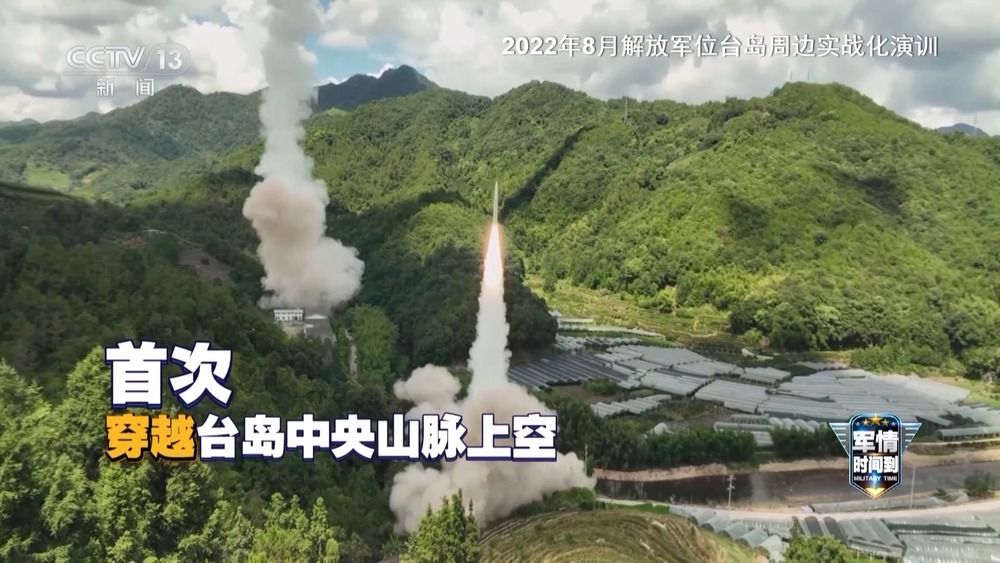
我军在台岛周边联合演练阵容显著升级
Zhong Guo Xin Wen Wang· 2026-01-03 13:14
Core Viewpoint - The recent military exercises conducted by the Chinese People's Liberation Army (PLA) around Taiwan demonstrate a significant upgrade in joint operational capabilities, reflecting a strong commitment to safeguarding national sovereignty and territorial integrity [1][3]. Group 1: Military Exercises Overview - The "Justice Mission-2025" exercise, starting on December 29, 2025, involves multiple branches of the military, including land, sea, air, and rocket forces, focusing on combat readiness and joint operational capabilities [1]. - The "Joint Sword" exercises in April 2023 and subsequent drills in 2024 emphasized integrated operations, including regional air dominance and precision strikes on critical targets [2]. - The PLA's joint exercises have evolved since August 2022, showcasing a comprehensive approach to military operations around Taiwan, with significant advancements in equipment and tactics [3]. Group 2: Tactical Enhancements - The integration of advanced aircraft such as the J-20 and J-16 has enhanced the effectiveness of joint training, demonstrating a high level of operational synergy among different military branches [3]. - Recent exercises have been characterized by their proximity to Taiwan's coastline, with some operations occurring within nine kilometers, significantly increasing the deterrent effect [4]. - The PLA's ability to coordinate firepower and intelligence sharing across different military regions has improved, allowing for more efficient operational responses [5]. Group 3: Response to External Threats - The ongoing increase in U.S. arms sales to Taiwan has prompted the PLA to enhance its defensive and offensive capabilities, ensuring readiness to counter any potential threats [5]. - The PLA's training objectives remain focused on improving real combat capabilities in response to evolving strategic conditions in the Taiwan Strait [5].
央视军事:解放军无人机演练精准猎杀海马斯海马斯火箭炮具备跨海峡攻击能力
Bei Jing Ri Bao Ke Hu Duan· 2025-12-30 13:10
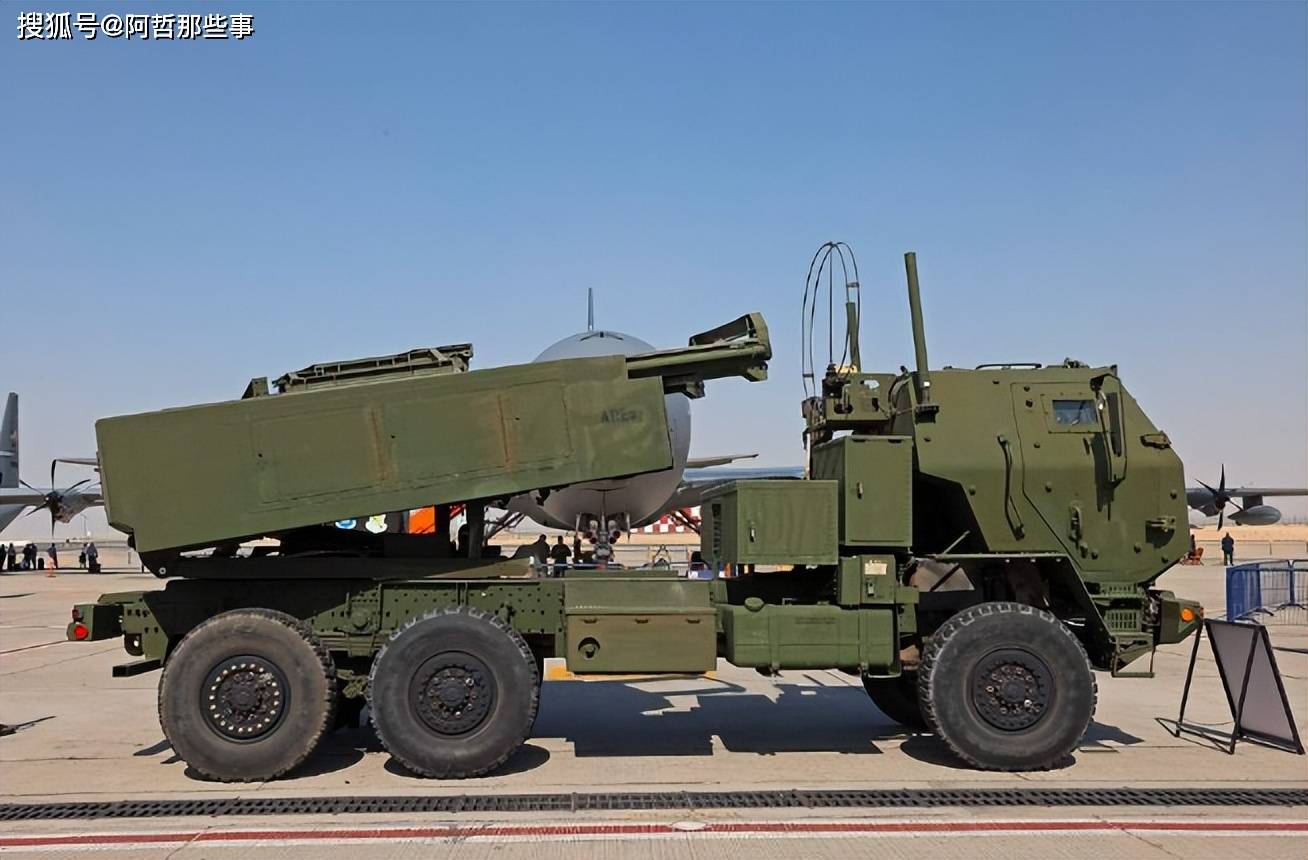
Core Viewpoint - The article discusses the recent military exercises conducted by the People's Liberation Army (PLA) around Taiwan, highlighting the capabilities of the "HIMARS" rocket artillery system acquired by Taiwan from the United States and the implications for regional security [1] Group 1: Military Exercises - The PLA conducted exercises on December 29 and 30, focusing on precision targeting of high-mobility ground targets using drones [1] - The inclusion of drones in the "Mission of Justice - 2025" exercise allows for enhanced tracking and targeting capabilities against high-value assets [1] Group 2: HIMARS Capabilities - The "HIMARS" system can launch tactical missiles with a range of approximately 300 kilometers, providing cross-strait attack capabilities [1] - The acquisition of "HIMARS" by the Democratic Progressive Party (DPP) government is viewed as a significant investment in military capability, potentially escalating tensions in the region [1] Group 3: Strategic Implications - The article suggests that the "HIMARS" system could become a critical tool in the event of provocations from pro-independence forces in Taiwan, indicating its role in potential conflict scenarios [1] - The emphasis on targeting high-value assets, including "HIMARS," reflects a strategic approach to countering perceived threats in the region [1]
央视披露:美对台超110亿美元军售包括“海马斯”火箭炮、自杀无人机、反坦克导弹、自行榴弹炮;专家:美国“出兵协防”可能性越来越小
Mei Ri Jing Ji Xin Wen· 2025-12-25 00:51
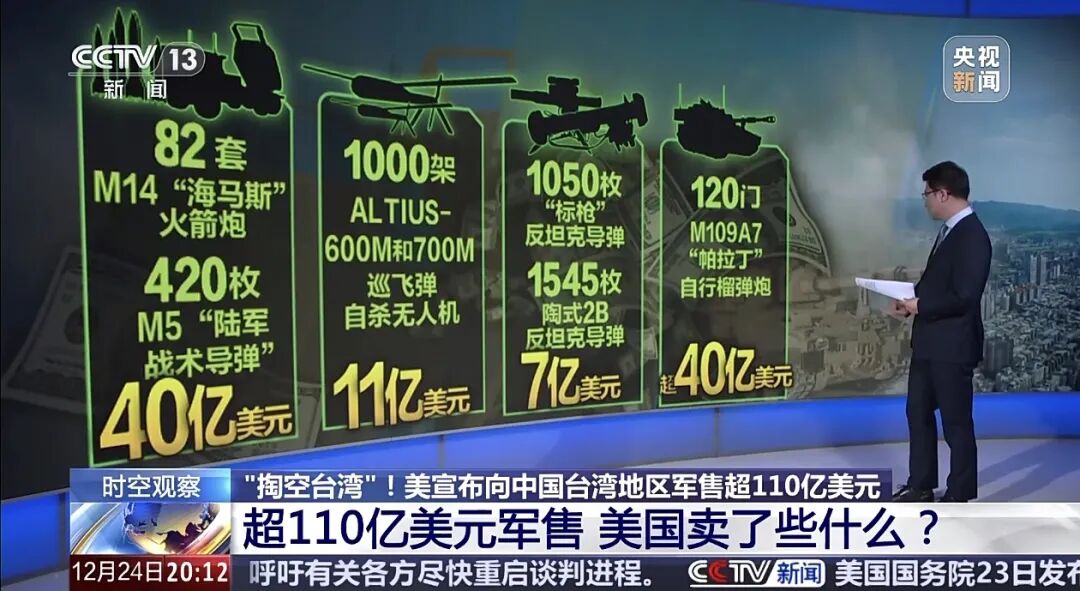
Group 1 - The core point of the article is the announcement of a record-breaking arms sale from the United States to Taiwan, totaling over $11 billion, which is the largest in history for such transactions [1][10]. - The arms sale includes four main components: 82 sets of M142 "HIMARS" rocket systems and 420 M57 "Army Tactical Missiles" valued at $4 billion, 1,000 ALTIUS-600M and 700M suicide drones worth $1.1 billion, 1,050 "Javelin" anti-tank missiles and 1,545 TOW 2B anti-tank missiles totaling $700 million, and 120 M109A7 "Paladin" self-propelled howitzers valued at over $4 billion [3][5][4]. Group 2 - The military analyst Shao Yongling noted that the choice of these specific weapons aims to enhance Taiwan's defense capabilities, particularly against potential land invasions [3][7]. - The article highlights concerns within Taiwan regarding the financial implications of such a large military expenditure, with fears that it may deplete Taiwan's economic resources and impact social welfare and education budgets [10][12]. - There is a prevailing sentiment among Taiwanese scholars that the arms sale may ultimately be detrimental to Taiwan, as it positions the island as a pawn in U.S. strategic interests without direct military support from the U.S. [12][14]. Group 3 - The article discusses the broader implications of U.S. actions on Taiwan's economy, including increased military spending that could lead to a significant portion of Taiwan's budget being allocated to defense, thereby affecting other sectors [16][18]. - The ongoing U.S. strategy is perceived as a method to extract economic value from Taiwan, particularly in the semiconductor industry, which is crucial for Taiwan's competitive edge [13][14]. - The potential for increased economic disparity in Taiwan, referred to as "Taiwan disease," is highlighted, suggesting that the arms sale and related economic policies could exacerbate existing inequalities [18].
超111亿美元,对台军售美国究竟意欲何为?军事专家犀利点评
Yang Shi Wang· 2025-12-24 07:06
Group 1 - The core viewpoint of the article emphasizes that no amount of advanced weapon sales to Taiwan can prevent China's eventual reunification, and China will take necessary measures to safeguard its sovereignty and territorial integrity [1] - The recent arms sale from the U.S. to Taiwan amounts to over $11.1 billion, marking the largest arms sale in history to Taiwan, with a focus on anti-landing combat equipment [3] - The arms package includes 82 sets of M142 "HIMARS" rocket launchers and 420 M57 "Army Tactical Missiles," valued at $4 billion, which will increase Taiwan's total HIMARS to 111 sets [5] Group 2 - The arms sale also features 1,000 ALTIUS-600M and 700M suicide drones, valued at $1.1 billion, capable of targeting armored land vehicles and surface ships [5] - Additionally, the package includes 1,050 "Javelin" anti-tank missiles and 1,545 TOW-2B anti-tank missiles, totaling $700 million, aimed at post-landing heavy armored targets [5] - The sale further comprises 120 M109A7 "Paladin" self-propelled howitzers, valued at over $4 billion, which will complement the HIMARS systems [5] Group 3 - The U.S. strategy appears to focus on enhancing Taiwan's anti-landing capabilities while reducing the likelihood of direct military intervention, indicating a shift towards accelerating Taiwan's armament [7] - This approach aims to maximize the costs for China in pursuing reunification, while also suggesting that the U.S. is preparing for a potential abandonment of Taiwan by profiting from arms sales [7]
96吨稀金归国!中美算总账,118亿美债抛售震动全球
Sou Hu Cai Jing· 2025-12-21 17:05
Group 1 - The article highlights a series of retaliatory actions taken by China in response to U.S. military sales to Taiwan, including the cancellation of a 132,000-ton wheat order and the sale of $11.8 billion in U.S. Treasury bonds, signaling a shift in the dynamics of U.S.-China relations [1][8][11] - The smuggling case involving 166 tons of antimony ingots is emphasized as a significant national security threat, given that antimony is a critical material for military applications, with China controlling a substantial portion of global supply [3][4][5] - The U.S. military sales to Taiwan, amounting to $11.1 billion, represent the highest level of arms sales since 1979, indicating a strategic shift towards land warfare capabilities, which China perceives as a direct threat [5][6][8] Group 2 - The cancellation of the wheat order is described as a precise strike against U.S. agricultural interests, which heavily rely on Chinese imports, highlighting the interconnectedness of U.S. agricultural states and their dependency on China [5][8][9] - The article discusses China's strategy of leveraging its control over rare metals and agricultural imports to counter U.S. provocations, indicating a shift from reactive to proactive measures in international relations [8][9][10] - The overall narrative suggests that China is now in a position of strength, capable of dictating terms in the U.S.-China relationship, with a focus on maintaining national interests and countering perceived threats effectively [9][11]
终于破案!要跟美国算总账,中方追回96吨稀金,抛售118亿美债
Sou Hu Cai Jing· 2025-12-20 11:47
Group 1 - A significant rare metal smuggling case involving over 200 million yuan has been uncovered, with 166 tons of strategic antimony ingots intercepted and 27 individuals arrested for colluding with foreign forces [3][5][7] - Antimony is crucial for defense industries, used in semiconductors and missile guidance systems, with China holding 48% of global reserves and over 60% of production [10][13] - The smuggling operation was sophisticated, with profits exceeding 49.8 million yuan, and involved a network that manipulated export regulations to ship antimony to military enterprises abroad [19][20][22] Group 2 - The U.S. announced a record $11.1 billion arms sale to Taiwan, the highest since 1979, including advanced weaponry aimed at enhancing Taiwan's military capabilities [25][27] - This arms sale reflects a strategic shift in U.S. support for Taiwan, focusing on land-based combat systems rather than air and naval superiority [29][30] - The U.S. aims to strengthen its military-industrial complex and bind Taiwan closer to its geopolitical strategy, while also attempting to shift semiconductor production from Taiwan to the U.S. [37][38] Group 3 - Following the arms sale announcement, China swiftly responded by canceling a significant wheat order from the U.S., amounting to 132,000 tons, which represents 35% of monthly exports to China [40][42][43] - The ongoing U.S.-China rivalry is characterized by strategic maneuvers, with the U.S. consistently attempting to contain China's growth through tariffs and military support to Taiwan [47][49] - China's response strategies have become more proactive and effective, allowing it to maintain control over the global rare metal market and adapt its export policies based on compliance with international regulations [51][53]