提升宏观经济治理效能

Search documents
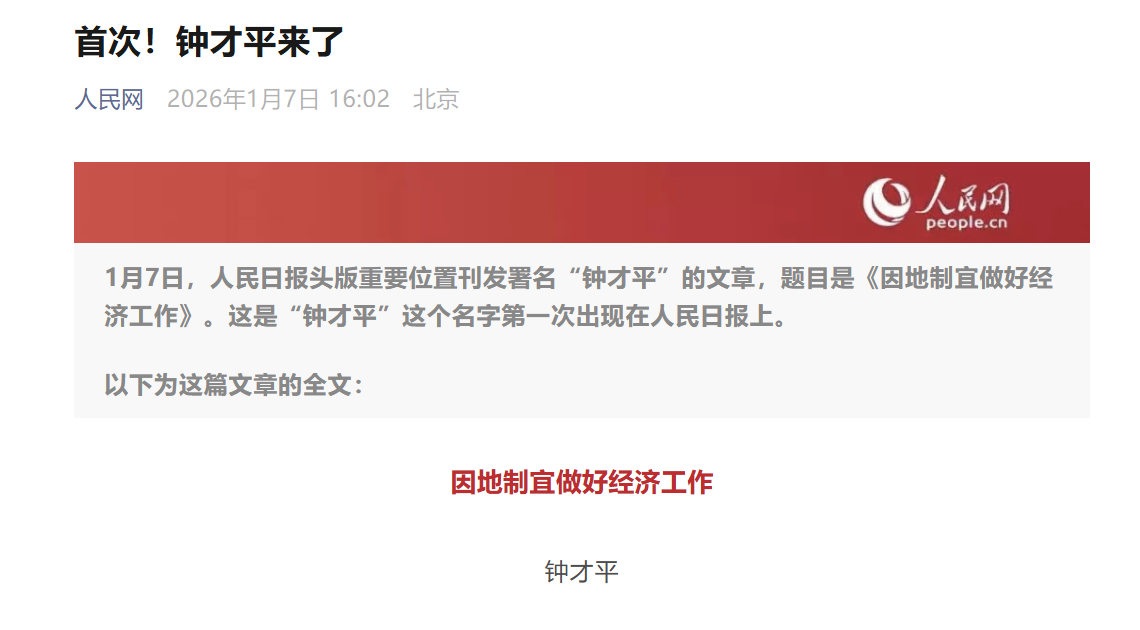
“钟才平”首次亮相人民日报,连发重磅文章有何深意
2 1 Shi Ji Jing Ji Bao Dao· 2026-01-12 14:01
Core Viewpoint - The series of articles by "Zhong Caiping" published in the People's Daily starting January 7 serves as a significant indicator of the government's economic strategy for 2026, emphasizing practical guidance for economic work and addressing key areas of focus [1][4]. Group 1: Articles Overview - The "Zhong Caiping" series consists of six articles covering themes such as tailored economic work, development towards new and superior standards, enhancing macroeconomic governance, promoting consumption and investment, improving livelihoods, and expanding openness [5]. - The articles aim to clarify the central government's strategic framework for the upcoming period, particularly in light of the recent Central Economic Work Conference's focus on 2026's key tasks [5][6]. Group 2: Economic Policy Insights - The article titled "Enhancing Policy Integration Effects" highlights a new emphasis on stabilizing economic growth and reasonable price recovery as key considerations for monetary policy, reflecting a shift in approach [8]. - The 2026 monetary policy is expected to maintain a moderately loose stance, focusing on high-quality economic development and reasonable price recovery, with a combination of total and structural policy tools to support demand and stabilize market expectations [9]. Group 3: Investment and Consumption Dynamics - The article "Coordinating Consumption and Investment" argues that investment and consumption are not mutually exclusive but rather mutually reinforcing, essential for achieving a growth target of around 5% in 2026 [10]. - Recent measures include the early release of a project list and central budget investment plan totaling 295 billion yuan, aimed at stabilizing investment and ensuring continuity in project execution [11]. Group 4: Real Estate Sector Outlook - The article "Promoting High-Quality Development in Real Estate" indicates that there remains significant potential in the real estate sector, with unmet housing demand among urban residents, suggesting a continued role as a pillar industry [12]. - The focus on improving livelihoods through real estate development is expected to stimulate substantial investment, with initiatives like affordable housing and urban infrastructure projects projected to generate nearly 2 trillion yuan in annual investment [12].

中等收入群体倍增!中央这场“十五五”发布会释放八大政策信号
2 1 Shi Ji Jing Ji Bao Dao· 2025-10-24 10:09
Core Viewpoint - The article discusses the key signals and goals outlined in the "15th Five-Year Plan" (2021-2025) of China, emphasizing the importance of high-quality development, technological self-reliance, and the expansion of domestic demand as part of China's modernization strategy. Economic Growth and Quality - Economic growth is expected to remain within a reasonable range, with a noticeable increase in the resident consumption rate [3] - The focus is on achieving significant results in high-quality development, with an emphasis on optimizing economic structure, technological advancement, and efficiency improvement [4] Industry Development - The plan aims to create a modern industrial system, prioritizing the enhancement of traditional industries and the cultivation of emerging industries [5][6] - The traditional industries, which account for approximately 80% of manufacturing value-added, will be optimized, while new strategic industries like renewable energy and aerospace will be developed [5][6] Domestic Demand Expansion - The strategy emphasizes the importance of expanding domestic demand, with a goal to double the middle-income group over the next decade [7][8] - The retail sales of consumer goods are projected to exceed 50 trillion yuan by 2025, indicating a robust consumer market [7] Technological Innovation - The plan highlights the need for significant breakthroughs in key technologies, particularly in artificial intelligence and semiconductor industries [9][10] - A comprehensive approach to enhance the national innovation system and support high-tech enterprises is outlined [9] High-Level Opening Up - The strategy includes expanding high-level opening up, focusing on trade innovation and enhancing the investment environment [11][12] - The emphasis is on balancing GDP and GNI, recognizing the importance of national income in assessing economic health [13] Population and Health Development - The plan advocates for policies to support population quality development, including improved maternity support and healthcare services [14][15] - The goal is to increase the average life expectancy from 79 to around 80 years by 2024 through enhanced health services [15] Macroeconomic Governance - The strategy aims to improve macroeconomic governance efficiency, addressing issues like low-price competition and overdue payments to businesses [16][17] - A focus on coordinated economic policies and effective communication with market participants is emphasized [17] Green Transition - The plan aims for a comprehensive green transition, with expectations for the green low-carbon industry to potentially double in size over the next five years [18][19][20] - Specific measures include the establishment of carbon emission control systems and the promotion of clean energy sources [19][20]