
支付机构增资

Search documents
年内支付业“冰火两重天”:头部增资竞速,中小牌照加速清退
Nan Fang Du Shi Bao· 2025-10-25 09:06
Core Insights - The payment industry is experiencing a "polarized" situation since 2025, with leading payment institutions increasing capital significantly while smaller institutions are being forced out of the market due to license cancellations [1][7]. Group 1: Capital Increases by Leading Institutions - A wave of capital increases has been observed among licensed payment institutions since October, with over 10 institutions having completed capital increases in 2025 [2][6]. - Notable capital increases include: - Wangyin Online (Beijing) Payment Technology Co., Ltd. increasing its registered capital to 1.5 billion RMB [2]. - Yinseng Payment Service Co., Ltd. increasing its registered capital to 310 million RMB [5]. - Zhejiang Vipshop Payment Service Co., Ltd. increasing its registered capital to 200 million RMB [5]. - Tencent's payment service, Tenpay, received approval for a capital increase of 7 billion RMB, raising its registered capital to 22.3 billion RMB, marking a 45.75% increase [5]. Group 2: Regulatory Impact and Market Dynamics - The implementation of the "Non-Bank Payment Institution Supervision and Administration Regulations" in May 2024 has raised the minimum registered capital requirement to 100 million RMB, prompting many institutions to increase capital to comply with regulations [6]. - As of now, the number of licensed payment institutions has decreased to 164, with a total of 107 licenses canceled, indicating a trend of consolidation in the industry [7][9]. - The cancellation of licenses is primarily affecting smaller institutions, with 11 institutions having their licenses revoked in 2025 alone [7]. Group 3: Future Outlook - The ongoing "reshuffling" in the payment industry is expected to continue, leading to increased market concentration [10]. - For leading institutions, the focus will remain on compliance and diversified development, while smaller institutions must find niche markets to survive [10].

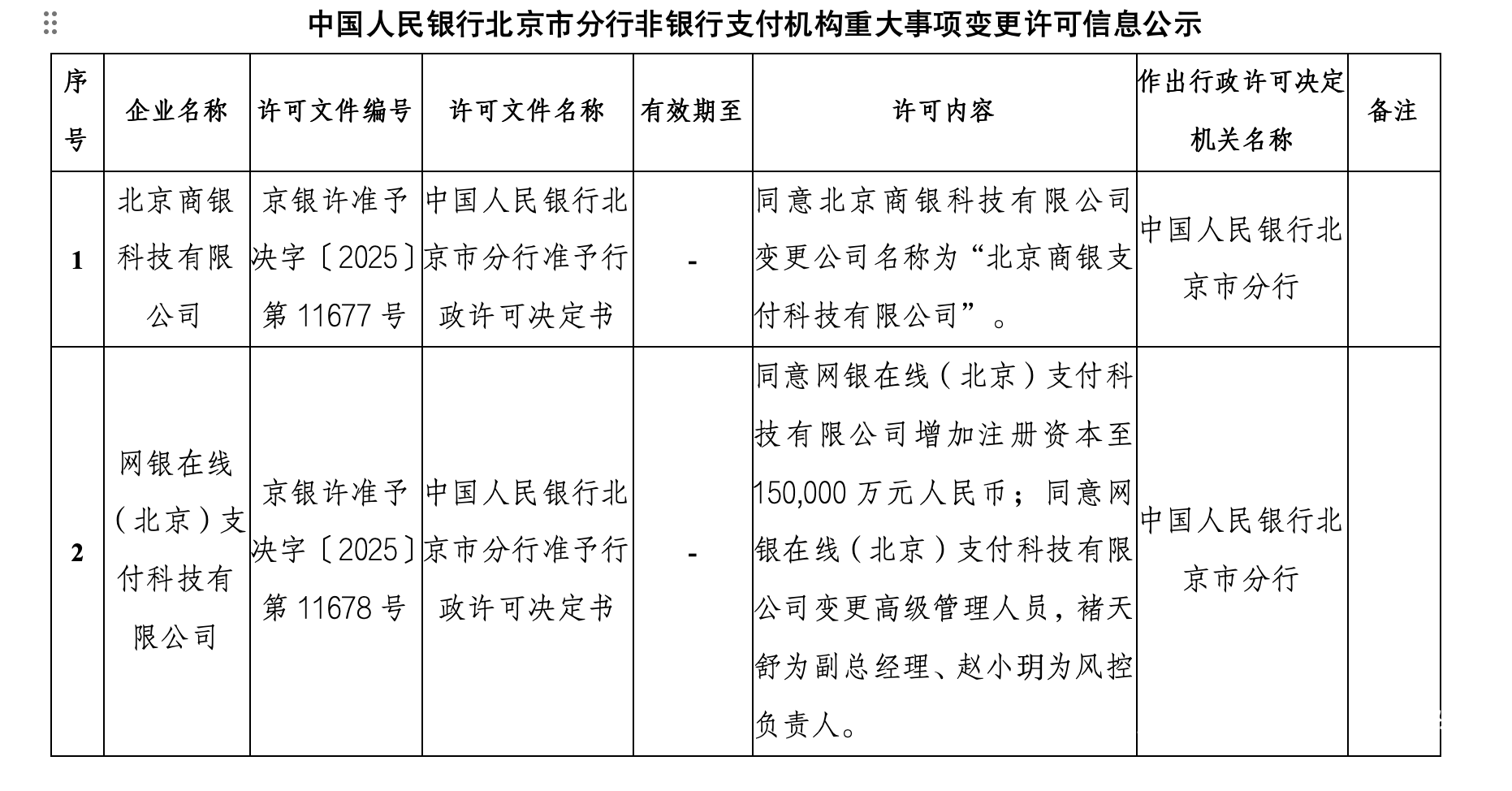
合规约束叠加业务拓展需求 年内13家支付机构获批增资
2 1 Shi Ji Jing Ji Bao Dao· 2025-10-23 15:06
Core Insights - The surge in capital increases among third-party payment companies is primarily driven by the implementation of the "Non-Bank Payment Institution Supervision Management Regulations" in May 2024, which sets a minimum registered capital requirement of 100 million RMB and establishes dynamic net asset requirements linked to reserve fund scales [1][2][6] Group 1: Regulatory Changes - The "Non-Bank Payment Institution Supervision Management Regulations" is the first administrative regulation for payment institutions in China, enhancing the regulatory framework and legal hierarchy in the payment sector [2] - The regulations stipulate that the minimum registered capital for non-bank payment institutions is 100 million RMB, which must be paid-in capital [2][5] - Since the implementation of the regulations, payment institutions have accelerated their capital increases to comply with regulatory requirements [2][5] Group 2: Capital Increase Trends - As of 2025, 13 payment institutions have been approved for capital increases, including notable increases from companies like Zhejiang Vipshop Payment Service Co., Ltd. and XTransfer [3][6] - Noteworthy capital increases include WeChat Pay's operator, Tenpay, with a registered capital of 22.3 billion RMB, and PayPal China with 4.52 billion RMB [6] Group 3: Business Development Motivations - Beyond compliance, payment institutions are also increasing capital to support business development, enabling them to engage in high-value services such as cross-border payments and comprehensive financial solutions [8][9] - Increased capital enhances the risk management capabilities of payment institutions, allowing them to better handle potential risks such as fraud and liquidity issues [9] Group 4: Financial Health and Market Position - Higher registered capital improves the financial strength of payment institutions, enhancing their market reputation and customer trust [9] - The capital increase is seen as a necessary step to ensure business continuity and expansion in a competitive market [8][9]
合规约束叠加业务拓展需求,年内13家支付机构获批增资
2 1 Shi Ji Jing Ji Bao Dao· 2025-10-23 13:29
Core Insights - The article highlights a significant trend of capital increases among third-party payment institutions in China, driven by regulatory changes and the need for business expansion [1][2][3] Regulatory Changes - The implementation of the "Non-Bank Payment Institution Supervision Management Regulations" in May 2024 has set a minimum registered capital requirement of 100 million RMB for payment institutions, which has prompted many to increase their capital [2][4] - The regulations also link net asset requirements to the scale of reserve funds, creating a dynamic capital requirement for payment institutions [5][6] Capital Increase Trends - As of 2025, 13 payment institutions have been approved for capital increases, including notable companies like Zhejiang Vipshop Payment Service Co., Ltd. and XTransfer [2][3] - Specific examples of capital increases include Nezha Payment increasing to 3.11 billion RMB and Xiaomi's payment institution "Jiefu Ruitong" receiving approval for capital increase [2][3] Business Development - Payment institutions are increasing capital not only to meet regulatory requirements but also to support business development, particularly in high-value services such as cross-border payments and technology services [7][8] - Companies like Douyin Payment and Tenpay have cited capital increases as a means to enhance service quality and ensure user safety [7][8] Risk Management and Market Position - Increased capital enhances the risk management capabilities of payment institutions, allowing them to better handle potential risks such as fraud and liquidity issues [8] - A higher registered capital improves the market reputation and credibility of payment institutions, fostering trust among customers and partners [8]
财付通增资223亿 支付行业“资本竞赛”升级
Bei Jing Shang Bao· 2025-06-11 16:40
Core Viewpoint - The significant capital increase by Tencent's payment subsidiary, Tenpay, from 10 billion to 153 billion yuan in April 2024, and then to 223 billion yuan by June 2025, highlights the growing regulatory demands and competitive strategies within the payment industry [1][2][3] Group 1: Company Actions - Tenpay's recent capital increase to 223 billion yuan was approved on May 30, 2025, marking a substantial growth in its registered capital within just one year [1][2] - The company aims to enhance its technological innovation, improve payment service quality, and ensure payment security and stability through this capital increase [2][3] Group 2: Regulatory Environment - The implementation of the "Non-Bank Payment Institutions Supervision Management Regulations" and its detailed rules has raised the capital requirements for payment institutions, necessitating increases in registered capital [2][3] - According to the regulations, payment institutions must meet minimum net asset requirements based on their average balance of reserve funds, which has implications for their capital structure [3] Group 3: Industry Trends - The payment industry is experiencing a "capital competition," with major players increasing their capital investments while smaller institutions struggle to survive [1][4] - Analysts predict that as regulatory policies become clearer and market competition intensifies, more payment institutions will seek to increase their capital to comply with new requirements and enhance their market competitiveness [3][4]