支线项目

Search documents
DeepSeek等8大产品都是意外?! 改变世界的项目们,最初都没被“当个事儿办”
Sou Hu Cai Jing· 2026-01-13 01:47
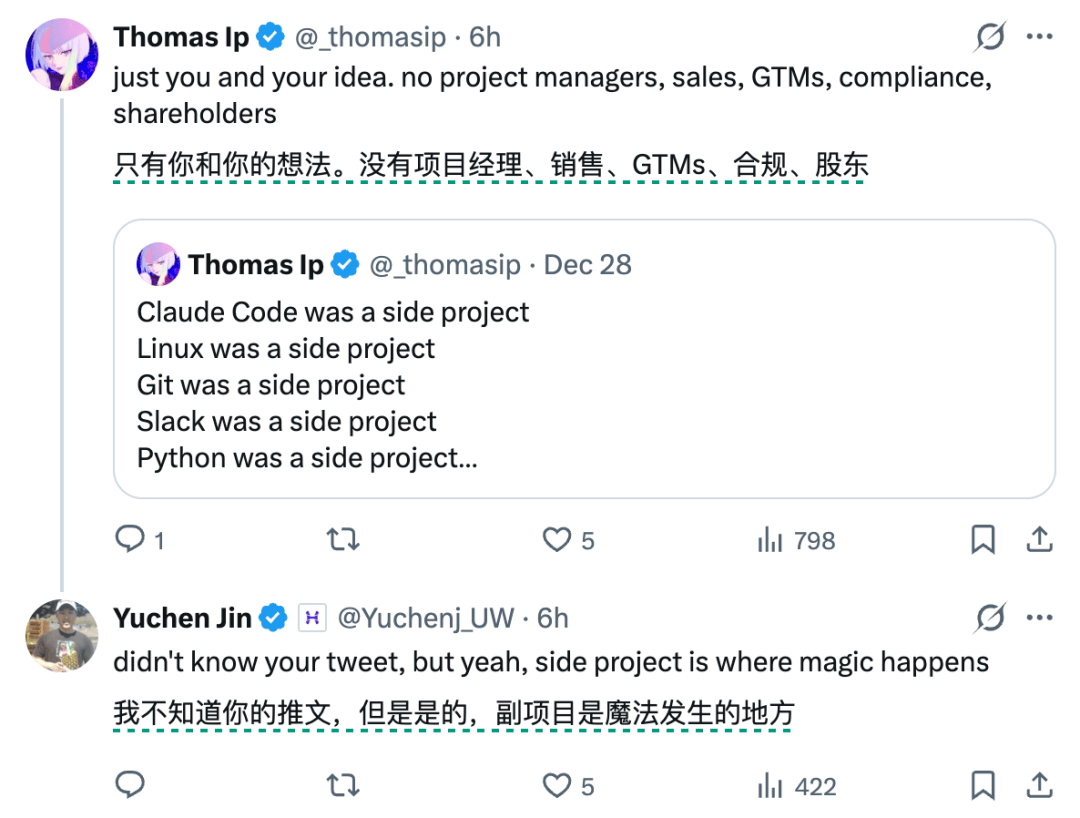
Core Insights - Many groundbreaking products initially started as side projects, which were not considered significant at their inception [1][2][3][5][6] - Side projects are defined as non-core, non-KPI driven initiatives that are not part of a company's strategic plan [1] - The success of side projects can be attributed to their ability to operate without the constraints typically associated with mainline projects, allowing for greater innovation and flexibility [2][3][6] Group 1: Examples of Successful Side Projects - DeepSeek, a side project of Huansquare Quantitative, emerged from internal technical research and has become a significant tool in quantitative trading [2] - Qwen, developed by Alibaba, was initially a side project that allowed for more autonomy and faster iteration, ultimately leading to its integration into the company's main offerings [3] - Claude Code, initially a simple experimental project by an engineer, evolved into a key product for Anthropic, demonstrating the potential of side projects to gain traction unexpectedly [5] Group 2: Impact of AI on Project Development - The integration of AI into software engineering has lowered the cost of experimentation, enabling individuals to validate ideas more quickly and easily [7][8] - Side projects often begin by addressing specific problems and evolve through real-world usage, which enhances their maturity and relevance [8] - The shift towards AI-driven development suggests that early signals of future trends may increasingly emerge from projects that were initially overlooked [10] Group 3: Strategic Considerations - While AI enhances execution efficiency, it does not necessarily improve the accuracy of strategic judgments, highlighting a potential limitation of mainline projects [10] - The evolving landscape indicates that side projects may play a crucial role in validating directions before scaling up to mainline initiatives [10]



DeepSeek等8大产品都是意外?! 改变世界的项目们,最初都没被“当个事儿办”
量子位· 2026-01-11 04:02
Core Viewpoint - Side projects, often overlooked initially, can lead to groundbreaking products and innovations in the tech industry, demonstrating that exploration and experimentation can yield significant results [1][2][3]. Group 1: Definition and Characteristics of Side Projects - A side project is defined as a non-core, non-KPI driven initiative that is not strategically planned at its inception [2]. - These projects are less constrained by traditional business structures, allowing for more creative freedom and innovation [3][12]. - The lack of formal oversight enables these projects to evolve organically, often leading to unexpected successes [13][40]. Group 2: Examples of Successful Side Projects - DeepSeek, a side project of Huafang Quantitative, emerged from internal technical research and has become a significant tool in quantitative trading [4][11]. - Qwen, initially a side project at Alibaba, has successfully transitioned into a prominent open-source model, benefiting from reduced decision-making constraints [18][22]. - Claude Code started as an experimental project by engineer Boris Cherny and evolved into a key product for Anthropic, showcasing the potential of side projects to disrupt traditional product development [27][32]. Group 3: Advantages of Side Projects - Side projects can enhance the likelihood of success due to less bureaucratic interference, allowing teams to iterate quickly and adapt based on real-world feedback [22][25]. - The cost of experimentation is lower in the AI era, enabling individuals to validate ideas more swiftly without extensive resource coordination [37][44]. - The flexibility of side projects allows for rapid adjustments and improvements, ultimately leading to more robust and mature products [41][43]. Group 4: Implications for Future Projects - The trend indicates that early signals of future innovations may increasingly arise from projects initially deemed non-essential [53]. - While not all side projects guarantee success when scaled, they provide a foundation for larger initiatives once their value is proven [54][55].