
教育本质

Search documents
幸福比优秀重要
Xin Lang Cai Jing· 2026-01-28 16:48
Core Perspective - The essence of education is questioned, emphasizing that the ultimate goal should be to enable children to experience and create happiness rather than merely achieving excellence [2][4]. Group 1: Education's Purpose - The current educational environment prioritizes rankings and scores, leading to a neglect of the fundamental pursuit of happiness in children [2][3]. - Children often feel pressured by parental expectations and academic demands, which can result in anxiety and fatigue despite achieving high scores [2][3]. - A child who can ask questions freely, play joyfully, and feel warmth in life, even if not academically top, can accumulate significant happiness, which becomes a lifelong asset [2]. Group 2: Teacher's Role - Education should not be a production line for "excellent products" but a process of awakening souls and nurturing lives [3]. - Teachers should focus on each child's uniqueness, fostering curiosity and imagination rather than solely emphasizing knowledge transmission and skill training [3]. - The role of teachers extends beyond imparting knowledge; they should also teach children to love life and find beauty in the ordinary [3]. Group 3: Parental Perspective - Parents often equate excellence with immediate success, overlooking the long-term importance of happiness as a foundational aspect of a child's life [3]. - Many parents plan their children's futures without considering their true desires, mistakenly believing that providing the best resources equates to responsible parenting [3]. - A child raised in an environment of love and respect can develop a healthy personality and positive mindset, enabling them to face life's challenges and achieve their own happiness [3]. Group 4: Conclusion - The ultimate goal of education is not to produce numerous "top students" or "elites," but to ensure that every child can become a happy individual [4]. - It is essential to let go of the obsession with excellence and return to the essence of education, nurturing children with love and acceptance [4].


“走红”村小折射的过度养育困境
Xin Lang Cai Jing· 2026-01-22 19:12
Core Viewpoint - The article discusses the phenomenon of "over-parenting" in education, contrasting the innovative educational approach of Zhang Pingyuan, principal of Fanjiashao Primary School, with traditional parenting methods that prioritize safety over experiential learning [1][2][3] Group 1: Educational Philosophy - Zhang Pingyuan emphasizes the importance of balancing academic achievement with children's health and well-being, advocating for a holistic approach to education that prepares children for real-world challenges [1] - The principal's philosophy includes allowing children to engage with tools and risks, fostering skills such as focus, responsibility, and risk assessment, which are not developed in overly protective environments [2] Group 2: Over-Parenting Concerns - The article highlights a contrasting parenting style where children are excessively shielded from risks, leading to a lack of independence and resilience, as exemplified by the case of a child who is not allowed to cross the street alone [2] - It raises questions about the implications of creating a "perfect" growth environment for children, suggesting that such practices may hinder their ability to navigate real-life challenges [2] Group 3: Historical Context and Educational Insights - The article references the educational philosophy of British educator A.S. Neill, who advocated for allowing children to grow according to their own desires and abilities, suggesting that true education should not be about removing obstacles but teaching children to overcome them [2] - It also cites American educator Alfie Kohn, who argues that effective education involves preparing children to face challenges rather than providing a cushioned path, reinforcing the idea that resilience and capability are essential for personal development [2]
“告别”的课何以动人(暖闻热评)
Ren Min Ri Bao· 2025-12-26 03:20
Group 1 - The article highlights the importance of emotional support and understanding in education, as demonstrated by a teacher's compassionate approach to a student's death [1][2] - The teacher's decision to tell the class that the student "transferred" instead of passing away reflects a deep understanding of children's emotional capacities and the need for gentle guidance in processing loss [1][2] - The letters written by the students serve as a testament to their genuine feelings and the enduring bond of friendship, illustrating how love and memory can transcend death [1] Group 2 - The discussion emphasizes the need for educators to focus not only on academic achievements but also on the emotional and psychological development of students, addressing the shortcomings of a purely performance-based educational system [2][3] - It calls for a more holistic approach to education that includes emotional education, resilience training, and interpersonal skills, which are crucial for children's overall development [2][3] - The article advocates for educators to possess not only teaching skills but also a strong sense of responsibility, empathy, and the ability to connect with students on a deeper level [3]
“踩”着孩子过河,教育的本质是父母的自身醒悟!
Jing Ji Guan Cha Bao· 2025-12-09 01:39
Core Viewpoint - The essence of education lies in the self-awareness of parents, as the issues seen in children often reflect the problems within the parents themselves [1][2]. Group 1: Parental Influence - Parents are likened to roots of a tree, while children are the flowers; issues in children often stem from the parents' own issues [1]. - A parent's fears can lead to increased demands on their children, creating a cycle of control and anxiety [3][4]. - Reducing internal fears allows children to grow naturally, maximizing their wisdom and abilities [5][6]. Group 2: Nature of Education - True education should focus on wisdom rather than merely accumulating knowledge, as excessive knowledge can hinder a child's natural development [11][12]. - Wisdom is characterized by an empty state, allowing for greater capacity to utilize knowledge effectively [13][14]. - Education should prioritize maintaining a child's inner space rather than overloading them with information [15]. Group 3: Love and Expectations - The common belief that love is measured by expectations and responsibilities is challenged; these are often manifestations of fear rather than true love [16][18]. - Genuine love is unconditional and free from fear, allowing children to be themselves without pressure [30][32]. Group 4: Parent-Child Relationship - The relationship between parents and children is a reflection of the parent's relationship with themselves; resolving internal conflicts can improve external relationships [34][37]. - To address children's issues, parents must first confront their own problems, as children are a reflection of their family and societal environment [39][40]. Group 5: Self-Reflection in Education - Education is a means of self-reflection and personal growth for parents, with children serving as a mirror for their own development [45][46]. - The process of educating children can lead to the parent's own self-realization and fulfillment [41][42].
佛山鱼档三少年火上热搜,启示不只是假期怎样过
Nan Fang Du Shi Bao· 2025-11-24 10:32
Core Viewpoint - The story of three children working at a fish stall in Foshan highlights a shift in educational values, emphasizing experiential learning and character development over traditional academic achievements [1][3][4]. Group 1: Educational Insights - The children demonstrate that hands-on experiences, such as fish cleaning and selling, provide valuable life skills and lessons in responsibility and integrity [2][3]. - The narrative challenges the conventional view of education, suggesting that true learning occurs outside the classroom through real-life experiences [3][4]. - Parents' initial concerns about the physical demands of the work were overcome by allowing the children to engage in their own learning process, showcasing the importance of trust in modern parenting [4]. Group 2: Societal Reflection - The public's positive reaction to the children's story reflects a broader societal questioning of educational priorities, advocating for a return to the essence of education that fosters character and gratitude [3][4]. - The story serves as a reminder that education should not solely focus on academic success but also on nurturing qualities like responsibility and resilience [3][4]. - The diverse backgrounds of families and children indicate that there is no single successful educational approach, encouraging a more individualized perspective on learning [4].
7月教育行业融资报告:融资8200万,教育行业资本正押注哪些新变量?
Sou Hu Cai Jing· 2025-08-27 10:37
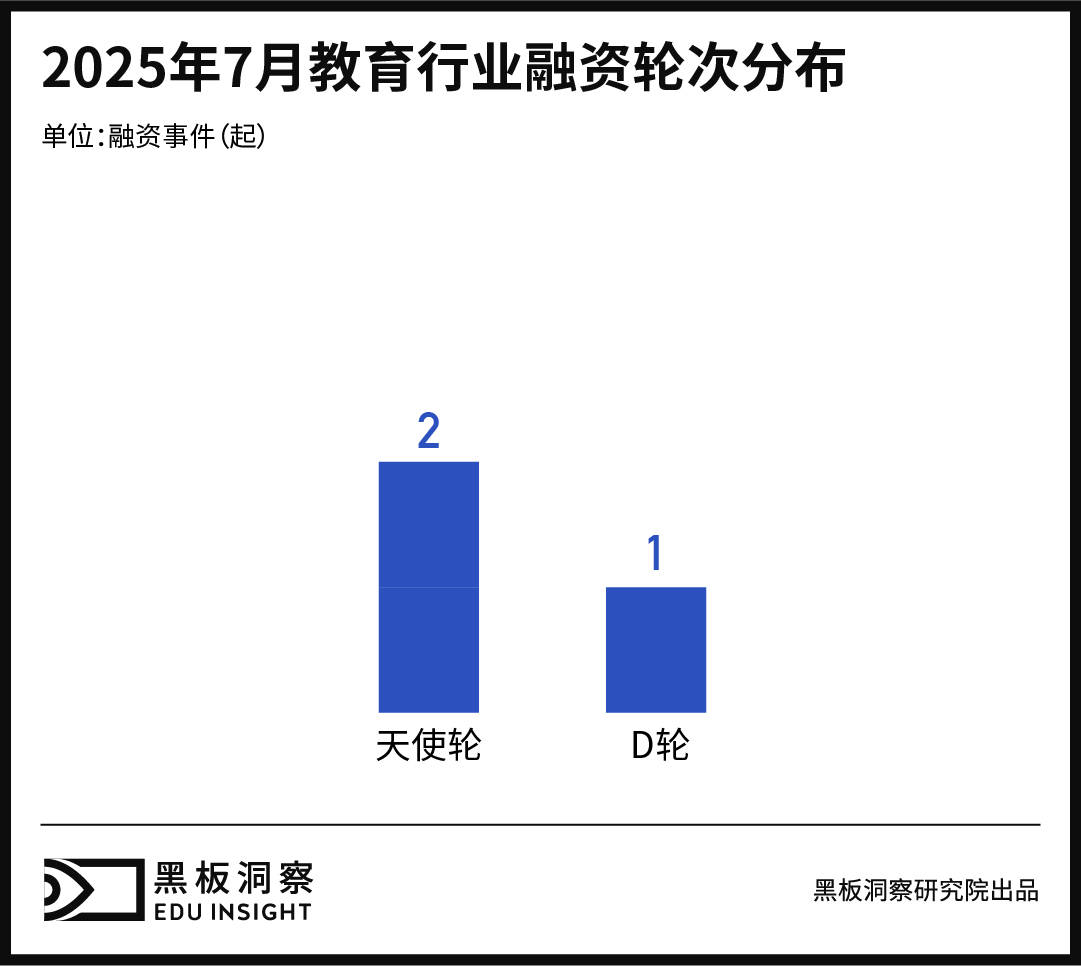
Financing Events - In July 2025, the education sector experienced 3 financing events, totaling approximately 82 million RMB [1] - The financing rounds included 2 angel rounds and 1 D round [3] Regional Distribution - Financing events occurred in 3 regions: Shanghai, Guangdong, and Zhejiang, with each region having 1 event [4] Financing Amounts - Among the financing events, 2 were in the tens of millions range, while 1 event did not disclose its financing amount [6] Sub-Sectors - The financing events in July were distributed across language training, enterprise services, and children's programming, with each sector having 1 event [8] Detailed Financing Table - A detailed table of financing events includes: - Wala English: AI contextual learning service, angel round, Shanghai, disclosed amount of 12 million USD, investors include Good Future, Shunwei Capital, and Northern Light Venture Capital [9] - Xiaomawang: Youth programming education service, D round, Zhejiang, disclosed amount in hundreds of millions RMB, investors include Yuhang District Industrial Fund [9] - Treasure Species: Campus marketing service provider, angel round, Guangdong, disclosed amount of 10 million RMB, investor undisclosed [9] Industry Trends - The education industry is transitioning from "incremental expansion" to "stock optimization," driven by demographic changes, tightening policies, and a return to rational capital [10] - The decline in financing heat is not a sign of recession but a process that forces companies to return to the essence of education and validate long-term value [10] - Key themes such as teaching efficiency, learning motivation, and skill enhancement are being re-emphasized, with capital focusing on the integration of technology into teaching scenarios and the sustainability of products [10] - The education sector is shifting from a fast-paced competition for traffic to a long-term competition centered around content, technology, and organizational strength [10]
如厕自由上热搜是教育的耻辱
Jing Ji Guan Cha Bao· 2025-05-30 09:13
Group 1 - The core issue highlighted is the absurdity of school management practices that prioritize academic performance over students' basic physiological needs, such as restroom access [1][2][3] - The military-style management in schools is driven by an unhealthy obsession with升学率 (college admission rates), leading to extreme measures that compromise students' well-being [2][3] - The societal pressure from parents and the education system reinforces these practices, as high-stakes exams like 高考 (Gaokao) dominate the educational landscape, often at the expense of students' health [3][4] Group 2 - The article argues that education should focus on nurturing well-rounded individuals rather than merely producing high-scoring students, emphasizing the need for flexibility and empathy in educational practices [4] - The lack of attention to students' basic needs, such as restroom access, reflects a broader issue in the education system where students are treated as mere score-generating machines [3][4] - The discussion calls for a reevaluation of educational values, advocating for a system that promotes mental and physical health alongside academic achievement [4]
开启数智时代“创生教育”(科教视界)
Ren Min Ri Bao· 2025-05-27 22:11
Group 1 - The core viewpoint emphasizes the transition from the industrial era to the digital intelligence era, driven by the rapid development of AI technology, necessitating a shift in education towards personalized learning and the cultivation of higher-order thinking skills, particularly imagination and creativity [1] - The essence of education is to promote better growth, especially in thinking, which is influenced by genetic, external, and internal factors, with a focus on internal factors in the digital intelligence era [1] - The nature of innovation is to pose and solve problems, creating value for society, with a strong emphasis on the internal drive of individuals as more critical than external factors and genetics [2] Group 2 - The new educational paradigm in the digital intelligence era is termed "Innovation-Motivated Education" (IME), which focuses on innovation as the intrinsic driving force for personal growth [3] - The historical context of educational reforms in China, including the restoration of the college entrance examination and the expansion of higher education, has led to the cultivation of a large number of knowledge-based talents [3] - The founder of Shenzhen Zero One Academy has extensive experience in various fields related to education and talent cultivation, reinforcing the belief in the necessity of educational innovation [3][4]