数字年俗

Search documents
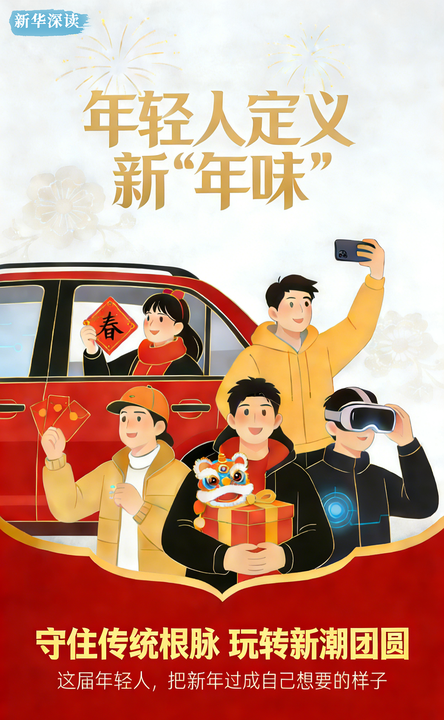
新华深读|年轻人定义新“年味”
Bei Jing Ri Bao Ke Hu Duan· 2026-02-13 01:51
Core Insights - The article discusses the evolving nature of Chinese New Year celebrations, particularly how younger generations are reshaping traditions with a focus on personal expression and emotional value rather than just practicality [2][3][4]. Group 1: Changing Consumer Behavior - Young consumers prioritize emotional value in their purchases, opting for personalized gifts and experiences over traditional bulk buying for family gatherings [3][4]. - Data from Tmall indicates that by 2026, users born after 2000 will account for over 30% of the New Year consumption growth, with a 47% year-on-year increase in spending [3]. - The rise of "social currency" items like game cartridges and pet products reflects a shift towards individualistic and experiential consumption among younger generations [4]. Group 2: New Traditions and Practices - The concept of "reverse New Year" is gaining popularity, with more parents traveling to their children's cities for celebrations, leading to an 84% increase in ticket bookings for this trend [8]. - Young people are redefining family gatherings, focusing on quality time rather than traditional social obligations, as evidenced by a growing preference for relaxed celebrations [10][9]. Group 3: Evolving Culinary Practices - The traditional New Year feast is shifting from elaborate home-cooked meals to more convenient options, with a significant increase in the popularity of pre-prepared dishes [14][15]. - Data shows a 92% year-on-year increase in sales of New Year-related products, indicating a preference for easy-to-prepare meals that allow for more time spent with family [15]. Group 4: Digital Integration in Celebrations - The integration of technology into New Year traditions is evident, with younger generations utilizing AI and digital platforms for creating personalized greetings and virtual celebrations [18][19]. - The rise of digital interactions, such as custom red envelopes and online gatherings, highlights a shift towards a more interactive and engaging celebration style [19]. Group 5: Cultural Significance and Global Reach - The article emphasizes that while the forms of celebration are changing, the core values of family reunion and new beginnings remain intact, showcasing the resilience of cultural traditions [20][21]. - Young people are not only preserving but also innovating traditional customs, allowing Chinese New Year to resonate globally, as seen in the increasing popularity of cultural products and performances abroad [21].

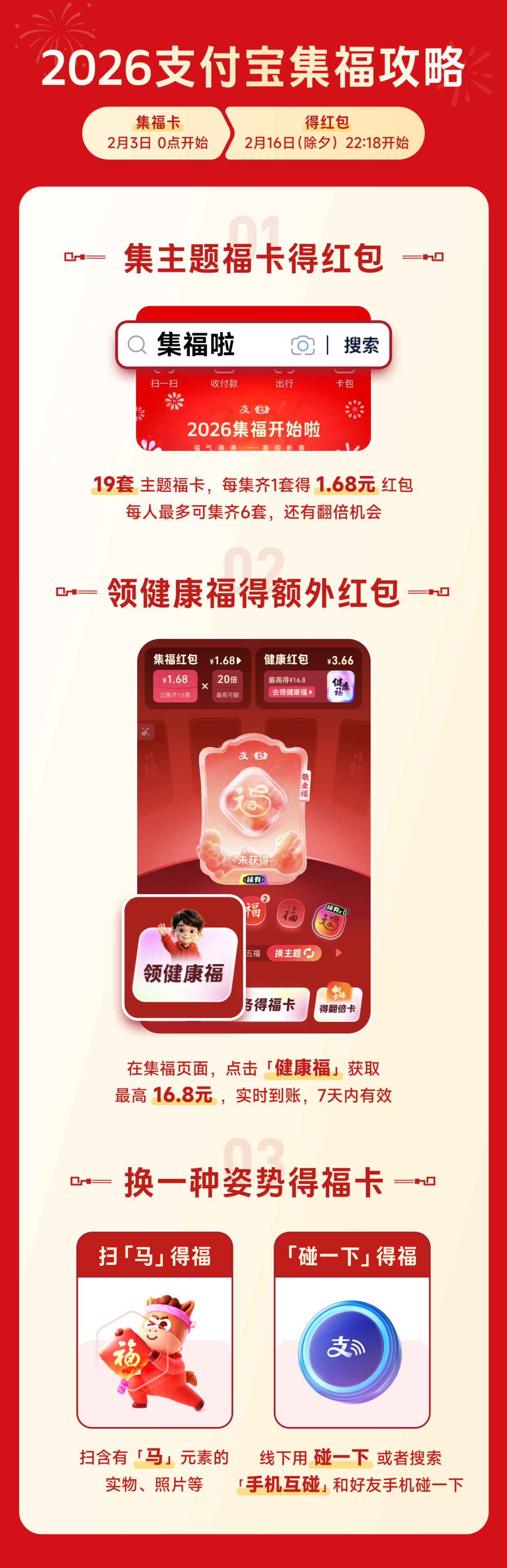
支付宝2026集福 五福多一福,AI扫马、全场景“碰一下”可得福
Huan Qiu Wang· 2026-02-02 05:34
Core Insights - The 2026 "Alipay Collecting Blessings" event will launch on February 3 at midnight and run until New Year's Eve, introducing new features such as the independent "Health Blessing" and various interactive gameplay options [1][2]. Group 1: Event Overview - The event allows users to search for "Collecting Blessings" on Alipay to participate, with a focus on enhancing user experience through new features [1]. - This year, the event introduces a "Health Blessing" that provides users with a small red envelope upon collection, reflecting a common desire for health and safety during the New Year [2]. Group 2: Blessing Cards and Rewards - A total of 19 themed blessing card sets will be available, including classic blessings and collaborations with various IPs from gaming, pop culture, and film, allowing users to collect up to 6 sets for a guaranteed reward of 1.68 yuan [3][7]. - Users can also have the chance to draw "double" and "tenfold" cards, with all rewards being announced on New Year's Eve at 22:18 [3]. Group 3: Interactive Features - New interactive features include the "AI Scan Horse" to collect blessing cards by scanning items with horse elements, and the introduction of AI glasses for a more immersive experience [4]. - Users can collect blessings through various everyday activities such as offline payments, bike rides, and social interactions, enhancing the integration of digital traditions into daily life [4]. Group 4: Historical Context - Since its launch in 2016, the "Collecting Blessings" event has seen participation from over 1 billion users, becoming a significant digital New Year tradition for millions [4].