
代理商务

Search documents
Paysafe (PSFE) - 2025 Q4 - Earnings Call Transcript
2026-03-03 14:30
Financial Data and Key Metrics Changes - In 2025, the company reported $1.7 billion in revenue, reflecting a growth of 6% excluding the disposition of a business line [5] - Adjusted EBITDA declined 5% to $429 million, with an adjusted EBITDA margin of 25.2% [27] - The company generated $298 million in unlevered free cash flow for the full year, despite divesting a business line that generated over $40 million in EBITDA the prior year [6][27] Business Line Data and Key Metrics Changes - The merchant solutions segment reported revenue of $222.7 million in Q4, with full-year revenue of $904.7 million, representing organic growth of 2% for Q4 and 5% for the full year [28] - The digital wallet segment saw revenue increase by 13% to $220.2 million in Q4, leading to full-year revenue of $815 million, with 6% reported growth [31] - The SMB business experienced a modest revenue growth of 1% for the year, with a decline of 3% in Q4 [28] Market Data and Key Metrics Changes - North America, the largest market, grew 5% in 2025, while Europe grew 7% normalized for FX [7] - Latin America was flat for the year but saw over 20% growth in Q4 [8] - The digital wallet active users reached 7.8 million at quarter end, reflecting a growth of 6% year-over-year [12] Company Strategy and Development Direction - The company aims to enhance its classic wallet user experience and expand its Paysafe Wallet in Europe, focusing on building a simple, everyday digital banking wallet [17] - The strategic focus includes capturing opportunities in existing and target e-commerce verticals, supported by enhancements to the gateway and bank network [17] - The company is committed to reducing its net leverage ratio below 5 times by the end of 2026 while continuing to return capital to shareholders [33] Management's Comments on Operating Environment and Future Outlook - Management expressed confidence in the operational and strategic progress made in 2025, which is expected to enable improved execution in 2026 [9] - The outlook for 2026 is described as clean, with no significant changes in the macroeconomic environment anticipated [45] - The company expects revenue growth in the range of 5%-8% for 2026, with adjusted EBITDA reflecting similar growth [34] Other Important Information - The company has made significant structural changes over the past three years, modernizing its platform and upgrading talent [4] - The Vitality Index, which measures the health of the organization and innovation momentum, reached $270 million in revenue, representing 16% of total company revenue [13][19] - The company has added four new board members, enhancing its governance and strategic direction [90] Q&A Session Summary Question: What strategic initiatives are in place to re-accelerate SMB growth? - Management highlighted the engagement of new leadership in the SMB space and strong product offerings, indicating a positive outlook for 2026 [39][41] Question: What are the expectations regarding the macro environment for 2026? - Management indicated stability in the FX side and a clean year without significant changes in the macroeconomic environment [43][45] Question: Can you elaborate on the opportunity with the Paysafe Wallet? - The company is seeing strong momentum with the Paysafe Wallet, currently in 18 countries, and plans to focus on growth within Europe [50][52] Question: How is Paysafe preparing for agentic commerce? - The company is working on foundational changes to expand its addressable market and enhance experiences in the entertainment and experience economy [54][55] Question: What are the strengths and challenges between direct and ISO strategies? - Management noted that direct sales have a higher margin profile, while the ISO channel requires support and training for partners [80][81]

Meta Prepares to Integrate Native Stablecoin Payments Across Global Platforms
FinanceFeeds· 2026-02-25 06:00
Core Insights - Meta Platforms, Inc. is set to integrate native stablecoin payment features across its ecosystem, including WhatsApp, Instagram, and Facebook, marking a significant shift towards decentralized finance [1] - The new "Meta Pay" protocol will allow over 3.8 billion monthly active users to send, receive, and store dollar-pegged stablecoins easily, utilizing a "multi-stablecoin" approach for liquidity and compliance [1] - The integration aims to build a "commercial layer" of the metaverse, facilitating a frictionless global economy for creators and businesses [1] Group 1: Agentic Commerce and Digital Advertising - The rise of "agentic commerce" is a key driver for Meta's stablecoin initiative, enabling AI assistants to manage transactions and purchasing decisions for users [2] - By providing a blockchain-based payment rail, Meta allows autonomous agents to utilize a "native currency" for tasks like automated subscriptions and real-time ad bidding [2] - This integration is expected to lower business costs on the platform, particularly benefiting small enterprises in emerging markets [2] Group 2: Regulatory Environment - Meta's stablecoin rollout aligns with the "Digital Asset Market Clarity Act" in the U.S. and the "MiCA 2.0" framework in the EU, providing a legal framework for engaging with digital assets [3] - The company has invested in compliance tools to meet regulatory standards while ensuring user privacy through zero-knowledge proofs [3] - Despite criticism from European central banks regarding potential impacts on monetary sovereignty, the U.S. administration supports the project as a means to maintain the dollar's global dominance [3]



谷歌电话会全文&详解:1850亿支出“不得不花”!确认与苹果合作!Gemini并非SaaS的“终结者”!
美股IPO· 2026-02-05 04:02
Core Viewpoint - Google is heavily investing in AI, with projected capital expenditures reaching $175 billion to $185 billion by 2026, primarily for servers and data centers, as part of its commitment to the AI arms race [1][4][5]. Capital Expenditure - Alphabet's projected capital expenditure for 2026 is between $175 billion and $185 billion, with investments expected to increase quarterly [5][50]. - Approximately 60% of the capital expenditure will be allocated to servers, while 40% will go towards data centers and network equipment [6][50]. - The significant capital expenditure is anticipated to lead to increased depreciation costs, which will exert pressure on profit margins [6][50]. AI and SaaS Market - CEO Sundar Pichai emphasized that Gemini is an "engine" for SaaS companies rather than a threat, with 95% of the top 20 SaaS companies adopting Gemini [7][31]. - The Gemini App has surpassed 750 million monthly active users, indicating strong engagement and potential for monetization [10][23]. - Pichai confirmed a partnership with Apple to develop the next generation of Apple Foundation models based on Gemini technology, enhancing Google's position in the iOS ecosystem [8][9]. Cloud Business and Infrastructure - Google Cloud's revenue grew by 48%, driven by strong demand for AI infrastructure and services [13][52]. - The company employs a dual strategy of using both self-developed TPUs and NVIDIA GPUs to enhance its cloud offerings [14][30]. - The backlog of orders for Google Cloud has increased by 55%, reaching $240 billion, reflecting robust demand for AI-driven products [52]. YouTube and Advertising - YouTube's advertising revenue grew by 9%, with Shorts averaging over 200 billion daily views, indicating strong viewer engagement [33][43]. - The integration of AI into advertising tools has improved ad quality and targeting, enhancing the effectiveness of campaigns [39][41]. - YouTube continues to innovate with new subscription models and interactive ad formats, aiming to increase advertiser ROI [43][41]. Efficiency and Internal Operations - The company has reduced the service unit cost of Gemini by 78% through model optimization and efficiency improvements [17]. - Approximately 50% of the code is now written by coding agents, allowing engineers to focus on higher-level tasks [17][59]. - Google is committed to continuously seeking operational efficiencies to fund growth investments, particularly in AI and cloud services [59].

PayPal(PYPL) - 2025 Q4 - Earnings Call Transcript
2026-02-03 14:02
Financial Data and Key Metrics Changes - PayPal's total payment volume (TPV) grew 9% year-over-year in Q4 and 7% for the full year, reaching $1.8 trillion [32] - Full year revenue increased 4% to $33.2 billion, with non-GAAP EPS rising 14% to $5.31 [33] - Adjusted free cash flow for the year was $6.4 billion, with $2.1 billion in Q4 [33][39] Business Line Data and Key Metrics Changes - Venmo revenue grew approximately 20% to $1.7 billion, with total active accounts surpassing 100 million [6][24] - Buy Now, Pay Later (BNPL) achieved over $40 billion in TPV, growing more than 20% year-over-year [8] - Online branded checkout TPV grew only 1% in Q4, down from 5% in Q3, indicating a slowdown [9] Market Data and Key Metrics Changes - U.S. retail weakness impacted branded checkout performance, particularly among lower and middle-income consumers [9] - International growth moderated, especially in Germany, due to macroeconomic factors and competition [9] - High-growth verticals like travel and gaming experienced deceleration, affecting overall TPV growth [10] Company Strategy and Development Direction - The company is focusing on three strategic priorities for 2026: experience, presentment, and selection to enhance branded checkout performance [11][30] - A new rewards program, PayPal+, is set to launch in 2026 to drive consumer engagement and repeat usage [19] - The appointment of Enrique Lores as CEO aims to improve execution and operational discipline [4][5] Management's Comments on Operating Environment and Future Outlook - Management acknowledged that execution has not met expectations and emphasized the need for faster decision-making and prioritization [5][50] - The company is no longer committing to a specific multi-year growth outlook due to a more challenging environment than anticipated [29][42] - Management remains confident in the long-term growth potential of Venmo, PSP, and BNPL despite current challenges in branded checkout [29][44] Other Important Information - The company completed $1.5 billion in share repurchases in Q4, totaling $6 billion for the year, and initiated a quarterly dividend of $0.14 per share [39] - Monthly active accounts increased by 1% to 231 million, with transactions per active account growing by 5% [34] Q&A Session Summary Question: What is the rationale behind the CEO change? - The board's decision was primarily focused on execution rather than strategy, with Enrique Lores expected to enhance operational efficiency and decision-making [48][50] Question: How will the company engage merchants to adopt the new checkout experience? - Engagement strategies vary by merchant size and needs, focusing on integration, co-marketing, and tailored approaches for high-impact merchants [53][56] Question: What is the expected timeline for seeing benefits from recent investments? - Investments are expected to impact results throughout 2026, with minimal in-year benefits assumed for the current year [58][66] Question: How does the company plan to balance growth and capital return? - The focus remains on transforming the business and investing in growth while maintaining a strong capital return profile [61]

PayPal(PYPL) - 2025 Q4 - Earnings Call Transcript
2026-02-03 14:02
Financial Data and Key Metrics Changes - PayPal's total payment volume (TPV) grew 9% on a spot basis and 6% on a currency-neutral basis in Q4, reaching $1.8 trillion for the full year [31][32] - Full year revenue increased by 4% on both a spot and currency-neutral basis to $33.2 billion, with non-GAAP EPS rising 14% for the year to $5.31 [32][31] - Adjusted free cash flow for the full year was $6.4 billion, with $2.1 billion in Q4 [32][38] Business Line Data and Key Metrics Changes - Venmo revenue grew approximately 20% to $1.7 billion in 2025, with TPV increasing 13% in Q4 [5][23] - The enterprise payment business returned to double-digit volume growth in Q4, with notable strength in PSP, which saw volume growth accelerate to 12% [24][34] - Buy Now, Pay Later (BNPL) delivered over $40 billion in TPV in 2025, growing more than 20% year-over-year [6][21] Market Data and Key Metrics Changes - Online branded checkout TPV grew only 1% on a currency-neutral basis in Q4, down from 5% in Q3, primarily due to U.S. retail weakness and international headwinds, particularly in Germany [8][9] - The company experienced deceleration in high-growth verticals such as travel, ticketing, crypto, and gaming [9][10] Company Strategy and Development Direction - The company is focusing on three strategic priorities for 2026: experience, presentment, and selection, to restore momentum in branded checkout [10][29] - PayPal is shifting its approach to focus on strategic merchants, representing nearly 25% of branded checkout volume, to enhance execution and decision-making [16][20] - The company plans to enhance consumer engagement through loyalty programs and a new app designed for BNPL management and rewards tracking [19][21] Management's Comments on Operating Environment and Future Outlook - Management acknowledged that execution has not met expectations and emphasized the need for faster decision-making and clearer prioritization under the new CEO [3][49] - The company is no longer committing to a specific multi-year growth outlook due to a more challenging environment than anticipated, opting instead for annual guidance [28][41] - Management expressed confidence in the long-term growth potential of Venmo, PSP, and BNPL despite current challenges in branded checkout [27][42] Other Important Information - The company appointed Enrique Lores as the new President and CEO, effective March 1, to enhance execution and strategic focus [3][4] - PayPal's cash and cash equivalents stood at $14.8 billion, with $11.6 billion in debt at the end of the quarter [38] Q&A Session Summary Question: What is the rationale behind the CEO change? - The board's decision was primarily focused on improving execution rather than altering strategy, with Enrique Lores expected to enhance operational efficiency and decision-making [47][48] Question: How will PayPal engage merchants to adopt the new checkout experience? - Engagement strategies will vary by merchant size and needs, focusing on integration, co-marketing, and tailored approaches for high-impact merchants [51][54] Question: What is the expected timeline for seeing benefits from recent investments? - The company anticipates gradual improvements throughout 2026, with investments already impacting performance [57][60] Question: How does PayPal balance growth and capital return? - The focus remains on transforming the business and investing in growth while maintaining a strong capital return profile, including share buybacks and dividends [60][61] Question: What parts of the business are expected to turn around in 2026? - The company expects traction from improved merchant integration and marketing strategies, with a focus on prioritizing high-impact merchants [63][66]
AI电商走到哪了?
Hua Er Jie Jian Wen· 2026-02-03 12:36
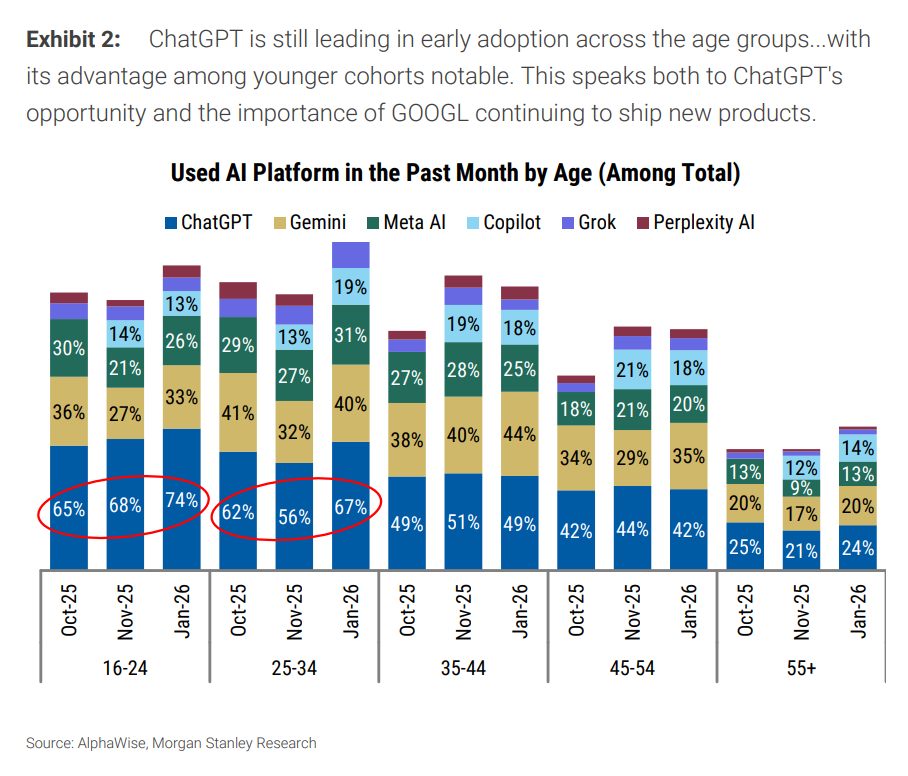
Core Insights - The emergence of "agent commerce" is transforming the e-commerce landscape, with significant growth expected in the coming years, potentially reaching a total GMV of $190 billion to $385 billion by 2030, driven by AI agents [1] - The current market is characterized by a "dual-track" competition between general AI platforms like ChatGPT and Gemini, and specialized AI tools from retail giants such as Amazon and Walmart [1] Group 1: Market Trends - The penetration rate of general AI platforms is approaching 50%, with ChatGPT and Gemini showing monthly usage rates of 47% and 33% respectively as of January 2026 [2] - Younger demographics dominate the usage of ChatGPT, with a usage rate of 65% to 75% among individuals aged 16-34, indicating a potential risk for Google if it fails to attract younger users [2] Group 2: Consumer Behavior - Approximately 40% to 55% of AI platform users are utilizing these tools for product research and price comparison, with 30% to 40% of agent users completing purchases [6][8] - In the past month, around 18% of the U.S. population has made purchases through ChatGPT, and about 10% through Gemini, highlighting significant early adoption and growth potential [8] Group 3: Retail Response - Retail giants are actively developing their own AI tools, such as Walmart's Sparky and Amazon's Rufus, which, despite lower user penetration, exhibit high purchase intent among users [10] - The purchasing conversion rates for specialized retail AI tools are reportedly equal to or exceed those of general platforms, suggesting a strategic opportunity for retailers to leverage their existing user bases [11] Group 4: Product Categories - High-frequency consumer goods, particularly groceries, are emerging as a key area for AI-driven e-commerce, with 50% of users purchasing groceries through AI platforms [12] - The grocery category is identified as a critical strategic focus for unlocking agent commerce in the next five years, emphasizing the importance of capturing user habits in this segment [12]
Visa(V) - 2026 Q1 - Earnings Call Transcript
2026-01-29 23:02
Financial Data and Key Metrics Changes - In the fiscal first quarter, the company reported a net revenue increase of 15% year-over-year to $10.9 billion, with EPS also up 15% [5][24] - Payments volume grew 8% year-over-year in constant dollars, reaching nearly $4 trillion, while processed transactions increased by 9% year-over-year, totaling $69 billion [5][24] - Operating expenses rose by 16%, primarily due to unfavorable foreign exchange impacts and higher-than-expected marketing expenses [30] Business Line Data and Key Metrics Changes - Consumer payments revenue was driven by strong payments volume, cross-border volume, and processed transaction growth [29] - Commercial and money movement solutions revenue grew 20% year-over-year in constant dollars, with commercial payments volume also increasing by 10% [29] - Value-added services revenue surged by 28% year-over-year in constant dollars, driven by strong demand across all portfolios [30][22] Market Data and Key Metrics Changes - U.S. payments volume increased by 7%, with e-commerce growth outpacing face-to-face spending [25] - Total international payments volume rose by 9% year-over-year in constant dollars, consistent with previous quarters [27] - Cross-border volume, excluding intra-Europe transactions, was up 11% year-over-year, with travel-related cross-border volume also increasing by 10% [28] Company Strategy and Development Direction - The company is focused on enhancing its Visa-as-a-Service stack, which includes innovations in payments technology, such as Visa credentials, agentic commerce, and stablecoins [5][13] - The strategy emphasizes building scalable technologies to enable money movement and payments businesses globally [5] - The company aims to be a key enabler in agentic commerce and stablecoin integration, expanding its capabilities in these areas [13][15] Management's Comments on Operating Environment and Future Outlook - Management expressed confidence in the resilience of consumer spending and the effectiveness of their strategy, despite lower-than-expected currency volatility [24][35] - The company anticipates continued strong performance in value-added services and commercial solutions, which are expected to offset potential challenges from market volatility [50] - Management remains engaged with policymakers regarding regulatory risks, particularly concerning the CCCA, emphasizing the competitive nature of the industry [56][58] Other Important Information - The company repurchased approximately $3.8 billion in stock and distributed about $1.3 billion in dividends to shareholders during the quarter [31] - The company has launched a stablecoins advisory practice to assist clients in developing stablecoin strategies [14] Q&A Session Summary Question: Opportunities around value-added services for events - Management highlighted the ability to leverage sponsorships for bespoke client programs, particularly around major events like the FIFA World Cup and the Olympics [41][44] Question: Strength in value-added services and capital return strategy - Management noted strong performance in value-added services and commercial solutions, with a programmatic approach to capital return and share buybacks [49][51] Question: Regulatory environment and CCCA implications - Management emphasized the harmful effects of CCCA and the importance of educating policymakers on the competitive landscape and the need for innovation [56][58] Question: Growth in commercial solutions and spending trends - Management attributed growth in commercial solutions to successful product strategies and client engagement, with stable international volume growth across regions [62][66] Question: Flex credential growth trajectory - Management described the Flex credential as a versatile payment solution with significant growth potential, although still in early development stages [80][82] Question: Investment in processing assets and market opportunities - Management confirmed ongoing investments in processing technologies, particularly through the acquisition of Pismo, to modernize tech stacks for financial institutions [88][89]

Mastercard(MA) - 2025 Q4 - Earnings Call Transcript
2026-01-29 15:02
Financial Data and Key Metrics Changes - For Q4 2025, net revenues increased by 15%, with value-added services and solutions net revenue up 22% on a non-GAAP currency-neutral basis [4][22] - Operating income rose by 17%, while net income and EPS increased by 17% and 20% respectively, with EPS at $4.76, including a $0.10 contribution from share repurchases [23][24] - Worldwide gross dollar volume (GDV) grew by 7% year-over-year, with U.S. GDV increasing by 4% and international volume rising by 9% [24][25] Business Line Data and Key Metrics Changes - Payment network net revenue increased by 9%, driven by domestic and cross-border transaction growth, while value-added services and solutions net revenue increased by 22% [25][26] - Commercial credit and debit volumes represented 13% of total GDV, growing at 11% year-over-year on a local currency basis [14] - The company secured over 60 new affluent programs globally in 2025, indicating strong performance in affluent segments [7][8] Market Data and Key Metrics Changes - Cross-border volume increased by 14% globally, reflecting growth in both travel and non-travel-related spending [24] - Contactless penetration reached 77% of all in-person switched purchase transactions, up 5 percentage points from the previous year [25] - The company reported a 10% year-over-year growth in switch transactions for Q4 [25][26] Company Strategy and Development Direction - The company is focused on executing its clear strategy, benefiting from a diversified business model across geographies and payment adjacencies [5][6] - Recent strategic reviews will lead to reductions in some areas but increased investment in others, indicating a commitment to innovation and agility [5][6] - The company is actively engaging in emerging opportunities such as stablecoins and agentic commerce, positioning itself as a leader in the evolving payments landscape [10][11] Management's Comments on Operating Environment and Future Outlook - Management remains optimistic about the fundamentals of the business despite geopolitical and macroeconomic uncertainties [5][30] - The company expects net revenues to grow at the high end of a low double digits range on a currency-neutral basis for 2026, with a tailwind from foreign exchange [30][32] - The macroeconomic environment is supportive, with balanced job markets underpinning healthy consumer and business spending [30] Other Important Information - The company secured various multi-year government grants that will benefit operating expenses and other income, with an expected operating expense benefit of around 5.5 percentage points [23] - A one-time restructuring charge of approximately $200 million is expected in Q1 2026, impacting about 4% of full-time employees globally [33] Q&A Session Summary Question: Details on the Capital One renegotiation - Management expressed excitement about the extension of the credit portfolio agreement with Capital One, emphasizing the value of the Mastercard network [35][36] Question: Implications of the CCCA - Management noted that there is a united opposition to the proposed Credit Card Competition Act, highlighting concerns about consumer choice and cybersecurity risks [37][39] Question: Health of the consumer - Management indicated that consumer spending remains healthy, with savvy consumers utilizing loyalty programs effectively [44][46] Question: Sensitivity to FX volatility - Management acknowledged the challenges in predicting FX volatility but emphasized the company's ability to deliver value through currency conversion services [48][49] Question: Future growth of value-added services - Management expressed confidence in the continued growth of value-added services, driven by the interconnectedness with the payment network [50][51]

Cimpress(CMPR) - 2026 Q2 - Earnings Call Transcript
2026-01-29 14:02
Financial Data and Key Metrics Changes - Cimpress achieved over $1 billion in quarterly revenue for the first time, with organic constant currency growth of 4% in the first half of the year, exceeding the previous guidance of 2%-3% [9][16] - Revenue grew 11% on a reported basis and 4% on an organic constant currency basis in Q2, with adjusted EBITDA growth in the first half equal to the full year dollar growth in prior guidance [9][10] - Adjusted free cash flow declined by $9.2 million to an inflow of $124 million, attributed to lower net working capital inflows [15][16] Business Line Data and Key Metrics Changes - In the Vista segment, organic constant currency growth was 5%, up from 3% in the prior year quarter, driven by double-digit growth in promotional products, apparel, gifts, and packaging [10][12] - The Print Brothers segment reported revenue growth of 26%, with a contribution of $18 million from a tuck-in acquisition [11][12] - Variable gross profit per customer in Vista grew 9% year-over-year, indicating a strong trend in customer value [12][30] Market Data and Key Metrics Changes - Strong performance in North America was the main driver of growth, with overall growth across all markets in Vista [11][12] - In Europe, consumer performance was weaker, with a decline in holiday cards year-over-year, attributed to tough comparisons from the previous year [21][22] Company Strategy and Development Direction - Cimpress is focusing on elevated products to improve customer lifetime value and wallet share, with significant investments in manufacturing capabilities and technology [4][5][8] - The company is pursuing cross Cimpress fulfillment (XCF) to drive efficiencies and innovation in product introductions [5][6][8] - A strong financial future is anticipated, with a target of at least $600 million in EBITDA by fiscal 2028, supported by cost efficiencies and potential tuck-in M&A opportunities [7][8] Management's Comments on Operating Environment and Future Outlook - Management expressed confidence in achieving fiscal 2028 targets, citing past investments that have enhanced customer value and competitive advantage [8][17] - The impact of tariffs is expected to lessen in future quarters as supply chain remediation continues [14] - Management noted that currency movements provided a $4.1 million benefit to EBITDA in Q2, which is expected to continue favorably [14][27] Other Important Information - The company allocated $22.6 million for the purchase of non-controlling interests in the Print Brothers segment, with no material outstanding non-controlling interests remaining [45][46] - A tuck-in acquisition was completed for $10.4 million, expected to yield significant synergies and returns above the 15% hurdle rate [48][50] Q&A Session Summary Question: How would you characterize the holiday season for Vista? - Management reported a strong quarter for Vista, particularly in North America, with a balanced approach to holiday messaging leading to positive results [18] Question: What were the biggest areas of outperformance versus initial FY 2026 guidance? - Management indicated solid execution across the board, with some unexpected challenges, but overall performance aligned with plans [24][25] Question: Can you discuss the North American business for the Print Group? - The Print Group is on track with production capabilities being built out, with revenues growing but still small [33][34] Question: How does the company view the opportunity for Cross Cimpress Fulfillment? - Management sees significant growth potential in Cross Cimpress Fulfillment, which has doubled in revenue within a year [41][42] Question: What is the company's stance on share repurchases? - Management indicated that share repurchases will continue in the second half of the year, dependent on price and other opportunities [55][56]

Cimpress(CMPR) - 2026 Q2 - Earnings Call Transcript
2026-01-29 14:00
Financial Data and Key Metrics Changes - Cimpress achieved a milestone by exceeding $1 billion in quarterly revenue for the first time, with reported revenue growth of 11% and organic constant currency growth of 4% in Q2 [10][11] - Adjusted EBITDA increased by $6.6 million year-over-year, with profit dollars rising 8% on a consolidated basis [12][13] - Adjusted free cash flow declined by $9.2 million to an inflow of $124 million, attributed to lower net working capital inflows [15][17] Business Line Data and Key Metrics Changes - In the Vista segment, organic constant currency growth was 5%, up from 3% in the prior year quarter, driven by double-digit growth in promotional products, apparel, gifts, and packaging [11][12] - The Print Brothers segment reported a revenue growth of 26%, with a contribution of $18 million from a tuck-in acquisition [12][17] - Legacy products, such as business cards and stationery, declined by 1%, consistent with previous quarters [11][12] Market Data and Key Metrics Changes - Strong performance in North America was the main driver of growth, with all markets in Vista showing growth [12][13] - Customer and order count increased in the Upload and Print segment, fueling a combined organic constant currency revenue growth of 6% [12] - National Pen revenue benefited from tariff-related price increases, contributing to overall segment performance [12] Company Strategy and Development Direction - Cimpress is focused on enhancing customer lifetime value through elevated products, which have shown a 9% year-over-year increase in variable gross profit per customer [4][11] - The company is investing in manufacturing efficiencies and new product introductions, with a roadmap targeting at least $600 million in EBITDA by fiscal 2028 [8][9] - Cross Cimpress fulfillment (XCF) is a strategic initiative aimed at driving efficiencies and innovation across brands, enhancing competitive advantage [5][6][34] Management's Comments on Operating Environment and Future Outlook - Management expressed confidence in achieving fiscal 2028 targets, with expectations for significant efficiencies across profit and loss statements [8][9] - The impact of tariffs is expected to lessen in future quarters as supply chain remediation continues [14] - Management highlighted the importance of AI and technology investments in driving operational efficiencies and customer value [6][64] Other Important Information - The company raised its annual guidance for revenue, adjusted EBITDA, and free cash flow based on strong first-half results [10][17] - Net leverage at the end of Q2 was 2.97 times trailing twelve months EBITDA, down from the previous quarter [16][18] - Cimpress completed a tuck-in acquisition for $10.4 million, with significant synergy opportunities anticipated [52][53] Q&A Session Summary Question: How would you characterize the holiday season for Vista? - Management reported a strong quarter for Vista, particularly in North America, with flat volume in holiday cards in the U.S. and double-digit growth in Canada [20][21][22] Question: Can you discuss the biggest areas of outperformance versus initial FY 2026 guidance? - Management noted solid execution across the board, with some unexpected challenges, but overall performance aligned with plans [26][27] Question: What are the underlying trends for promotional products and elevated categories? - Strong growth in elevated products demonstrates increased wallet share among small business customers, with variable gross profit per customer growing consistently [32][33] Question: How is the North American business for the Print Group trending? - The Print Group is on track with revenue growth, focusing on building production capabilities, with revenues around $3 million for the first half [36][37] Question: What is the company's view on Cross Cimpress Fulfillment? - Management sees significant growth potential in Cross Cimpress Fulfillment, which has doubled in revenue within a year, contributing to gross profit increases [45][46] Question: Can you provide details on the tuck-in acquisition made this quarter? - The acquisition involved an Austrian printing group with significant synergy opportunities, expected to yield returns comfortably above the 15% hurdle rate [52][53][55]