数据中心通信

Search documents
显卡还没跑满,数据中心先被“网线”卡脖子了
3 6 Ke· 2025-12-17 01:23
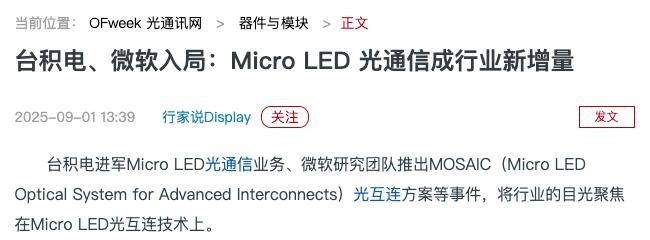
Core Viewpoint - Microsoft is researching Micro LED optical interconnect technology (MOSAIC) to address data transmission bottlenecks in computing centers caused by insufficient bandwidth [1][25]. Group 1: Data Transmission Challenges - Data centers face limitations in bandwidth due to traditional copper cables and optical fibers, which cannot meet the high-speed requirements of AI computing [2][12]. - The typical maximum speed of home network cables is 1 Gbps to 2.5 Gbps, while data center ports commonly operate at 100 Gbps, with AI centers requiring speeds starting at 400 Gbps [4][6]. - The increasing size of AI models necessitates significant data exchange between servers and GPUs, leading to higher bandwidth demands [6]. Group 2: Limitations of Current Technologies - Copper cables can only maintain high transmission speeds over short distances (1-2 meters), while optical fibers, although faster and capable of longer distances, suffer from high power consumption and reliability issues [8][9]. - Using optical fibers exclusively can lead to increased power consumption by 17% and frequent link failures in large GPU clusters [9][11]. Group 3: Introduction of MOSAIC Technology - MOSAIC utilizes Micro LED pixels as light sources, allowing each pixel to function as an independent data transmission channel, enabling a new method of data transfer [14][16]. - Unlike traditional optical communication, which relies on high-speed narrow bandwidth, MOSAIC operates on a "wide and slow" principle, achieving high bandwidth through multiple low-speed channels [16][17]. - MOSAIC can achieve 800 Gbps bandwidth using 400 Micro LED pixels, each transmitting at 2 Gbps, which is a significant advancement over traditional methods [17][21]. Group 4: Advantages of MOSAIC - MOSAIC technology promises to reduce power consumption by up to 68% compared to traditional optical interconnects, while also significantly improving reliability [23]. - The compact size of Micro LED modules allows for high-density configurations without increasing the overall footprint compared to traditional optical modules [19][22]. - The use of multi-core imaging fibers in MOSAIC can support hundreds of optical channels, surpassing the limitations of copper cables and traditional optical fibers [22]. Group 5: Future Outlook - Currently, MOSAIC is in the technical validation stage, with companies like TSMC and others working on prototypes and industry positioning for future commercialization [25]. - The potential of MOSAIC to enhance communication efficiency could address the current bottlenecks in computing centers, making it a critical development in the AI competition landscape [25].



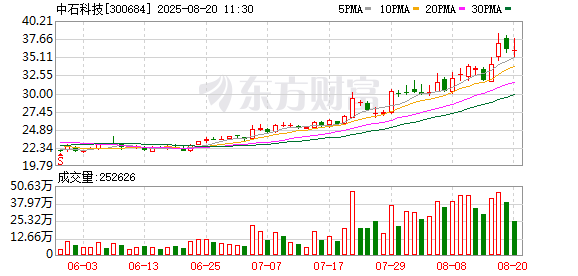
中石科技:公司热模组核心零部件、TIM材料等产品批量供货于服务器厂商,并积极推进液冷散热模组客户导入
Mei Ri Jing Ji Xin Wen· 2025-08-20 04:26
Group 1 - The company is actively promoting industry solutions and core materials, as well as modules for application in computing power devices, aiming to create new growth curves [2] - In the data center communication sector, the company is continuously expanding its customer base, with its integrated VC module products receiving product certification and mass production from leading domestic and international clients [2] - The company is supplying core components of thermal modules, TIM materials, and is actively advancing the customer introduction of liquid cooling thermal modules, thereby enhancing the value of its supplied products [2]