数据准确性

Search documents
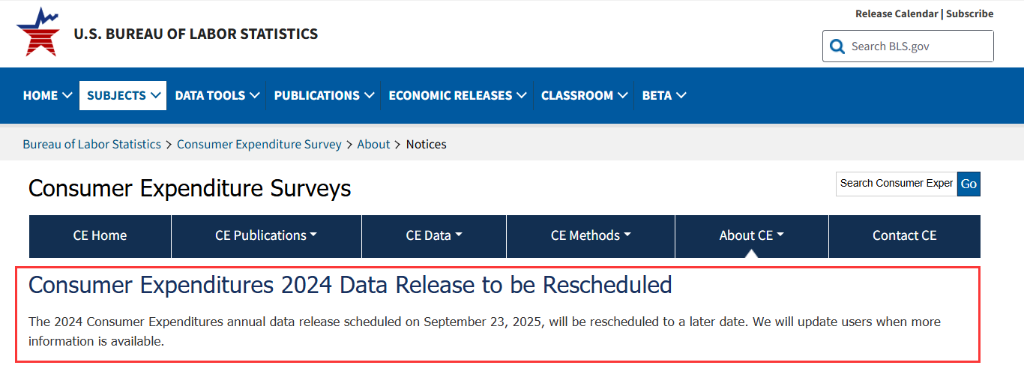
美国年度消费者支出数据将推迟发布,美劳工统计局“罕见”拒绝解释原因
Hua Er Jie Jian Wen· 2025-09-20 02:32
Core Points - The U.S. Bureau of Labor Statistics (BLS) announced a delay in the release of the 2024 annual consumer spending data, originally scheduled for next Tuesday, without providing a reason or a new timeline for publication [1][4][5] Group 1: Delay Announcement - The BLS's announcement of the delay is unusual due to the lack of explanation or context, which has raised market concerns [4][5] - Last year's report also faced a delay, but the BLS provided a new release date and explained the reason for the postponement, which contrasts with the current situation [5][6] Group 2: Implications of the Delay - Analysts suggest that if the annual data can be finalized by the end of the year, there should be sufficient time to incorporate the new weights into the Consumer Price Index (CPI) for January 2026 [6] - Former BLS director William Beach indicated that the delay might simply be due to the publication process not being fully prepared, but he expressed concern if further delays occur [6] Group 3: Challenges Facing the BLS - The BLS is currently facing political pressure, staff shortages, and limited resources, which complicate its operations [7][8] - Following significant revisions to employment data, former BLS director Erika McEntarfer was dismissed, and the White House nominated E.J. Antoni to lead the agency, which has drawn criticism regarding its political implications [7] - An internal investigation has been initiated into the BLS's economic data collection processes, highlighting challenges in gathering and reporting critical economic data [7][8][9]

独家洞察 | RAG如何提升人工智能准确性
慧甚FactSet· 2025-06-10 05:12
Core Viewpoint - The accuracy of data is crucial for financial services companies utilizing Generative AI (GenAI) and Large Language Models (LLM), as inaccurate or low-quality data can adversely affect company strategy, operations, risk management, and compliance [1][3]. Group 1: Causes of Data Inaccuracy - Data inaccuracy in the financial services sector often arises from multiple factors, including the increasing volume and variety of data sourced from multiple vendors, patents, and third-party sources [4]. - "Hallucination" is a significant challenge in the financial sector regarding Generative AI, where models generate coherent but factually incorrect or misleading information due to their reliance on learned patterns from training data without factual verification [4]. Group 2: Importance of Retrieval-Augmented Generation (RAG) - RAG is a critical technology for improving the accuracy of Generative AI and significantly reducing hallucinations by integrating real data with generated responses [6]. - RAG combines the generative capabilities of LLMs with effective data retrieval systems, allowing for more accurate and contextually relevant answers, especially in financial risk assessments [6]. - RAG enhances the utilization of various data formats, enabling the processing of both structured and unstructured data efficiently, and connects existing legacy systems without the need for costly migrations or retraining of LLMs [7]. Group 3: Benefits of RAG - RAG helps address the main causes of data inaccuracy discussed earlier, providing more accurate answers based on proprietary data and reducing hallucinations [8]. - It allows for the integration of the latest knowledge and user permission management, ensuring that responses are based on up-to-date information [8].