数据驱动控制

Search documents
数据驱动如何重塑海洋机器人控制?顶刊权威综述,港科大、大连海事大学团队综述数据驱动时代下的海洋机器人控制
机器人大讲堂· 2026-01-05 00:00
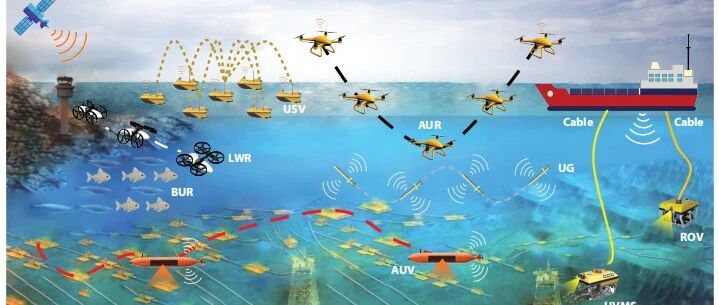
Core Insights - The article discusses the evolution and significance of underwater robots, highlighting their roles in ocean exploration, resource investigation, engineering inspection, and national defense [1][2][3]. Group 1: Types of Underwater Robots - The family of underwater robots includes Autonomous Underwater Vehicles (AUVs), Remotely Operated Vehicles (ROVs), Unmanned Surface Vehicles (USVs), and underwater gliders (UG), each designed for specific tasks [2][3]. - Bionic underwater robots (BUR) mimic fish movements, while air-water cross-domain robots (AUR) can seamlessly switch between air and underwater operations [3]. Group 2: Control Systems and Challenges - Control systems are crucial for underwater robots, ensuring basic movement and supporting complex autonomous decisions [3]. - Traditional control methods face limitations in complex marine environments due to non-linear dynamics, model uncertainties, and unpredictable disturbances [4][5]. Group 3: Data-Driven Control Approaches - The rise of machine learning has introduced data-driven control methods, which allow robots to learn from data rather than relying solely on precise mathematical models [7]. - Data-driven methods are categorized into model-based, model-free, and hybrid approaches, enhancing adaptability and robustness in control [7][8][9]. Group 4: Multi-Robot Collaboration - Multi-robot systems enhance operational efficiency and coverage, enabling complex tasks like large-scale flow field mapping and underwater collaborative operations [12][14]. - Collaborative control strategies include coordinated formations, game-theoretic competition, and cross-domain cooperation, leveraging the strengths of multiple robots [12][14]. Group 5: Open Source Technology - The emergence of open-source platforms is democratizing ocean robot research, providing low-cost testing environments and hardware options for researchers [15][16]. - Open-source software frameworks like ROS facilitate seamless integration between simulation and real-world applications, promoting algorithm sharing and innovation [16]. Group 6: Future Directions - Future developments in underwater robotics will focus on enhancing intelligence, autonomy, and safety, addressing challenges such as data efficiency and communication constraints [17]. - The integration of physical information learning and offline reinforcement learning will enable rapid learning with minimal data, while advancements in cross-domain collaboration will create a comprehensive exploration network [17].

清华首次提出数据驱动控制新形式,算法效率直翻三倍
量子位· 2025-09-12 08:46
Core Viewpoint - The article discusses a paradigm shift in control theory from model-driven control to data-driven control, emphasizing the need for a standardized data representation in the latter to enhance efficiency and reduce redundancy in algorithm design [1][7][12]. Group 1: Introduction to Data-Driven Control - The rise of big data has led to a new turning point in control theory, transitioning from reliance on models to reliance on data [1]. - There is a lack of standardized data representation in the data-driven control field, prompting research from Tsinghua University to introduce a new data-based system description format [2][12]. Group 2: Standard Form in Data-Driven Control - Each sample in the proposed standard form consists of necessary transfer and pluggable attributes, which describe system dynamics and user-defined features, respectively [3][19]. - The new data standard form can be customized according to algorithm requirements, significantly accelerating controller design and improving the efficiency of data-driven algorithms [4][32]. Group 3: Challenges and Solutions - The transition to data-driven control faces challenges due to the vast amounts of complex interaction data generated by systems like robotics and autonomous driving [12]. - Efficiently organizing and describing data to minimize redundant calculations and speed up algorithm execution is a core challenge in data-driven control [16]. Group 4: Application of Data Standard Form - A typical application example demonstrates that many reinforcement learning algorithms require nearest neighbor searches to ensure reliable controller design [20]. - By pre-defining spatial attributes for each sample, the proposed data standard form can significantly accelerate the nearest neighbor search process [22][28]. Group 5: Experimental Results - Experiments conducted in the D4RL dataset's Hopper environment showed that using the spatial standard form reduced training time from approximately 20 hours to just 7 hours, achieving a threefold efficiency improvement [29][31].