
文旅经济发展

Search documents
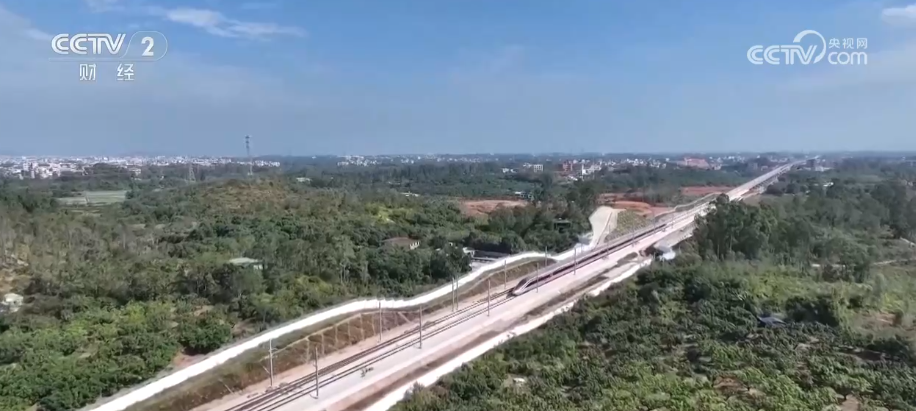
春运通途透过新线看变化 交通能级提升助推文旅经济新发展
Yang Shi Wang· 2026-02-08 07:01
Core Viewpoint - The introduction of the Guangzhan and Shanshan high-speed rail lines in 2026 will significantly enhance the high-speed rail network in Guangdong, alleviating pressure during the Spring Festival travel peak and providing new travel options for passengers [1][3]. Group 1: High-Speed Rail Network Expansion - The total operational mileage of Guangdong's high-speed rail has surpassed 3,400 kilometers, ranking first in the country [3]. - The new lines create a direct fast track from Zhanjiang North Station to Shantou Station, significantly reducing travel time compared to previous routes [3]. - Travel time from Guangzhou to Zhanjiang has been reduced to approximately 1.5 hours, with some segments seeing over a 50% reduction in travel time [3][5]. Group 2: Impact on Travel and Tourism - The enhanced transportation capabilities are expected to boost local tourism, with a projected 45% increase in tourist traffic to the western Guangdong region [5]. - The Spring Festival travel volume is anticipated to reach 78.55 million passengers, a year-on-year increase of 4.8%, with an average of 1.964 million passengers daily [5]. - The number of train services planned for the pre-festival period will increase by 202.5 pairs compared to the previous year [5]. Group 3: Operational Enhancements - The operational capacity towards Zhanjiang, Shantou, and Meizhou has been significantly increased, with additional high-speed trains being introduced [7]. - High-speed trains on the Jingguang and Guiguang lines will operate at speeds of 350 km/h and 300 km/h, respectively, further shortening travel times [7].

西安-兴义-珠海航线正式开通
Xi An Ri Bao· 2026-01-29 02:35
Core Viewpoint - The new Xi'an-Xingyi-Zhuhai route launched by Xinhai Hang Longan Airlines aims to meet diverse travel demands during the upcoming Spring Festival, enhancing connectivity among the three cities and promoting regional tourism development [1] Group 1: Route Details - The new route operates four times a week on Mondays, Wednesdays, Fridays, and Sundays [1] - Flight 9H8499 departs from Xi'an at 13:25, arrives in Xingyi at 15:50, then departs Xingyi at 16:35 and arrives in Zhuhai at 18:30; the return flight 9H8500 leaves Zhuhai at 19:30, arrives in Xingyi at 21:40, and departs Xingyi at 22:30, arriving back in Xi'an at 00:40 the next day [1] Group 2: Regional Impact - The new route features unique flights from Xi'an to Xingyi and Xingyi to Zhuhai, enhancing travel options [1] - Xingyi, located in Guizhou Province, has a favorable subtropical humid monsoon climate, making it an attractive destination year-round [1] - The route will significantly shorten travel times between the three cities, linking Xi'an's historical heritage, Xingyi's karst natural scenery, and Zhuhai's coastal attractions, thereby facilitating resource sharing and tourism exchange [1]
运营古建民居期待新模式
Su Zhou Ri Bao· 2025-07-18 06:25
Core Viewpoint - The article discusses the ongoing efforts in Suzhou to protect and utilize ancient buildings and villages, highlighting the challenges and potential benefits of opening these historical sites to the public for tourism and cultural engagement [1][5]. Group 1: Public Demand and Historical Significance - Citizens are calling for the opening of ancient residential buildings to enhance cultural tourism and boost the local economy, particularly in historically significant areas like Dongshan Town [2][3]. - Dongshan Town is recognized for its rich history, with several ancient villages being designated as cultural heritage sites, attracting many visitors [2]. Group 2: Current State of Ancient Buildings - Key historical sites such as Huaiyin Hall and Mingshan Hall are currently closed to the public, despite their status as national key cultural relics, limiting tourist access [3][4]. - The management cites safety, maintenance, and lack of necessary facilities as reasons for the closures, indicating a need for improvements before public access can be granted [4][5]. Group 3: Challenges in Activation and Utilization - The article emphasizes the importance of preserving cultural relics while also exploring ways to activate and utilize these sites for public benefit, which poses significant technical and financial challenges [5][6]. - Strict preservation requirements often conflict with modern usage needs, making it difficult to find a balance between protection and public engagement [5][6]. Group 4: Policy Support and Successful Cases - There is a call for more policy support to create tailored activation strategies for different levels of ancient buildings, with some successful examples already in place [6]. - The article mentions that private investments have led to the successful transformation of some ancient buildings into modern accommodations, demonstrating a potential model for future developments [6].