
广汕高铁

Search documents
春运通途透过新线看变化 交通能级提升助推文旅经济新发展
Yang Shi Wang· 2026-02-08 07:01
Core Viewpoint - The introduction of the Guangzhan and Shanshan high-speed rail lines in 2026 will significantly enhance the high-speed rail network in Guangdong, alleviating pressure during the Spring Festival travel peak and providing new travel options for passengers [1][3]. Group 1: High-Speed Rail Network Expansion - The total operational mileage of Guangdong's high-speed rail has surpassed 3,400 kilometers, ranking first in the country [3]. - The new lines create a direct fast track from Zhanjiang North Station to Shantou Station, significantly reducing travel time compared to previous routes [3]. - Travel time from Guangzhou to Zhanjiang has been reduced to approximately 1.5 hours, with some segments seeing over a 50% reduction in travel time [3][5]. Group 2: Impact on Travel and Tourism - The enhanced transportation capabilities are expected to boost local tourism, with a projected 45% increase in tourist traffic to the western Guangdong region [5]. - The Spring Festival travel volume is anticipated to reach 78.55 million passengers, a year-on-year increase of 4.8%, with an average of 1.964 million passengers daily [5]. - The number of train services planned for the pre-festival period will increase by 202.5 pairs compared to the previous year [5]. Group 3: Operational Enhancements - The operational capacity towards Zhanjiang, Shantou, and Meizhou has been significantly increased, with additional high-speed trains being introduced [7]. - High-speed trains on the Jingguang and Guiguang lines will operate at speeds of 350 km/h and 300 km/h, respectively, further shortening travel times [7].

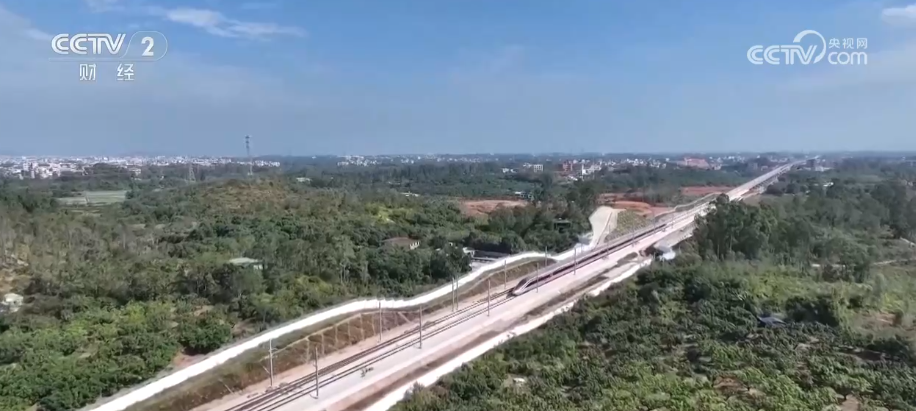
广湛高铁接入广州站 粤西粤东打通350公里时速高铁通道
Xin Lang Cai Jing· 2026-01-30 06:15
Core Viewpoint - The opening of the Guangzhan High-Speed Railway enhances the connectivity between Zhanjiang North and Guangzhou, significantly improving the transportation network in Guangdong and facilitating regional economic development [1][2] Group 1: Infrastructure Development - The Guangzhan High-Speed Railway connects Zhanjiang North to Shantou, reducing travel time to 4 hours and 27 minutes, thus improving the efficiency of the Guangdong high-speed rail network [1] - The railway serves multiple cities and counties along the route, including Maoming, Yangjiang, Yangchun, Xinxing, Shanwei, and Chao'nan, enhancing accessibility for residents [1] Group 2: Economic Impact - The new railway line supports the integration of the Guangdong-Hong Kong-Macao Greater Bay Area with the eastern and western regions of Guangdong, promoting coordinated regional development [2] - The increased frequency of trains, with 66 services starting from February 2, will stimulate the flow of people, goods, and capital, thereby invigorating the economy in western Guangdong [1] Group 3: Future Plans - The railway department plans to optimize operations towards Shantou and improve service quality, while also enhancing supporting infrastructure for better connectivity with other high-speed rail lines [2]
东南沿海,迎来“超级通道”!
Xin Lang Cai Jing· 2025-12-19 11:15
Core Viewpoint - The opening of two high-speed rail lines in Guangdong, the Guangzhou-Zhanjiang High-Speed Railway and the Shantou-Shanwei High-Speed Railway, marks a significant advancement in regional connectivity and infrastructure development in China, enhancing economic integration across the province and beyond [2][10][18]. Group 1: High-Speed Rail Details - The Guangzhou-Zhanjiang High-Speed Railway (Guangzhan Railway) will officially open on December 22, 2023, with a total length of 401 kilometers and a design speed of 350 km/h [2][5]. - The Shantou-Shanwei High-Speed Railway (Shanshan Railway) will also commence operations on the same day, covering 162 kilometers and connecting Shantou to Shantou South [5][7]. - Both railways will create a "super corridor" that connects multiple cities, including Shantou, Zhanjiang, Guangzhou, and others, facilitating travel times of approximately 1.5 hours to Guangzhou [18]. Group 2: Economic and Regional Development - The construction of these railways addresses regional development disparities in Guangdong, where the Pearl River Delta (PRD) region accounts for 81.5% of the province's GDP, while the eastern and western regions lag behind [13][14]. - The development aims to enhance the economic capabilities of Shantou and Zhanjiang, which are designated as provincial sub-center cities, and to promote overall growth in the eastern Guangdong region [16][18]. - The railways are part of a broader strategy outlined in the "14th Five-Year Plan" to create new growth poles in the eastern and western regions, linking them with the PRD [16][19]. Group 3: Engineering and Technical Achievements - The Shantou Bay Undersea Tunnel, part of the Shanshan Railway, is noted for its engineering challenges, including high water pressure and complex geological conditions, marking significant technical achievements in railway construction [11][12]. - The tunnel is recognized as the world's first high-speed railway undersea tunnel with a single bore and dual tracks designed for speeds of 350 km/h, showcasing advancements in railway engineering [12][10]. Group 4: Future Developments - The completion of these railways is expected to enhance connectivity with other regions, including the construction of additional high-speed rail lines such as the YQG Railway and the Hainan Railway, further integrating Guangdong with neighboring provinces [21][22][25]. - Future projects aim to extend the "super corridor" to connect with key economic areas, enhancing the overall transportation network in southern China [27][19].

广州高铁进城破局:46年老站焕新,大湾区交通版图重构
Nan Fang Du Shi Bao· 2025-07-23 14:46
Core Points - The transition of Guangzhou Station from traditional slow trains to high-speed trains marks a significant milestone in the city's "high-speed rail into the city" strategy [1][2][4] - The new train operation schedule starting July 1, 2023, will see a dramatic increase in high-speed train services, with over 90% of trains being high-speed by 2025 [2][3] - The construction of the Guangnan Link Line will connect major railway stations, enhancing the overall efficiency of the transportation network in Guangzhou [6][9] Group 1: Historical Context - Guangzhou Station, established in 1974, has been a crucial node in China's railway network, witnessing significant passenger flow during peak periods [3] - The station has undergone several upgrades, including major renovations in 2015 and 2023, to adapt to the high-speed rail era [3][5] Group 2: Infrastructure Development - The "high-speed rail into the city" strategy aims to alleviate the long-standing issue of high-speed stations being located far from city centers, enhancing accessibility for commuters [4][6] - The Guangnan Link Line, a key project, will connect Guangzhou South Station with other major stations, significantly reducing travel time and improving connectivity [6][9] Group 3: Economic Impact - The integration of high-speed rail into the city is expected to create a "one-hour living circle," facilitating faster connections between Guangzhou and surrounding regions [7][9] - The expansion of the high-speed rail network is projected to boost regional economic development, with an estimated 4,700 kilometers of railway coverage by 2025 [10]