
汕汕高铁

Search documents
(新春走基层)铁轨映初心,三位女列车长的春运守护
Xin Lang Cai Jing· 2026-02-13 14:17
Core Viewpoint - The article highlights the dedication and service of three female train conductors during the Spring Festival travel rush, showcasing their commitment to passenger care and the evolution of railway services over the years [1][4][8] Group 1: Individual Contributions - Xiao Junyan, a train conductor with 20 years of experience, prepares for the Spring Festival by ensuring essential items are available for passengers, demonstrating her commitment to service [1][3] - Gao Ran, a conductor on the Xiamen-Shenzhen high-speed railway, emphasizes the improvements in service efficiency due to technological advancements, such as differentiated ticket checks [4][5] - Sun Tingting, a conductor on the Shantou-Shenzhen high-speed railway, actively assists elderly passengers, showcasing her dedication to providing personalized service [5][8] Group 2: Service Enhancements - The introduction of technology in ticket checking has significantly improved service efficiency on high-speed trains, allowing for a more streamlined passenger experience [4][5] - The railway department has implemented various refined service measures, such as phone booking for elderly passengers and on-board meal delivery, enhancing the overall travel experience [5] - Continuous training in emergency response and service skills for staff ensures a high level of preparedness and professionalism in passenger service [5]


春运通途透过新线看变化 交通能级提升助推文旅经济新发展
Yang Shi Wang· 2026-02-08 07:01
Core Viewpoint - The introduction of the Guangzhan and Shanshan high-speed rail lines in 2026 will significantly enhance the high-speed rail network in Guangdong, alleviating pressure during the Spring Festival travel peak and providing new travel options for passengers [1][3]. Group 1: High-Speed Rail Network Expansion - The total operational mileage of Guangdong's high-speed rail has surpassed 3,400 kilometers, ranking first in the country [3]. - The new lines create a direct fast track from Zhanjiang North Station to Shantou Station, significantly reducing travel time compared to previous routes [3]. - Travel time from Guangzhou to Zhanjiang has been reduced to approximately 1.5 hours, with some segments seeing over a 50% reduction in travel time [3][5]. Group 2: Impact on Travel and Tourism - The enhanced transportation capabilities are expected to boost local tourism, with a projected 45% increase in tourist traffic to the western Guangdong region [5]. - The Spring Festival travel volume is anticipated to reach 78.55 million passengers, a year-on-year increase of 4.8%, with an average of 1.964 million passengers daily [5]. - The number of train services planned for the pre-festival period will increase by 202.5 pairs compared to the previous year [5]. Group 3: Operational Enhancements - The operational capacity towards Zhanjiang, Shantou, and Meizhou has been significantly increased, with additional high-speed trains being introduced [7]. - High-speed trains on the Jingguang and Guiguang lines will operate at speeds of 350 km/h and 300 km/h, respectively, further shortening travel times [7].
“十四五”汕头完成交通基础设施投资810亿元 铁路建设取得突破
Xin Lang Cai Jing· 2026-01-04 10:44
Group 1 - The core viewpoint of the article highlights Shantou's efforts to establish itself as a high-level national comprehensive transportation hub, with significant investments in infrastructure over the past five years [1] - Shantou has completed transportation infrastructure investments totaling 81 billion yuan, which represents a 150% increase compared to the "13th Five-Year Plan" period [1] - The city has achieved near-complete coverage of highways, ranking sixth in density within Guangdong province, and has initiated the expansion of the Shantou-Fuzhou Expressway to connect with economic special zones [1] Group 2 - Rail construction has made significant progress, with the Shantou-Shantou High-Speed Railway now fully operational, allowing for a 90-minute direct connection to the Guangdong-Hong Kong-Macao Greater Bay Area [1] - Shantou has recently opened direct high-speed train services to Fujian and Zhejiang, marking its entry into the "high-speed rail era" and enabling same-day round trips to cities in the Yangtze River Delta [1] - The city is accelerating the realization of a half-hour commuting circle for the "Shan-Chao-Jie" intercity railway, which has commenced full construction [1] Group 3 - Port and shipping construction is being enhanced, with the Shantou Port Guang'ao Port Area establishing international shipping routes to Southeast Asia, Northeast Asia, and major ports in the Far East [1] - The ongoing construction of the third phase of the Guang'ao Port Area is expected to significantly increase the cargo throughput capacity of Shantou Port by approximately 70% [1] - The completion of the Bay Tunnel has greatly improved the accessibility of Shantou's urban layout, enhancing connectivity between the two banks of the bay [1] Group 4 - Shantou is continuously enhancing its urban comprehensive service capabilities, with the completion of various educational, medical, and sports facilities, including the East Coast Campus of Shantou University and the second phase of the Guangdong-Israel Institute of Technology [2] - The upgrades in urban service capacity reflect a significant improvement in the overall quality of life for residents [2]
七条高铁开通!高铁第一省再度易主,湖北增量第一
3 6 Ke· 2025-12-31 03:00
Core Insights - In the last ten days of December, seven high-speed rail lines were opened, marking a significant expansion of China's high-speed rail network [1][19][21] Group 1: New High-Speed Rail Openings - The Guangzhan High-Speed Rail and the Shanshan High-Speed Rail opened on December 22, significantly reducing travel time from Zhanjiang to Guangzhou from 2.5 hours to 1.5 hours [2] - The Baoyin High-Speed Rail's Baohui section opened on December 23, completing a total length of 519 kilometers, with a design speed of 250 km/h, connecting seven cities in Inner Mongolia to the national high-speed rail network [5] - The Wuyi High-Speed Rail, part of the East-West artery, opened on December 26, covering 314 kilometers at a speed of 350 km/h, reducing the commute time from Wuhan to Yichang to 69 minutes [7][10] - The Hangzhou-Qingzhou High-Speed Rail opened, covering 131 kilometers at a speed of 350 km/h, allowing travel from Quzhou West to Hangzhou West in 1 hour and 13 minutes [14] - The Xiyan High-Speed Rail, with a length of 299.8 kilometers and a design speed of 350 km/h, will reduce travel time from Xi'an to Yan'an from 2.5 hours to about 1 hour [15] - The Hefei-Xin High-Speed Rail's Hezi section opened on December 30, covering 198 kilometers with five new stations [17] Group 2: National High-Speed Rail Developments - By the end of 2025, a total of 12 new lines are expected to open, contributing to a national high-speed rail operating mileage exceeding 50,000 kilometers, achieving the "14th Five-Year Plan" goal [21][31] - Guangdong regained its position as the top province in high-speed rail mileage, surpassing Shandong with a total of 3,437 kilometers after adding approximately 421 kilometers in 2025 [23][25] - Hubei achieved the highest growth in high-speed rail mileage in 2025, adding 429 kilometers, which elevated its ranking from 13th to 5th nationally [27] - Inner Mongolia ranked third in growth with the opening of the Baoyin Railway's Baohui section, contributing 402 kilometers [28] - The total high-speed rail operating mileage in China is now the largest in the world, covering 97% of cities with populations over 500,000 and handling 80% of passenger traffic [22][21] Group 3: Future High-Speed Rail Plans - The national railway construction is set to continue aggressively, with plans to reach 180,000 kilometers of railway by 2030, including 60,000 kilometers of high-speed rail [36] - Major cities are actively planning and constructing new high-speed rail stations to enhance connectivity, with significant projects underway in cities like Zhengzhou, Shanghai, and Shenzhen [49][51]
中国最重要的“东西大动脉”,要来了
虎嗅APP· 2025-12-26 13:50
Group 1 - The opening of the Wuhan to Yichang section of the Yangtze River High-Speed Railway (Wuyichang High-Speed Railway) marks a significant milestone, bringing Hubei's high-speed rail operating mileage close to 2,600 kilometers, ranking it fifth in China [6][8] - The Yangtze River High-Speed Railway, also known as the Shanghai-Chongqing-Rong High-Speed Railway, spans 2,100 kilometers with a total investment of approximately 530 billion yuan, designed for a speed of 350 km/h, reducing travel time from Shanghai to Chengdu from 12 hours to 7 hours [10][11] - The railway will be constructed in segments, with the Wuyichang High-Speed Railway being the first section completed, and the entire line expected to be operational by around 2030 [15][18] Group 2 - The Yangtze River High-Speed Railway is crucial as it connects the Yangtze River Economic Belt, which includes six provinces and accounts for about 60% of China's economic output, with a combined GDP of nearly 40 trillion yuan and a population of 345 million [21][24] - The railway aims to address the limitations of existing transportation infrastructure, such as the lower design standards of the current railways and the predominance of freight traffic on the Yangtze River, thus facilitating faster passenger travel and alleviating congestion [25][27] - The completion of the high-speed railway is expected to significantly enhance economic activity by improving the flow of people, goods, and capital across the region, benefiting all cities along the route [29][31] Group 3 - The National Development and Reform Commission and the Ministry of Transport have indicated plans to promote the construction of both coastal and Yangtze River high-speed railways during the 14th Five-Year Plan period [32] - The coastal high-speed railway, which is longer at approximately 4,000 kilometers, aims to fill gaps in transportation between medium and small cities, enhancing connectivity and supporting regional economic development [40][41] - The completion of both the east-west and north-south high-speed rail networks will contribute to the overall formation of China's "eight vertical and eight horizontal" high-speed rail network [42]
回眸2025:更快更远更好,交通强国建设铺就民生幸福路
Xin Lang Cai Jing· 2025-12-24 06:29
Core Insights - The construction of a transportation powerhouse in China is focused on detailed achievements that enhance the efficiency of economic and social development by 2025, leading to improved quality of life and a vibrant "flowing China" [1] Group 1: Infrastructure Development - The opening of the Guangzhou-Zhanjiang and Shantou South to Shantou sections of the high-speed rail on December 22 marks a significant addition to the "Greater Bay Area" transportation network, enhancing regional development and reducing commuting times [2] - The competition for the title of "high-speed rail capital" reflects the rapid expansion of high-speed rail services, which now include smaller cities, thereby supporting coordinated regional development and improved public services [2] Group 2: International Connectivity - The ongoing development of the Shanghai International Shipping Center and the innovative air transport policies in Hainan Free Trade Port signify China's commitment to enhancing international connectivity, facilitating lower costs for business interactions and more frequent exchanges of people [3] - The "going out" strategy in transportation is creating opportunities for employment, education, business, and travel, making global travel more accessible [3] Group 3: User Experience Enhancement - The focus of transportation development is on meeting public needs, with improvements such as a refined high-speed rail points system, pet transportation services, and cultural initiatives like "book trains" enhancing the travel experience [4] - The reduction of tolls on certain highways is aimed at alleviating the financial burden on travelers, reflecting a commitment to prioritizing the needs of the people [4] - The transformation from a transportation power to a transportation powerhouse is characterized by a shift from merely moving people to providing a caring and efficient travel environment [4]
中国第一经济强省,完成了这项重大任务!
3 6 Ke· 2025-12-24 03:25
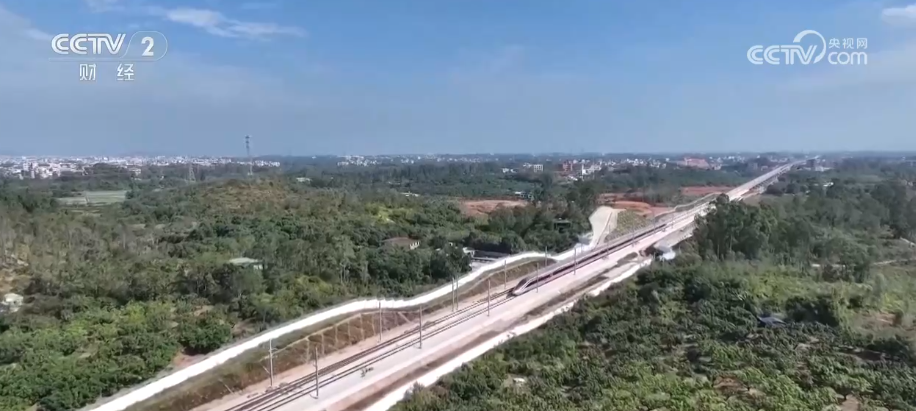
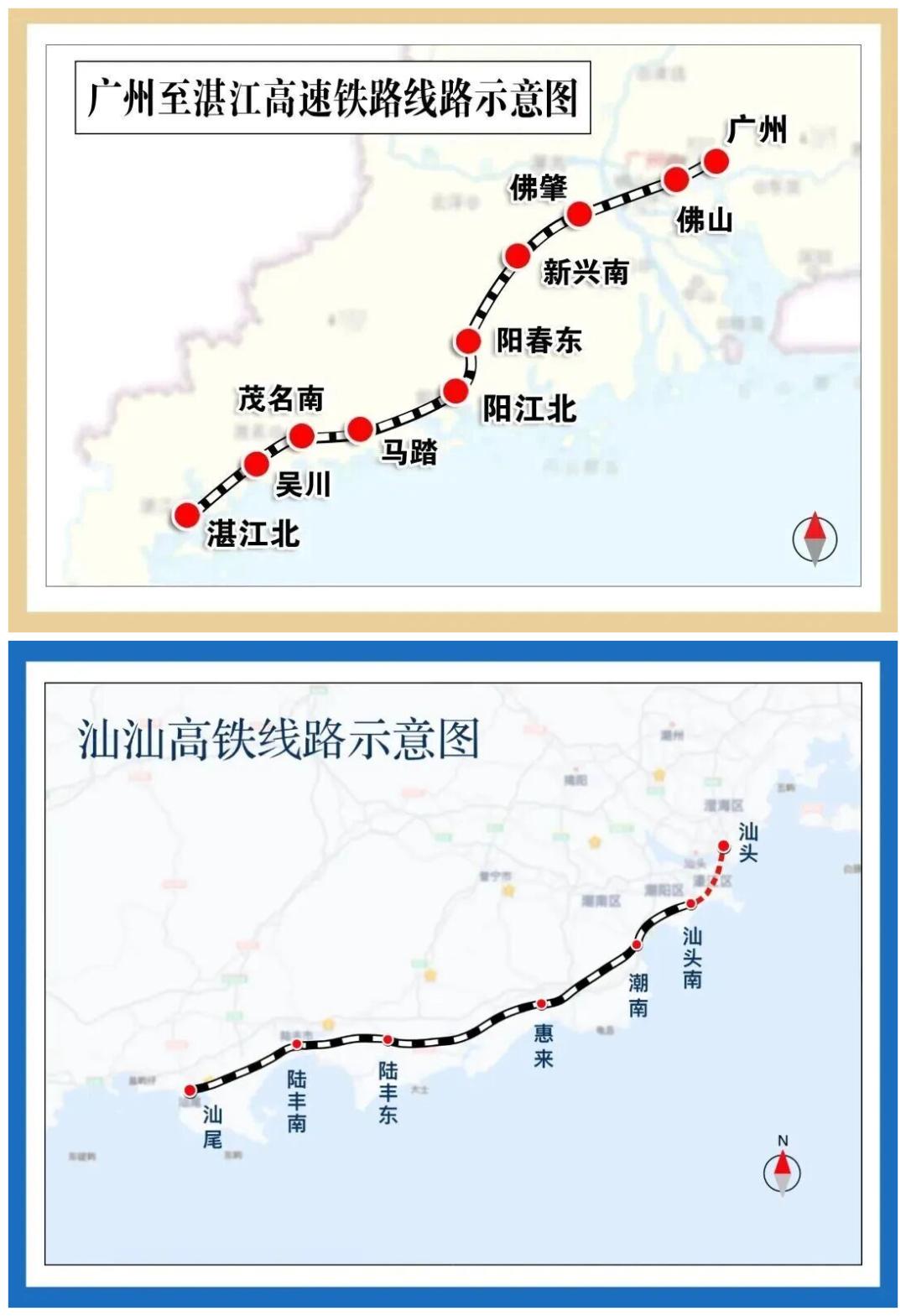
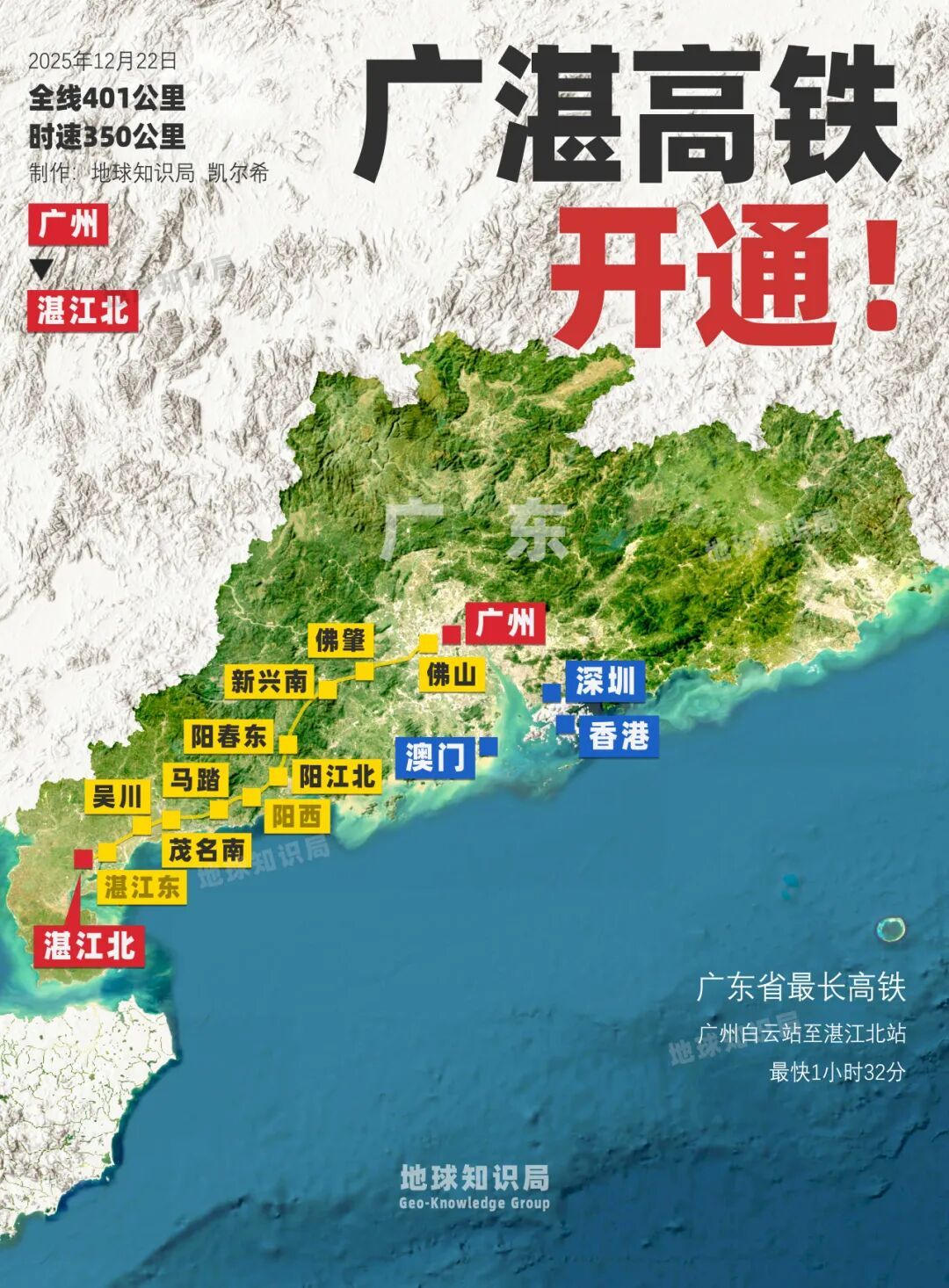
Core Viewpoint - The opening of the Guang-Zhan High-Speed Railway significantly enhances economic connectivity between the Greater Bay Area and the western Guangdong region, reducing travel time from Guangzhou to Zhanjiang to just one and a half hours [1][7]. Group 1: Project Overview - The Guang-Zhan High-Speed Railway is the longest high-speed rail line in Guangdong Province, measuring 401 kilometers in length [3]. - It operates at a maximum speed of 350 kilometers per hour and was built as a single-phase project [3][4]. - This railway is the highest standard, longest, and largest investment railway project ever constructed in Guangdong Province [4]. Group 2: Operational Details - The first train, G9785, departed from Guangzhou Baiyun Station at 10:30 AM, marking the official opening of the railway [4]. - Initially, up to 64 high-speed trains will operate daily, with travel times from Guangzhou Baiyun to Zhanjiang North and Maoming South being 1 hour 32 minutes and 1 hour 20 minutes, respectively [5]. - The new line reduces the travel time from Guangzhou to Zhanjiang by 61 minutes compared to the previous route via Jiangmen [5]. Group 3: Infrastructure and Connectivity - The railway connects seven cities: Guangzhou, Foshan, Zhaoqing, Yunfu, Yangjiang, Maoming, and Zhanjiang, with seven stations opening initially [4]. - Future connections include the ongoing construction of the Foshan-Zhaoqing station, which will serve as a high-speed station for the upcoming Pearl River Delta Hub (Guangzhou New Airport) [4][9]. - The Guang-Zhan High-Speed Railway will also link with the under-construction Hezhou-Zhanjiang high-speed railway and the planned Zhanjiang-Haikou high-speed railway, enhancing regional connectivity [9][10]. Group 4: Engineering Challenges - The railway features a high bridge-tunnel ratio of 76.7%, traversing complex geological conditions, including karst, soft soil, and expansive soil [4]. - Significant engineering feats include the Zhujiang Four-Line Super Bridge and the Zhanjiang Bay underwater tunnel, which set records for the longest single-bore underwater tunnel in China [4].
多领域迎来关键进展 我国经济尽显活力
Xin Lang Cai Jing· 2025-12-23 12:56
Group 1: Regional Foreign Trade Progress - The foreign trade scale in the Guangdong-Hong Kong-Macao Greater Bay Area reached 8.3 trillion yuan in the first 11 months of the year, a year-on-year increase of 4.6%, marking a historical high for the same period [2] - The Yangtze River Delta region's foreign trade exceeded 15 trillion yuan for the first time, reaching 15.46 trillion yuan, with a growth rate of 6.2% [2] - The Beijing-Tianjin-Hebei region's foreign trade amounted to 4.3 trillion yuan, with exports hitting a historical high of 1.32 trillion yuan, and private enterprises' exports exceeding 600 billion yuan, growing by 16.1% [4] Group 2: Economic Development Milestones - The first seventh freedom rights flight route from Hainan Free Trade Port, connecting Sanya and Prague, commenced operations, enhancing international connectivity [6] - The Guangzhou-Zhanjiang high-speed railway officially opened, reducing travel time between the two cities from approximately 2.5 hours to 1.5 hours, improving regional accessibility [8] - The Shantou-Shantou South high-speed railway was fully operational, with a total length of 162 kilometers and a design speed of 350 kilometers per hour, serving as a key node in the national high-speed rail network [10] Group 3: Innovations in Maritime Industry - The world's first methanol dual-fuel intelligent ultra-large oil tanker was delivered in Dalian, China, measuring approximately 333 meters in length and capable of carrying about 2.1 million barrels of crude oil [12] - The tanker features domestically developed methanol dual-fuel engines and fuel supply systems, which can reduce carbon dioxide emissions by up to 92%, meeting the latest international environmental standards [12][13] - The vessel is equipped with an intelligent ship-based platform and multiple intelligent systems for safe and efficient operational management, set to serve routes from the Middle East to the Far East [13]
南粤贯长虹 湾区新图景——从广湛高铁感受广东速度
Yang Guang Wang· 2025-12-23 12:34
Core Viewpoint - The launch of the Guangzhou-Zhanjiang High-Speed Railway (G9785) marks a significant expansion of China's high-speed rail network, enhancing connectivity between the Guangdong-Hong Kong-Macao Greater Bay Area and other strategic regions, thereby promoting regional economic integration and development [1][3][6]. Group 1: High-Speed Rail Development - The Guangzhou-Zhanjiang High-Speed Railway spans 401 kilometers with a design speed of 350 km/h, serving as a crucial link in the high-speed rail network [1]. - The addition of the Shantou to Shantou South section of the Shantou-Shantou High-Speed Railway expands Guangdong's high-speed rail network to 3,411 kilometers, making it one of the provinces with the highest rail density in the country [2]. - The completion of these railways creates a "golden corridor" that integrates Zhanjiang and Shantou into the Greater Bay Area's economic cycle [2][3]. Group 2: Economic Impact - The high-speed rail network significantly compresses travel time, allowing for a 90-minute commute between Zhanjiang and the Greater Bay Area, thus facilitating urban integration and regional collaboration [7]. - The economic growth of cities along the railway, such as Guangzhou, is projected to see a GDP increase of 700 billion yuan during the 14th Five-Year Plan, with retail and foreign trade maintaining a "double trillion" growth trend [5]. - The railway enhances Zhanjiang's role as a key player in the Greater Bay Area's industrial division, transforming it from a traditional support base to a frontline participant in economic activities [6]. Group 3: Infrastructure and Technological Advancements - The construction of the Guangzhou-Zhanjiang High-Speed Railway involved overcoming significant engineering challenges, including complex geological conditions and the need for advanced tunneling technology [15][17]. - The project showcases China's infrastructure capabilities, with a bridge-tunnel ratio of 76.7% and the completion of the longest high-speed railway underwater tunnel in the country [15]. - The railway's development is part of a broader strategy to enhance Guangdong's innovation capacity, with significant investments in research and development projected to reach 510 billion yuan by 2024 [18].
两条新线同日开通运营 广东高铁运营里程跃居全国第一
Nan Fang Ri Bao Wang Luo Ban· 2025-12-23 07:46
Core Insights - The opening of the Guang-Zhan High-Speed Railway marks a significant development in Guangdong's transportation infrastructure, enhancing connectivity for tourism and local economies [1] - The completion of the Shantou to Shantou South segment of the Shantou-Shantou High-Speed Railway signifies the full operation of this line, contributing to the overall high-speed rail network in Guangdong [1] - Guangdong's high-speed rail network now spans 6,433 kilometers, with 3,411 kilometers of that being high-speed rail operating at speeds of 200 km/h or above, making it the largest high-speed rail province in China [1] Group 1 - The Guang-Zhan High-Speed Railway is a key component of the national "eight vertical and eight horizontal" high-speed rail network, connecting the Guangdong-Hong Kong-Macao Greater Bay Area with Hainan Free Trade Port and the Beibu Gulf urban agglomeration [1] - The Shantou-Shantou High-Speed Railway will connect with the under-construction Zhang-Shan High-Speed Railway, enhancing north-south passenger capacity between economic regions such as the Pearl River Delta, Haixi, and Yangtze River Delta [1] Group 2 - Thirteen new lines, including Zhang-Shan and Shen-Shan, are under construction, accelerating Guangdong's goal of achieving "350 km/h high-speed rail access for every city" [2] - The high-speed rail network aims to create an economic living circle where cities in the Pearl River Delta can be reached within one hour, major cities in Guangdong and Hunan within two hours, and connections to regions like Beijing-Tianjin-Hebei and the Yangtze River Delta within six to eight hours [2] - The ongoing development of the rail network is expected to enhance the integration of the Guangdong-Hong Kong-Macao Greater Bay Area with the eastern and western parts of Guangdong, reinforcing the region's economic growth [2]