新内需

Search documents
净流出超7900亿元!
Zhong Guo Ji Jin Bao· 2026-02-02 06:24
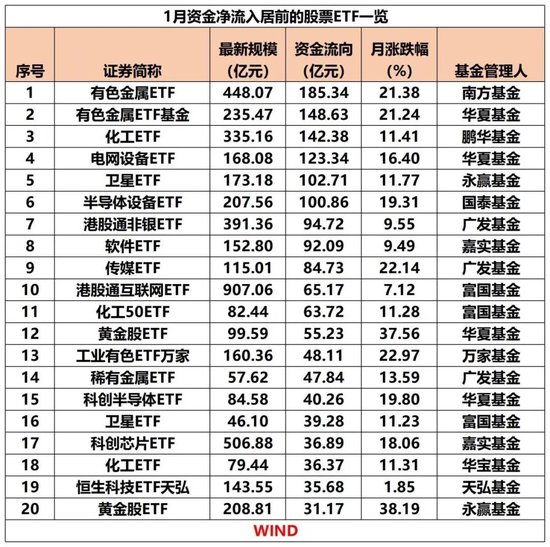
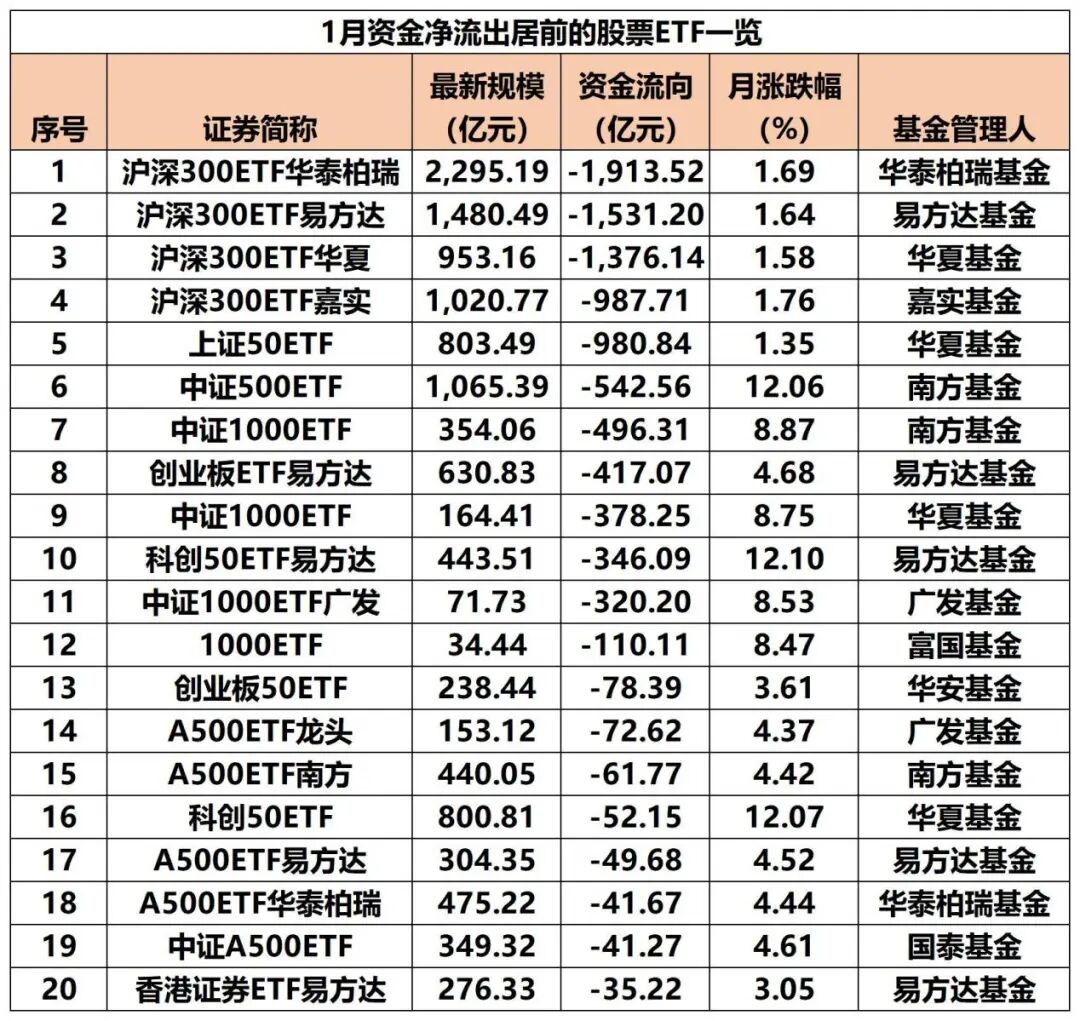
Core Viewpoint - In January, the stock ETF market experienced significant outflows, totaling over 790 billion yuan, with a notable net outflow of 37.20 billion yuan on January 30 alone [1][5][3]. Group 1: ETF Market Performance - On January 30, the Shanghai Composite Index fell over 2%, closing down 0.96% at 4117 points, with most industry sectors declining, while communication, electronics, and agriculture sectors showed gains [2][3]. - The total net outflow for all stock ETFs (including cross-border ETFs) in January reached 795.67 billion yuan [5]. - The largest inflows were seen in thematic ETFs such as non-ferrous metals, chemicals, electric grid equipment, and satellite ETFs, while broad-based ETFs like the CSI 300 ETF and SSE 50 ETF faced significant outflows [6][7]. Group 2: Specific ETF Data - On January 30, the SGE Gold 9999 index had the highest net inflow of 16.24 billion yuan, while the CSI 300 index saw the largest outflow of 73.23 billion yuan [3]. - Over the past five days, the SGE Gold 9999 index attracted over 20.2 billion yuan, and the chemical sector saw inflows exceeding 9.9 billion yuan [3]. - Leading fund companies like Huaxia Fund reported significant inflows in their non-ferrous metals ETF and chip ETF, with net inflows of 1.134 billion yuan and 430 million yuan, respectively [3]. Group 3: Sector Insights - The chemical industry ETF from E Fund saw a net inflow of 390 million yuan, while the chip ETF from E Fund had a net inflow of 170 million yuan [4]. - Analysts suggest that geopolitical uncertainties and rising nationalism may drive resource commodities into a super cycle, with metals like gold, silver, copper, aluminum, tungsten, and cobalt being particularly noteworthy [9]. - Investment opportunities are identified in sectors such as steel, building materials, chemicals, and silicon materials, which are expected to benefit from demand recovery [9].

1月股票ETF资金累计净流出超7900亿元
Xin Lang Cai Jing· 2026-02-02 06:22
Core Viewpoint - In January, the stock ETF market in China experienced a significant net outflow of over 790 billion yuan, indicating a turbulent market environment with specific sectors showing varied performance [1][5][11]. Summary by Category Market Performance - On January 30, the Shanghai Composite Index fell by over 2%, closing down 0.96% at 4117 points, with most sectors declining, while communication, electronics, and agriculture sectors showed gains [2][12]. - The total net outflow for stock ETFs (including cross-border ETFs) on January 30 was 37.20 billion yuan, with industry theme ETFs and commodity ETFs seeing inflows of 112.63 billion yuan and 21.66 billion yuan, respectively [3][13]. ETF Inflows and Outflows - In January, the cumulative net outflow for all stock ETFs reached 795.67 billion yuan, with popular theme ETFs like non-ferrous metals, chemicals, electric grid equipment, and satellite ETFs attracting significant inflows [5][15]. - The largest net outflows were observed in broad-based ETFs such as the CSI 300 ETF, which saw a net outflow of 1,913.52 million yuan, followed by other major ETFs [7][17]. Sector-Specific Insights - The SGE Gold 9999 index recorded a net inflow of 16.24 billion yuan on January 30, while the CSI 300 index had a net outflow of 73.23 billion yuan [3][13]. - Notable inflows were seen in specific ETFs managed by major fund companies, with the non-ferrous metals ETF and chip ETF from Huaxia Fund seeing inflows of 11.34 billion yuan and 4.3 billion yuan, respectively [3][13][14]. Investment Opportunities - Analysts suggest that geopolitical uncertainties and rising national consciousness may drive resource commodities into a super cycle, highlighting metals like gold, silver, copper, and aluminum as having long-term investment value [8][18]. - The focus is also on sectors benefiting from domestic demand and self-sufficiency trends, such as engineering machinery, new energy vehicles, and AI computing, which are expected to provide structural investment opportunities [8][18].