新能源汽车安全升级

Search documents
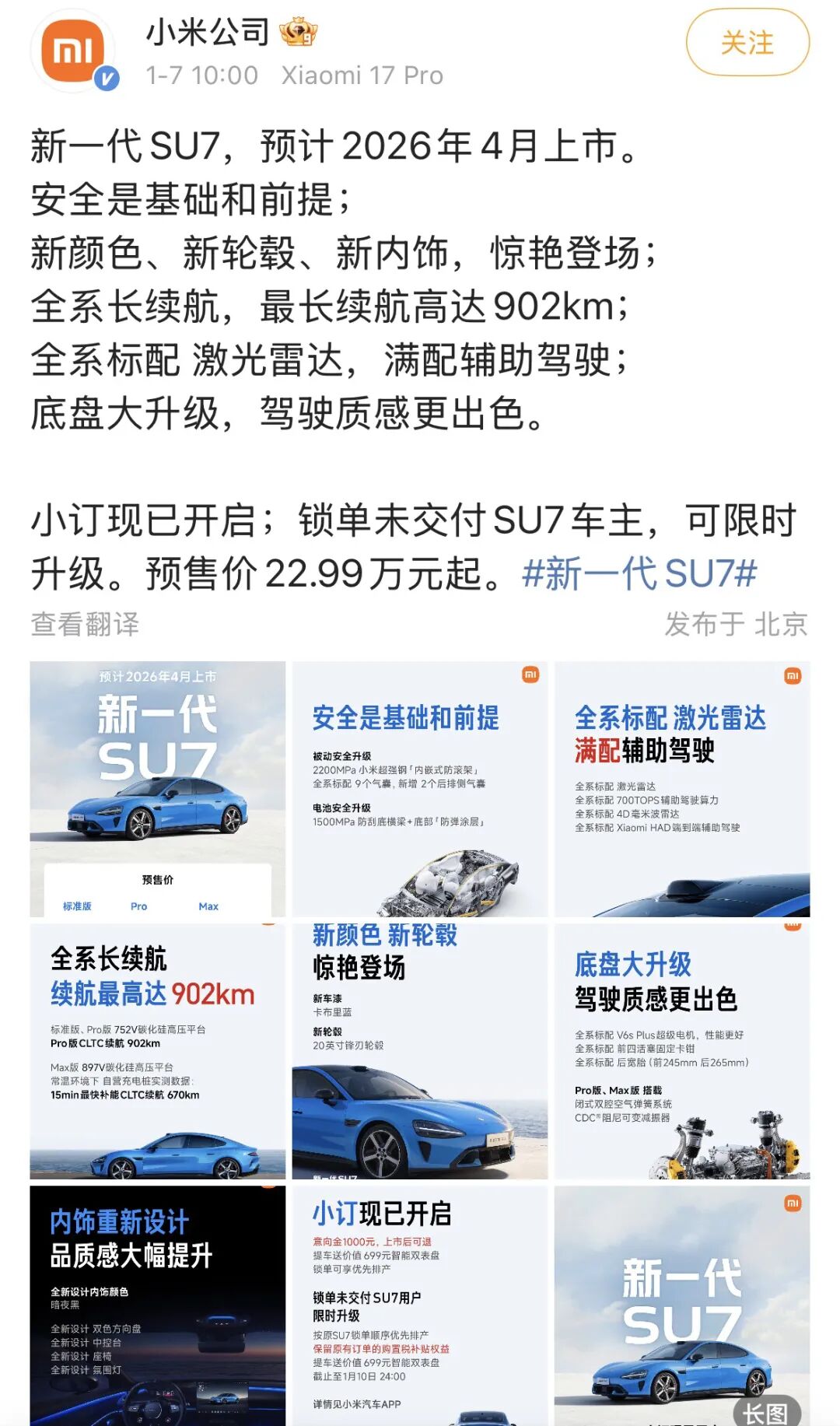
小米SU7迎来首次改款,4月正式上市
Guo Ji Jin Rong Bao· 2026-01-07 11:52
Core Viewpoint - Xiaomi Auto officially announced the first facelift of its mass-produced model SU7, with pre-orders starting immediately and an expected launch in April 2024 [1][6]. Group 1: Product Upgrades - The facelift of the SU7 focuses on four main areas: safety features, chassis technology, range capability, and design enhancements [6]. - Safety upgrades include an optimized battery thermal runaway prevention system and improved vehicle body strength, with all models now equipped with lidar [6]. - The new intelligent chassis system aims to enhance driving quality and stability through software and hardware collaboration [6]. - The maximum range of the vehicle has been significantly improved, exceeding 900 kilometers, addressing user concerns about range anxiety [6]. - New design elements include a "Capri Blue" paint option, new wheel styles, and refreshed interior design [6]. Group 2: Pricing and Market Position - The new SU7 will be available in three configurations: Standard, Pro, and Max, with pre-sale prices set at 229,900, 259,900, and 309,900 yuan, respectively, reflecting an increase of 10,000 to 14,000 yuan compared to the previous model [6]. - The emphasis on safety in this upgrade is likely a response to the increasing safety concerns in the electric vehicle industry, particularly in light of recent safety incidents [7]. Group 3: Sales Performance and Future Goals - In 2023, Xiaomi Auto's overall sales exceeded 410,000 units, surpassing the initial target of 300,000 and the revised target of 350,000 [7]. - The SU7 model contributed significantly to sales, with 230,000 units sold in the first eleven months of 2023, while the YU7 model sold 130,000 units during the same period [8]. - For 2026, the company has set an ambitious delivery target of 550,000 units, with hopes of exceeding this goal [9].


安全性提升推动新能源汽车发展:从政策驱动到技术深化的跨越 ——国内市场新能源汽车的安全升级与产业重构
Zhong Guo Chan Ye Jing Ji Xin Xi Wang· 2025-06-03 02:37
Core Insights - The Chinese electric vehicle (EV) industry is transitioning from a phase driven by policy subsidies and market incentives to a technology-driven phase focused on safety, marked by the implementation of the new battery safety standard GB38031-2025 in July 2026 [1][2] Policy Iteration - The increase in safety requirements is a response to the rise in EV fire incidents, which reached 640 in Q1 2024, a 32% year-on-year increase, with 90% linked to battery thermal runaway [2] - The new national standard shifts from a "5-minute escape time" to a "zero tolerance" approach, mandating that vehicles must not catch fire or explode within 2 hours after a thermal runaway event [4] Technological Changes - Key changes include upgrades in thermal runaway management, scenario-based safety testing, and occupant health protection [4] - Companies are adopting multi-layered protective technologies, such as CATL's NP technology, to enhance safety [4] - New testing scenarios include bottom impact tests and safety tests after 300 fast charging cycles, with companies like Dongfeng demonstrating superior protective capabilities [4] Technical Pathways - The rise in safety standards is fostering competition and integration of diverse technological routes [5] - Lithium iron phosphate batteries are gaining prominence due to their higher safety, while ternary lithium batteries are seeking breakthroughs through design optimizations [5] - Solid-state batteries are viewed as a long-term direction due to their non-flammable electrolytes [5] Industry Dynamics - Compliance with new safety standards is expected to increase battery system costs by 15%-20%, potentially leading to price hikes or market exits for low-end models [6] - Despite cost pressures, companies are committed to maintaining safety standards and will be cautious in adopting unverified technologies [6] - The industry is expected to see increased concentration, with 30% of production capacity affected by 2027, benefiting leading companies [6] Market Reconstruction - The new standards are expected to create significant demand in the testing and certification sector, with single test costs exceeding 2 million yuan [8] - Improved safety will likely lead to lower insurance premiums for compliant vehicles, with potential reductions of 15%-20% [8] - Consumer perception is shifting, with safety becoming a primary consideration in vehicle purchases, as 78% of companies have developed "non-flammable" technologies, although less than 40% fully meet all standards [8]