
新茶饮企业出海

Search documents
【关注】新茶饮产品高度同质化,上市效益普遍下滑
Sou Hu Cai Jing· 2025-06-13 09:30
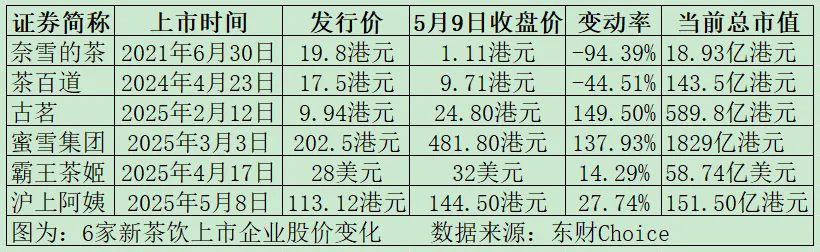
Core Viewpoint - The new tea beverage industry is experiencing a significant differentiation among leading companies following a series of IPOs, indicating a shift into a more competitive phase characterized by homogenization and over-expansion issues [1][10]. Company Performance - Companies like Gu Ming and Mi Xue Group have seen substantial stock price increases post-IPO, with Gu Ming rising by 149.50% and Mi Xue Group by 137.93% as of May 9 [2][3]. - In contrast, companies such as Nai Xue's Tea and Cha Bai Dao have faced significant declines in stock prices, with Nai Xue's Tea down 94.39% and Cha Bai Dao down 44.51% since their respective IPOs [2][7]. - The stock performance of Ba Wang Cha Ji and Hu Shang A Yi has also been weaker compared to their peers, with Ba Wang Cha Ji showing a modest increase of 14.29% and Hu Shang A Yi at 27.74% [3][5]. Market Trends - The new tea beverage market is projected to reach a scale of 354.72 billion yuan in 2024, with a stable growth forecast of 6.4% year-on-year, potentially exceeding 400 billion yuan by 2028 [14]. - The industry is transitioning from a growth phase focused on market share acquisition to a more mature phase emphasizing differentiation and refined strategies [14][16]. Challenges and Issues - The industry faces challenges such as product homogenization, excessive store expansion, and declining operational efficiency, leading to a "impossible triangle" scenario where companies struggle to balance scale expansion, cost control, and brand differentiation [10][12][16]. - Some companies have reported significant drops in net profit, with Cha Bai Dao experiencing a 58.55% decline in 2024, while Nai Xue's Tea reported substantial losses [8][12]. Strategic Directions - Companies are increasingly focusing on differentiation strategies, with Mi Xue Group leveraging its supply chain capabilities to gain competitive advantages [16]. - Expansion into overseas markets is a key strategy for many leading new tea beverage companies, with Ba Wang Cha Ji already testing its first North American store shortly after its IPO [17].

“新茶饮”竞争延向海外市场
Xin Lang Cai Jing· 2025-06-03 01:31
Core Insights - The core viewpoint of the news is that despite achieving significant revenue and profit growth in the first quarter, the overall growth rate of the new tea beverage industry is slowing down, prompting companies to seek overseas expansion as a new growth avenue [1][4]. Financial Performance - In the first quarter, the company reported a total merchandise transaction volume of 8.23 billion yuan, a year-on-year increase of 38% [2] - Revenue reached 3.39 billion yuan, reflecting a year-on-year growth of 35.4% [2] - Net profit was 677 million yuan, up 13.8% year-on-year, with a net profit margin of 20% [2] - The company had a total of 6,681 stores globally, with 241 new stores opened in the quarter, marking an increase of 2,598 stores compared to the same period last year [2] Market Trends - The new tea beverage market is becoming saturated, with many companies experiencing slower growth rates and increased competition [3] - Several newly listed tea beverage companies are facing challenges, with some reporting declines in revenue and profit [3] - The overall market is characterized by a proliferation of tea shops in high-density urban areas, leading to increased competition [3] Overseas Expansion - As the domestic market saturates, overseas expansion is becoming a key growth strategy for tea beverage companies [6] - The company reported that its overseas merchandise transaction volume reached 178 million yuan, a year-on-year increase of 85.3%, with a total of 169 overseas stores [6] - Other brands are also expanding internationally, with significant numbers of stores established in Southeast Asia [6] Challenges of Internationalization - The expansion into international markets presents challenges related to supply chain management, organizational structure, and cultural adaptation [7] - Future competition in the industry will hinge on the completeness of supply chains, necessitating robust supply chain management before further expansion [7]