新质人才供给体系

Search documents
人才蓝皮书:构建新质人才长周期供给体系
Xin Lang Cai Jing· 2025-12-31 16:58
Core Viewpoint - The development of future industries is a strategic choice to lead technological progress, drive industrial upgrades, and develop new productive forces, with a key focus on cultivating innovative talent [1] Group 1: Talent Development Strategies - The "Talent Blue Book: China Innovation Talent Development Report (2025)" emphasizes the need to shift from a single education reform approach to a proactive supply logic that includes "strategic guidance—pre-identification—type-based incubation—dynamic adaptation" to address the mismatch in supply and demand for new quality talent [1] - Experts suggest establishing high-end talent identification experimental zones in cutting-edge fields such as quantum information, brain-like intelligence, future computing power, and synthetic biology, utilizing a comprehensive identification model of "intelligent assessment + behavioral observation" to provide early foresight for national strategic talent resource absorption [1] - The proposal includes the "Future Technology Talent Seed Project," which aims to create experimental classes or top innovation colleges aligned with future industries, incorporating interdisciplinary education courses and challenging research projects to establish a continuous training pathway from secondary school to doctoral studies [1] Group 2: Talent Training Models - The blue book advocates for a bridge-type talent training model oriented towards strategic emerging industries, suggesting the transformation of key technology challenges into embedded training projects within real industrial scenarios to cultivate system integration and achievement conversion capabilities [2] - For future industries, an exploratory talent ecosystem should be constructed, relying on national laboratories to establish a "Future Scientist Preparatory Program" that provides a long-term, high-tolerance growth environment for young talents with non-mainstream thinking, cross-border potential, and disruptive problem awareness [2]
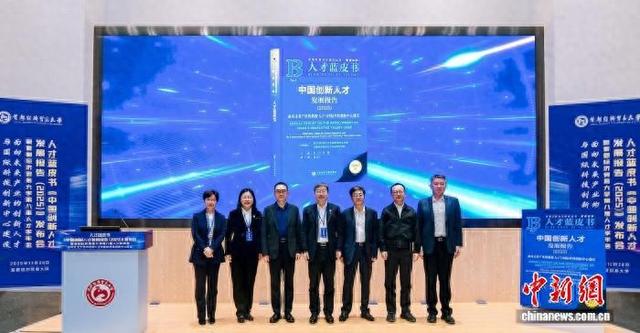
人才蓝皮书在京发布:中国创新人才发展指数总体运行良好
Zhong Guo Xin Wen Wang· 2025-12-28 13:21
Core Insights - The key to nurturing and expanding future industries lies in innovative talent development, as highlighted in the "Talent Blue Book: China Innovation Talent Development Report (2025)" released on December 28 [1][4] Group 1: Innovation Talent Development - The structure, scale, and development trends of China's innovative talent align with the needs of future industries, with a projected annual growth rate of 15.03% for the innovation talent development index from 2023 to 2025 [2][3] - The eastern region leads the country in innovation talent development index, with the Beijing-Tianjin-Hebei urban agglomeration showing a rising trend and the Yangtze River Delta urban agglomeration accelerating its growth [3][2] - The overall development of innovation talent in Beijing is positive, although attention is needed on the structural adjustments during the period of slowing growth [3][2] Group 2: Strategic Scientists and Research Directions - The number of strategic scientists, represented by academicians and winners of the National Highest Science and Technology Award, continues to grow, with a significant focus on future industries such as future health, materials, and manufacturing [2][3] - High-impact scientists and leading innovation groups are expanding, with a notable concentration of award winners in the future materials field located primarily in Beijing and the Yangtze River Delta [3][2] Group 3: Talent Evaluation and Supply System - A forward-looking, strategic, and dynamically adaptive talent evaluation system is urgently needed to better serve industrial upgrades and national strategic implementation, focusing on four core dimensions: innovation capability, quality, effectiveness, and contribution [6][7] - The report emphasizes the need to shift from a single education reform approach to a proactive supply logic that includes strategic guidance, pre-identification, type-based incubation, and dynamic adaptation [7] Group 4: Beijing's Talent Development Initiatives - Beijing has implemented measures to support the establishment of world-class new research and development institutions, with four institutions closely related to artificial intelligence established by June 2025 [9][10] - The Beijing General Artificial Intelligence Research Institute has developed a composite faculty structure and a collaborative training model to cultivate talent in the field of general artificial intelligence [9][10] - The Beijing Academy of Science and Intelligence focuses on integrating AI technology with scientific research, employing a comprehensive training model to develop the next generation of scientists and engineers [10][11]