
无人农场

Search documents
前荣耀AI实验室主任带队:用“超级大脑”接管农场,24小时不打烊
量子位· 2026-03-20 00:18
Core Viewpoint - The article discusses the innovative agricultural system called AlphaFarm, developed by Zhejiang Qiuwu Intelligent Technology, which aims to revolutionize farming by utilizing AI for autonomous decision-making and operations, addressing labor shortages and increasing agricultural efficiency [1][3][46]. Group 1: AlphaFarm Overview - AlphaFarm is described as the world's first autonomous decision-making unmanned farm system, capable of real-time monitoring and 100% autonomous execution [2][13]. - The system integrates advanced technologies, including a large agricultural language model (AgriLLM) and an iterative decision-reinforcement-cognition-optimization (IDRCO) engine, to enhance its decision-making capabilities [15][20]. Group 2: Team and Expertise - The founding team consists of experienced professionals from top tech companies and academic institutions, including AI veterans and experts in agriculture, which provides a strong foundation for the development of AlphaFarm [5][44]. - The team includes notable figures such as the founder Tang Yong, who has over 20 years of AI experience, and high-profile scientists who contribute to the system's academic rigor [5][44]. Group 3: Technological Innovations - AlphaFarm employs a multi-spectral inspection system that can analyze over 12 spectral bands for precise crop health diagnostics, achieving an accuracy rate of over 92% [26][27]. - The system's decision-making capabilities cover various agricultural scenarios, including planting planning, pest control, and real-time information retrieval, ensuring comprehensive support for farmers [21][24]. Group 4: Performance Metrics - The article highlights significant potential benefits of using AlphaFarm, including a reduction in labor costs by over 60%, an increase in operational efficiency by 3-5 times, and a yield improvement of 10-15% [49]. - AlphaFarm's evaluation framework, MAJE, assesses its performance across multiple dimensions, demonstrating its superiority over general AI models in agricultural decision-making [36][38][41]. Group 5: Future Aspirations - The ultimate goal of Qiuwu Intelligent Technology is to implement AlphaFarm across China's 1.8 billion acres of arable land, transforming the agricultural landscape through AI-driven solutions [51][54].

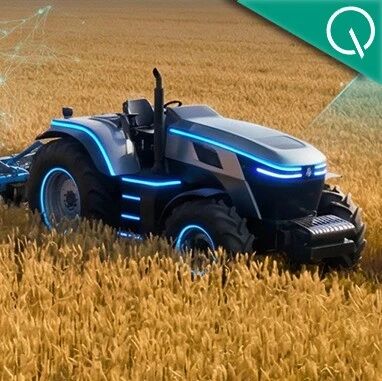
智慧农机深耕“无人农场” 勾勒中国农业新图景
Zhong Guo Xin Wen Wang· 2025-11-18 10:54
Core Insights - The article discusses the development of unmanned farms in China, highlighting the integration of advanced technologies to automate agricultural processes, thereby transforming traditional farming practices into a more efficient and precise model [1][3][4]. Group 1: Unmanned Farm Operations - An unmanned farm covering over 830 acres has been established in Zouping, Shandong, utilizing "space-ground integration" technology to achieve full automation in the cultivation, planting, management, and harvesting of crops like wheat and corn [1][3]. - The unmanned farm employs various irrigation systems and ground IoT devices, along with drones and remote sensing satellites, to monitor crop growth, soil moisture, weather conditions, and pest threats [1][3]. Group 2: Technological Advancements - The unmanned farm features five types of unmanned agricultural machines and ten types of smart equipment, enabling full-scene autonomous driving and operation [3][4]. - A three-dimensional perception network has been established using satellite remote sensing, drone surveillance, and ground sensors, allowing for automatic monitoring and diagnosis of agricultural conditions [3][4]. Group 3: Economic Impact - The implementation of unmanned farming has resulted in a reduction of labor by over 70%, a cost savings of at least 10%, and an increase in yield by no less than 5% [4][5]. - Farmers are increasingly adopting smart agriculture practices, with one farmer expanding his operations from 10 acres to 100 acres, benefiting from improved efficiency through the use of unmanned machinery [5]. Group 4: Future of Agriculture - The shift towards unmanned farms is seen as a response to the aging rural labor force, with technology attracting younger individuals to the agricultural sector [5]. - The article suggests that traditional farming roles may diminish as larger, more professionalized farms emerge, leading to a fundamental transformation in agricultural production methods [5].
