无人机产业

Search documents
空中\"货拉拉\"来了,无人机发展潜力巨大
Xuan Gu Bao· 2026-01-11 14:46
Group 1 - The "Tianma-1000" unmanned transport aircraft, developed by Xi'an Aisheng Technology Group, successfully completed its first flight test on January 11, demonstrating good flight data and capabilities [1] - The "Tianma-1000" integrates multiple functions such as logistics transport, emergency rescue, and material delivery, and is the first domestic model to adapt to high-altitude complex terrain, with a short takeoff distance of less than 200 meters and a maximum range of 1800 kilometers [1] - The Chinese civil drone market is experiencing high growth, with a projected market size of approximately 146.8 billion yuan in 2024 and expected to exceed 400 billion yuan by 2030, reflecting a compound annual growth rate of 18.3% from 2024 to 2030 [1] Group 2 - Inner Mongolia First Machinery Group holds a 4.2484% stake in Xi'an Aisheng Technology Group, as disclosed in its semi-annual report [2] - Aero Engine Corporation of China is focusing on developing a civil small and medium-sized aviation engine brand to support the first flight of the W5000 large cargo unmanned aircraft in the second half of 2025, aiming to capture the low-altitude logistics market [2]
中国无人机在美缺货,美国人为何对它“又爱又怕”?
吴晓波频道· 2025-06-28 17:33
Core Viewpoint - The article emphasizes China's dominant position in the global drone industry, highlighting its full-process manufacturing capabilities and the geopolitical implications of drone technology [7][10][40]. Group 1: Market Dynamics - DJI, a leading Chinese drone manufacturer, has faced challenges in the U.S. market, with its products disappearing from major retailers due to customs issues, despite holding 90% of the U.S. drone market share [1][4]. - The U.S. has implemented various restrictions on Chinese drones since 2017, citing data security concerns, which have escalated over the years [2][3]. - Despite these restrictions, DJI continues to dominate the U.S. market, indicating a complex relationship characterized by both fear and reliance [4][6]. Group 2: Industry Structure - The global drone supply chain is characterized by a "China-led, multi-country collaborative" model, with China controlling the entire process from R&D to production [8][12]. - China holds over 70% of global patent applications in the drone sector and dominates the production of key components such as lithium batteries and sensors [10][14]. - As of last year, China had approximately 14,000 drone companies, with a significant increase in registered products, showcasing rapid industry growth [12][16]. Group 3: Military Applications - China's military drone capabilities are advancing, with the potential to switch civilian production lines to military use within 48 hours, and an estimated annual production capacity of 30 million military drones [25][26]. - The article notes that while China leads in many aspects of drone technology, other countries like the U.S. and Israel also possess advanced military drone capabilities [40]. - The ongoing conflicts in regions like Ukraine and the Middle East have accelerated the innovation and deployment of military drones, demonstrating the evolving nature of warfare [28][29]. Group 4: Geopolitical Implications - The article discusses the tension between China's dominant supply chain position and the U.S. and its allies' desire for technological independence, leading to efforts to control critical components [17][19]. - Despite attempts at decoupling, the U.S. still finds it challenging to procure drones without relying on Chinese components, indicating the depth of China's integration into the global supply chain [18][40]. - The article concludes that the future of warfare will be defined by industrial strength across the entire supply chain, from raw materials to advanced algorithms [41].


【行业前瞻】2025-2030年全球及中国低空物流行业发展分析
Sou Hu Cai Jing· 2025-05-30 11:49
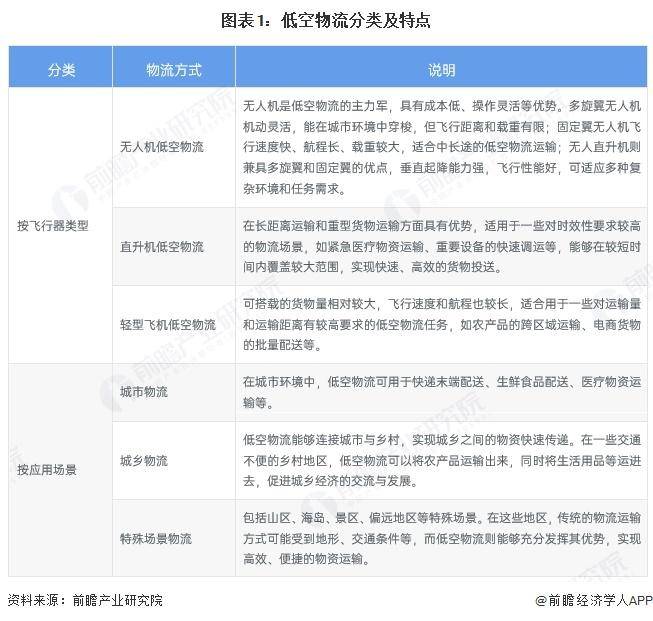
Core Viewpoint - The low-altitude economy, driven by both manned and unmanned aerial vehicles, is emerging as a significant sector in China, supported by government policies aimed at fostering its development [2][4]. Group 1: Definition and Industry Overview - The low-altitude economy encompasses a series of economic activities primarily utilizing aviation equipment and technologies, focusing on low-altitude airspace and low-altitude flight activities [1]. - The low-altitude logistics industry is a segment of the low-altitude economy, involving cargo transportation and related economic activities, primarily using manned and unmanned aerial vehicles [1]. Group 2: Policy Direction - The Chinese government has introduced multiple policies to support and regulate the drone industry, which is a key driver of the low-altitude economy's high-quality development [2]. - In 2024, the Chinese Premier highlighted the importance of developing the low-altitude economy in the government work report, marking its first inclusion in such a document [2]. Group 3: Policy Details - Various policies have been enacted, including the Civil Aviation Administration's roadmap for smart civil aviation, which aims to establish a management system for unmanned aerial vehicles by 2025 and a fully integrated operation system by 2030 [3]. - The Ministry of Industry and Information Technology has set guidelines for the development of civil unmanned aerial vehicles, emphasizing safety and regulatory compliance [4]. Group 4: Global Development Trends - The global low-altitude logistics industry is rapidly evolving, driven by increasing traffic congestion and advancements in drone technology, leading to significant market growth [5]. - The development stages of the global low-altitude logistics industry include an initial exploration phase, a preliminary development phase, and a current rapid development phase characterized by technological advancements and increased commercial applications [7]. Group 5: eVTOL Market Insights - The eVTOL (Electric Vertical Take-off and Landing) market has seen over 1000 concept products developed globally, with significant interest from various design institutions, although only a few companies have reached the certification stage [8].