无线短距通信技术

Search documents
上海星闪开放实验室落子青浦
Ge Long Hui· 2026-01-03 23:56
Core Viewpoint - The establishment of the Shanghai NearLink Open Laboratory marks a significant step in Shanghai's autonomous innovation ecosystem in the field of wireless short-range communication, highlighting advancements in technology and collaboration within the industry [1] Group 1: Technology Development - NearLink is a new generation wireless short-range communication technology brand independently developed in China, with standards set by the Ministry of Industry and Information Technology [1] - The technology shows significant improvements in transmission performance and device compatibility compared to traditional technologies like Bluetooth, applicable in smart vehicles, industrial intelligence, and smart home scenarios [1] Group 2: Collaboration and Ecosystem - The Shanghai NearLink Open Laboratory represents a deepening collaboration between Midea and the Shanghai HiSilicon industrial chain, serving as a core platform for building an international NearLink alliance and its industrial ecosystem [1] - The laboratory integrates common technology research and development, testing certification services, and ecosystem cultivation and empowerment [1] Group 3: Regional Innovation Growth - During the 14th Five-Year Plan period, the innovation and entrepreneurship density in Qingpu District has been continuously increasing, with social R&D expenditure averaging a growth of 19.2% over the past five years, projected to exceed 6.5 billion yuan in 2024 [1]
蓝牙和Wi-Fi之外,中国原生短距通信技术“星闪”加速商业化
Mei Ri Jing Ji Xin Wen· 2025-11-07 09:27
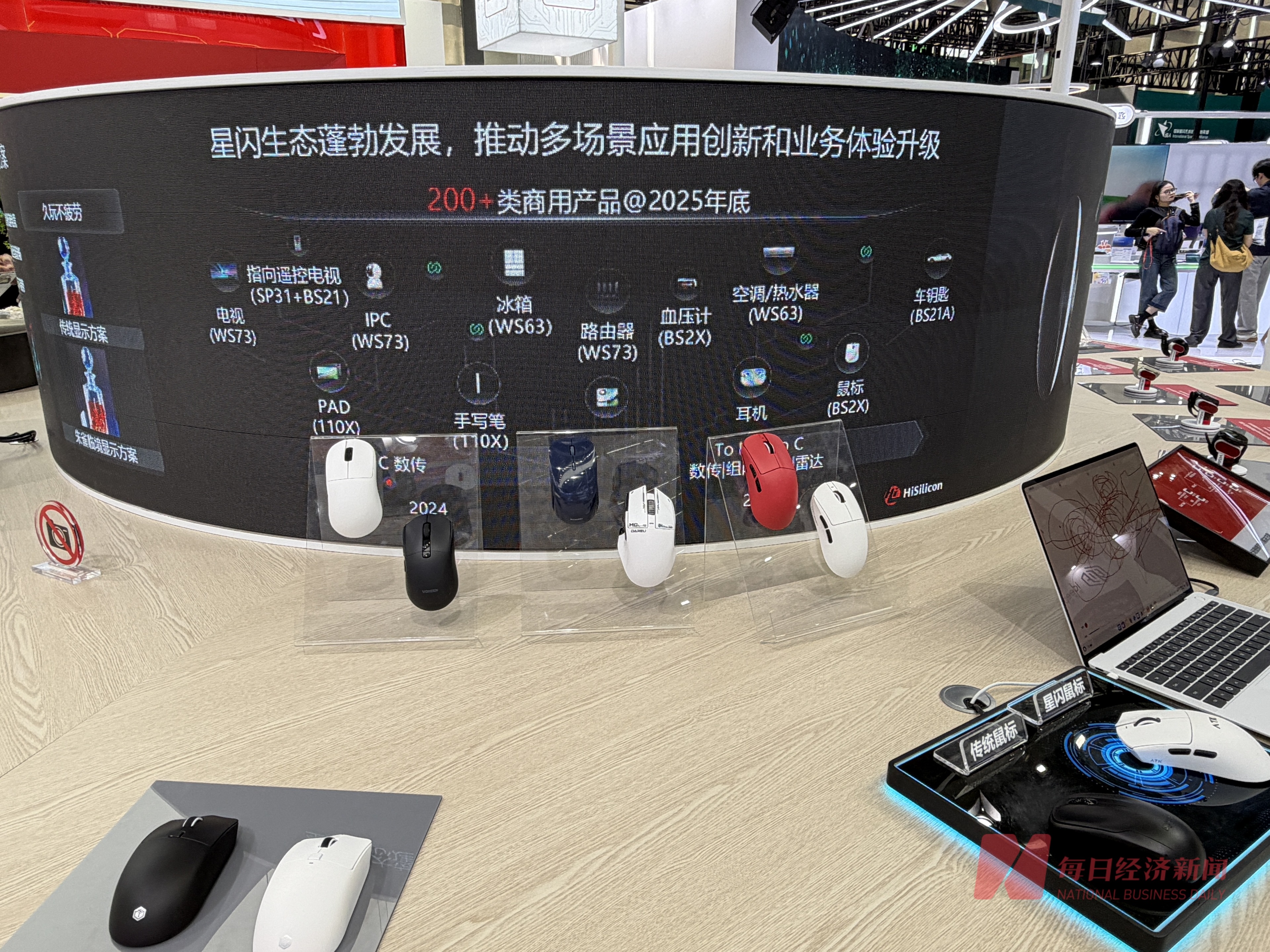
Core Viewpoint - The 2025 Consumer Electronics Innovation Conference (CEIC 2025) highlighted Huawei's advancements in the HarmonyOS and the introduction of the StarFlash technology, which aims to revolutionize short-range wireless communication, competing with existing technologies like Bluetooth and Wi-Fi [1]. Group 1: HarmonyOS and StarFlash Technology - Huawei's HarmonyOS has become a digital foundation for various industries transitioning into an intelligent society, with the latest version, HarmonyOS 6, introducing features like intelligent focus and smart capabilities [1]. - StarFlash is a new generation of short-range wireless communication technology developed in China, designed to integrate the advantages of Bluetooth and Wi-Fi, offering two communication interfaces: SLB for low latency and high reliability, and SLE for low power consumption [1]. - StarFlash technology boasts energy consumption at 60% of Bluetooth's, speeds over six times faster than Bluetooth, and supports ten times the number of terminal connections compared to Bluetooth [1]. Group 2: Applications and Market Potential - StarFlash technology is already being utilized in various devices, including keyboards, mice, smartwatches, and home appliances, with applications expanding rapidly [4]. - In high-reliability fields such as aerospace and industrial environments, StarFlash has replaced traditional cable connections, enhancing efficiency and reducing weight [4]. - The digital car key using StarFlash technology is expected to be a significant application in the next three years, offering improved accuracy and reduced costs compared to traditional solutions [4]. Group 3: Commercialization and Future Outlook - The expected shipment of StarFlash chips is projected to exceed 200 million units by the end of 2023, indicating a strong commercial push [4]. - Despite the promising technology, StarFlash currently has a low penetration rate compared to Bluetooth and Wi-Fi, with Bluetooth device shipments expected to reach 4.7 billion units in 2024 [5]. - The goal for StarFlash is to achieve what Bluetooth and Wi-Fi have accomplished over 20 years within the next decade, with aspirations for international expansion [5].