星闪(NearLink)

Search documents
上海星闪开放实验室落子青浦
Ge Long Hui· 2026-01-03 23:56
Core Viewpoint - The establishment of the Shanghai NearLink Open Laboratory marks a significant step in Shanghai's autonomous innovation ecosystem in the field of wireless short-range communication, highlighting advancements in technology and collaboration within the industry [1] Group 1: Technology Development - NearLink is a new generation wireless short-range communication technology brand independently developed in China, with standards set by the Ministry of Industry and Information Technology [1] - The technology shows significant improvements in transmission performance and device compatibility compared to traditional technologies like Bluetooth, applicable in smart vehicles, industrial intelligence, and smart home scenarios [1] Group 2: Collaboration and Ecosystem - The Shanghai NearLink Open Laboratory represents a deepening collaboration between Midea and the Shanghai HiSilicon industrial chain, serving as a core platform for building an international NearLink alliance and its industrial ecosystem [1] - The laboratory integrates common technology research and development, testing certification services, and ecosystem cultivation and empowerment [1] Group 3: Regional Innovation Growth - During the 14th Five-Year Plan period, the innovation and entrepreneurship density in Qingpu District has been continuously increasing, with social R&D expenditure averaging a growth of 19.2% over the past five years, projected to exceed 6.5 billion yuan in 2024 [1]
破界·共生·领航:星闪2025技术跃升与生态爆发新图景
艾瑞咨询· 2025-12-29 00:05
Core Viewpoint - The article emphasizes the transformative impact of NearLink technology in the wireless short-range communication sector, highlighting its role in enhancing connectivity across various applications, including smart homes, consumer electronics, and automotive electronics [1][3]. Group 1: Technological Advancements - In March 2025, the International NearLink Alliance released the 2.0 standard, which includes new core specifications for audio transmission and integrated sensing, establishing a comprehensive end-to-end protocol system [4]. - The technology boasts a low latency of 0.25 milliseconds, which is 1/30 of traditional technologies, and a transmission rate of 12 Mbps, enabling lossless audio transmission and improved performance in interference-prone environments [5][4]. - The release of two national standards in December 2025 marks a significant advancement in the NearLink technology standard system, promoting the standardized development and large-scale application of the new generation of wireless short-range communication [4]. Group 2: Ecosystem Expansion - NearLink has achieved a shipment of over 100 million devices by September 2025, validating its commercial value, with over 1,200 alliance members and more than 600 commercial products [2][7]. - The ecosystem is supported by over 300 chip module development boards, facilitating the integration of NearLink technology into various consumer products, thus enhancing user experience across multiple categories [7]. - The collaboration with over 100 developer partners, along with the provision of SDKs and development tools, has lowered the barriers for product development and fostered a positive feedback loop of industry growth and innovation [7]. Group 3: Application in Smart Homes - NearLink technology has entered a phase of product proliferation and commercial explosion in the smart home sector, with a range of devices including smart TVs, air conditioners, and routers leveraging its capabilities [13]. - The integration of NearLink in smart TVs has addressed traditional pain points such as imprecise operation and lag, enhancing user interaction and earning innovation awards [14]. - The smart air conditioning solutions utilizing NearLink technology provide personalized comfort by accurately sensing human presence, setting a benchmark for the industry [16]. Group 4: Application in Consumer Electronics - NearLink is driving innovation in wireless audio, wearable devices, and peripherals, enhancing user experience through high bandwidth and low latency [21]. - The audio solution developed with NearLink technology supports high-definition audio transmission and significantly improves connection stability and interference resistance [22]. - The introduction of NearLink in wearable devices, such as the Huawei WATCH 5, enhances interaction capabilities and integrates seamlessly with smart home devices [24]. Group 5: Application in Automotive Electronics - NearLink technology addresses key pain points in automotive wireless connectivity, enhancing precision and reliability in user interactions [32]. - The digital key solution utilizing NearLink technology significantly improves location accuracy and connection stability, gaining traction among major automotive manufacturers [33]. - The integration of NearLink in vehicle remote controls enhances user experience by providing precise and responsive control in dynamic environments [35]. Group 6: Future Outlook - The focus for NearLink in 2026 will be on transitioning from consumer-level applications to industrial-level scenarios, emphasizing the dual collaboration of technology capability and ecosystem facilitation [39]. - The strategy includes deepening user experience in existing sectors while expanding into new industrial applications, ensuring that NearLink evolves into a foundational technology for the Internet of Things [41][42].


星闪:让万物互联“飙”进未来
Xin Lang Cai Jing· 2025-12-26 16:58
Core Viewpoint - The article highlights the emergence of "NearLink," a Chinese-developed short-range wireless communication technology that significantly enhances connectivity and performance for smart devices, addressing the limitations of existing technologies like Bluetooth and Wi-Fi [2][3]. Group 1: Technology Development - NearLink was initiated in 2020 by the Ministry of Industry and Information Technology, gathering over 400 organizations, including Huawei and China Mobile, to develop a faster, more responsive, energy-efficient, and stable short-range communication technology [2]. - The first technical standard for NearLink was published in 2022, and in 2023, Huawei launched the first terminal product supporting NearLink, enabling high-quality lossless audio transmission [3]. Group 2: Performance Metrics - NearLink operates in two modes: one for low-power scenarios with transmission speeds six times faster than traditional Bluetooth, and another for high-speed needs capable of transmitting 8K ultra-high-definition video [4]. - The latency of NearLink can reach as low as 20 microseconds, making it 1500 times faster than traditional Bluetooth and 500 times faster than Wi-Fi, surpassing human neural response speed [4]. Group 3: Application Scenarios - NearLink can connect up to 4096 devices simultaneously, significantly outperforming traditional Wi-Fi routers, which can only handle 32 devices [6]. - In smart home applications, devices using NearLink can operate seamlessly without interference, even in environments with many connected devices [6]. Group 4: Energy Efficiency - NearLink is designed to be energy-efficient, consuming 60% less power than traditional Bluetooth and 80% less than Wi-Fi, leading to extended battery life for devices [8]. - For instance, smartwatches equipped with NearLink can have their battery life extended by 30%, and industrial sensors can see battery life increase from three months to eight months [8]. Group 5: Industry Impact - In the automotive sector, NearLink enhances vehicle key functionalities, improving accuracy and responsiveness for features like automatic unlocking and guest welcome [10]. - In industrial applications, NearLink facilitates real-time data transmission, significantly reducing operational delays and improving efficiency in manufacturing and healthcare settings [11]. Group 6: Future Prospects - To achieve widespread adoption comparable to Bluetooth and Wi-Fi, NearLink needs to expand its ecosystem and reduce costs, as the current chip price is approximately 15 yuan, nearly double that of traditional Bluetooth chips [12]. - The anticipated reduction in chip costs by 30% by 2026 is expected to make NearLink more accessible to consumers and encourage broader adoption across various device categories [12].
星闪应用前景广阔上市公司争相布局
Xin Hua Wang· 2025-08-12 05:48
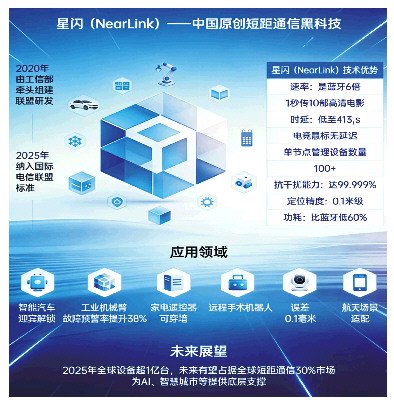
Core Viewpoint - Huawei's new wireless communication technology, NearLink (Star Flash), is gaining significant market attention due to its innovative features and potential applications in various industries, including consumer electronics and smart homes [1][2]. Group 1: Technology Overview - NearLink is a new wireless communication standard that combines the advantages of Bluetooth and WiFi, offering lower latency, reduced power consumption, and higher connection capacity [2][3]. - Compared to traditional wireless technologies, NearLink reduces power consumption by 60%, increases data transmission speed by six times, lowers transmission latency to 1/30 of previous standards, and supports up to 4096 device connections [2][3]. Group 2: Industry Impact and Adoption - The Star Flash Alliance, which has over 300 member companies, is pushing for the industrialization of NearLink technology, with several companies already making significant advancements in product development [1][5]. - Companies like Jiulian Technology and Chuangyao Technology are actively developing products that incorporate NearLink technology, with applications in smart home devices and high-performance wireless terminals [5][6]. Group 3: Future Prospects - 2023 is identified as the commercial launch year for NearLink, with expectations for a significant increase in device deployment in 2024 [5]. - The technology is anticipated to become a mainstream wireless communication standard, particularly in areas such as smart home devices, high-fidelity audio, and automotive applications [6][7].

晚报 | 6月25日主题前瞻
Xuan Gu Bao· 2025-06-24 14:41
Group 1: NearLink Technology - NearLink is a new generation of short-range wireless communication technology from China, aiming to innovate in short-distance communication and industry ecology [1] - The Star Flash SLE national standard is expected to be officially released this year, and the Star Flash SLB technology has become the only wireless technology that meets multi-channel high-definition video transmission requirements [1] - The technology has six leading capabilities: low latency, high throughput, high concurrency, high reliability, anti-interference, and precise positioning, positioning it to compete with Bluetooth and Wi-Fi [1] Group 2: AI in Education - AI-assisted college entrance examination volunteer filling services are gaining popularity, leveraging data and intelligent advantages to provide personalized decision support for students [2] - Over 10 million users utilized AI volunteer assistants on the day results were announced last year, with expectations for significant growth in users this year [2] - The trend towards AI volunteer filling represents information equality, benefiting companies involved in this sector [2] Group 3: AI and AR Glasses - The world's first mass-produced consumer-grade AI+AR glasses, Rokid Glasses, have officially started production with 250,000 pre-orders [3] - The glasses weigh approximately 49 grams and feature Qualcomm's Snapdragon AR1 platform, integrating various AI models for functionalities like real-time translation and smart prompting [3] - IDC predicts that global AR device shipments will exceed 40 million units by 2025, with the consumer market accounting for over 60% [3] Group 4: Rare Earth Research - A Chinese research team has successfully synthesized rare earth triple-bond compounds, challenging traditional understandings of rare earth element bonding capabilities [4] - This breakthrough provides new experimental evidence and theoretical support for the development of rare earth chemistry [4] Group 5: Financial Technology Initiatives - The People's Bank of China has introduced a three-year action plan to enhance financial technology, focusing on data utilization to support financial digital transformation [5] - The plan aims to guide financial institutions in leveraging vast data resources to enhance their foundational capabilities [5] Group 6: Chemical Industry Trends - The chemical sector is experiencing increased activity due to rising prices of H-acid and active dyes, alongside stricter environmental regulations [6] - Companies in the dye and chemical sectors are seeing stock price increases, with expectations for a rebound in demand and pricing in the second half of the year [6] Group 7: Macro and Industry News - A grand military parade featuring domestically produced main battle equipment will take place on September 3, showcasing advancements in traditional and new combat capabilities [6] - The Ministry of Commerce has announced initiatives to promote the consumption of new energy vehicles, integrating various automotive market activities [6] - The World Economic Forum's 2025 New Champions Annual Meeting is being held in Tianjin, focusing on renewable energy development and smart grid investments [7]