星座

Search documents
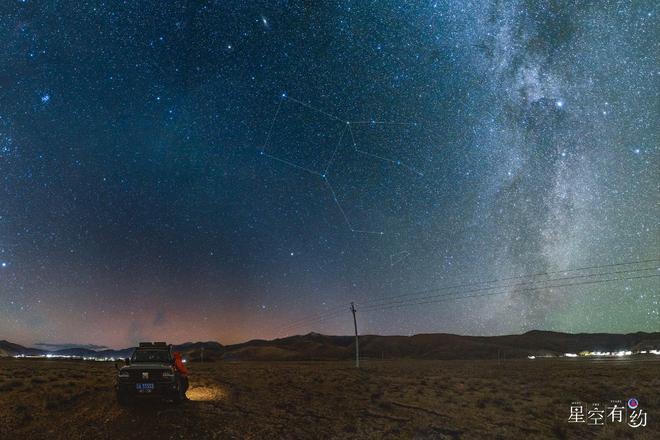
星空有约丨丙午马年看“天马行空”
Xin Hua She· 2026-02-17 08:47
Group 1 - The article discusses various constellations and celestial bodies related to the theme of "horse," particularly highlighting Pegasus, Equuleus, Sagittarius, and Centaurus [1][2] - Pegasus is noted for its prominent quadrilateral shape formed by stars from Andromeda and Pegasus, symbolizing the autumn night sky [1] - Equuleus, the second smallest constellation, is less visible and best observed in areas with low light pollution [1] - Sagittarius is mentioned as a region with a high concentration of deep-sky objects, including 15 Messier objects, the highest among all constellations [1] - Centaurus is home to Proxima Centauri, the closest known star to the solar system [1] Group 2 - The article also mentions other horse-related celestial bodies, such as the Horsehead Nebula in Orion and the Blue Horsehead Nebula in Scorpius [2] - The article emphasizes that the Spring Festival holiday is an excellent time to observe these horse-related constellations and celestial bodies, although some may not be visible due to seasonal changes [2] - Understanding and recognizing these "steeds" of the universe during the Year of the Horse is presented as a meaningful activity, regardless of visibility [2]

星空有约|丙午马年看“天马行空”
Xin Hua She· 2026-02-17 08:31
Group 1 - The article introduces various constellations and celestial bodies related to "horses," particularly focusing on Pegasus, Equuleus, and Sagittarius [1][3][10] - Pegasus is highlighted as a prominent constellation in the autumn sky, forming a quadrilateral known as the "Autumn Quadrilateral" with stars from Andromeda and Pegasus [1][3] - Equuleus, the second smallest constellation, is less noticeable in the autumn sky and is best observed in areas with low light pollution [3][6] - Sagittarius is noted for its proximity to the Milky Way's center, which contains numerous deep-sky objects, ranking first in the number of Messier objects among all constellations [3][6] Group 2 - The article mentions other horse-related celestial bodies, such as the Horsehead Nebula in Orion and the Blue Horsehead Nebula in Scorpius [9] - The article emphasizes that the Spring Festival holiday is an excellent time to observe constellations like Centaurus and the Horsehead Nebula, while Pegasus and Sagittarius are not currently visible due to seasonal changes [10]

冬季“星空大戏”的黄金时段来了 这份观赏指南请查收!
Xin Hua She· 2026-01-22 02:30
Core Points - The winter night sky offers a spectacular view with numerous bright stars, making it an ideal time for stargazing [1][3] - The "Winter Triangle" and "Winter Diamond" are prominent star patterns visible in the northern hemisphere, featuring some of the brightest stars [3][5] - The Orion constellation, particularly the Orion Nebula, plays a significant role in the winter sky, serving as a region for star formation [6][9] Group 1 - The winter sky in the northern hemisphere has the highest number of visible bright stars, with over ten stars of magnitude two or brighter [3] - The "Winter Triangle" consists of Sirius, Procyon, and Betelgeuse, which are among the ten brightest stars in the sky [3] - The "Winter Diamond" includes stars such as Sirius, Procyon, and Betelgeuse, showcasing a mix of different types of stars [5] Group 2 - Jupiter's position in the Gemini constellation enhances the winter sky's appeal, as it joins the prominent stars in the "Winter Diamond" [5] - The Orion constellation, particularly its belt, is a key feature of the winter sky, with the Orion Nebula being a notable area for new star formation [6][9] - The timing of star visibility changes slightly each day, with stars rising approximately four minutes earlier each day, affecting their visibility in different lunar months [9]

月薪3000,花2000改命,玄学怎么收割了年轻人?丨2025年轻人玄学消费报告
后浪研究所· 2025-07-31 07:59
Core Viewpoint - The article highlights a significant shift in the priorities of young people, with a focus on career and financial success over romantic relationships, indicating that 76.5% seek career luck and 74.9% seek financial luck, while only 49.6% seek love luck [2][3][4]. Group 1: Young People's Aspirations - The most desired fortunes among young people are career luck (76.5%) and financial luck (74.9%), while only 49.6% are interested in love luck [3][4]. - There is a notable gender difference in belief in metaphysics, with females showing a higher average belief score (6.73) compared to males (5.95) [5][6]. - Females are generally more proactive in seeking fortunes related to career and finance, while males show more interest in health and family matters [6][8]. Group 2: Metaphysical Trends - The three dominant areas of metaphysics among young people are Bazi (Chinese astrology), Western astrology, and Tarot, with Bazi being the most popular at 60% [11][12]. - Interest in metaphysical practices has been increasing, with a significant rise in temple visits and Tarot readings [11][12]. - Young people often engage with metaphysical content through platforms like Xiaohongshu, Bilibili, and Douyin, with Xiaohongshu being the most popular source (63%) [21][22]. Group 3: Spending on Metaphysics - Approximately 60% of young people have an annual budget for metaphysical spending of less than 500 yuan, while 20% spend over 1000 yuan [29][30]. - Common purchases include temple bracelets (50.8%), prayer pendants (38.6%), and energy crystals (30.1%), indicating a growing market for metaphysical products [31][32]. - The trend of metaphysical-themed merchandise is on the rise, with brands incorporating metaphysical elements into their marketing strategies [33][34]. Group 4: Psychological Aspects - The primary motivation for seeking metaphysical guidance is to alleviate stress and anxiety, with 70% of young people indicating this as a reason [37][38]. - The need for anxiety relief is particularly pronounced among the post-95 generation, followed by the post-00 generation [40][41]. - Metaphysical practices are increasingly viewed as a form of psychological support, helping individuals regain confidence and cope with uncertainties in life [57].