
星际天体观测

Search documents
新闻速递 | 天问一号成功观测星际天体阿特拉斯
Ren Min Ri Bao· 2025-11-16 22:12
Group 1 - The Tianwen-1 orbiter successfully observed the interstellar object Atlas (3I/ATLAS) from a distance of approximately 30 million kilometers, making it one of the closest spacecraft to observe this celestial body [1] - Atlas is the third known interstellar object to visit the solar system, traveling on a hyperbolic trajectory, and is estimated to be between 3 billion and 11 billion years old, potentially older than the solar system itself [1] - The Tianwen-1 team began preparations for the observation in early September, utilizing the orbiter's high-resolution camera and carefully designing the imaging strategy to successfully complete the observation [1] Group 2 - The documentary series "Lost Sleep," consisting of six episodes, has been broadcast on CCTV Documentary Channel, exploring the science of sleep [2] - The series features insights from over 40 experts in sleep medicine, neuroscience, psychology, and clinical medicine, presenting rigorous scientific experiments, real patient cases, and vivid imagery to reveal the mysteries of sleep [2] - Topics covered include the neural mechanisms of the brain, everyday sleep issues, the mysterious world of dreams, and the deadly risks of sleep apnea [2]
首个、首座、首次!本周,中国硬核实力再刷屏
Yang Shi Xin Wen· 2025-11-06 22:49
Group 1: Aerospace and Technology Breakthroughs - China's Tianwen-1 spacecraft has successfully observed the interstellar object Atlas, marking the first time a Chinese spacecraft has achieved this feat. The spacecraft was approximately 30 million kilometers away from the target during the observation [3][4] - The successful observation of Atlas is considered an important expansion task for Tianwen-1, which will aid in technical trials for asteroid exploration by Tianwen-2 [3] Group 2: Infrastructure Developments - The Tongling Yangtze River Bridge, the world's first double-layer cable-stayed and suspension collaborative system bridge, officially opened on November 6. The bridge spans 11.88 kilometers with a main span of 988 meters, serving both rail and road traffic [5] - The opening of the bridge enhances the regional river crossing capacity and allows for uninterrupted high-speed travel along the 641-kilometer G3 Jing-Tai Expressway in Anhui [5] Group 3: Marine and Environmental Innovations - China's Ministry of Natural Resources has released the world's first multi-modal large model for deep-sea habitats, named "Intelligent Cognition and Exploration Multi-modal Model for Deep-sea Habitats," which is a significant outcome of the United Nations' "Decade of Ocean Science" initiative [8] - This model features intelligent perception of deep-sea habitats, comprehensive intelligent simulation, governance decision-making solutions, and immersive cognitive navigation [8] Group 4: Navigation and Satellite Industry Growth - The China Satellite Navigation Association reported a strong growth trend in the BeiDou industry, with a steady increase in the comprehensive index and expanding application penetration across multiple fields [9] - By the end of 2024, China is expected to have 50 BeiDou navigation satellites in orbit, including 15 BeiDou-2 satellites and 35 BeiDou-3 satellites, marking a new phase of marketization, industrialization, and internationalization for the BeiDou system [9] - Currently, 88 BeiDou sounding stations in China are connected to the global meteorological data exchange system, contributing to global weather forecasting with "Chinese precision" [9]


天问一号成功观测星际天体阿特拉斯
Xin Hua She· 2025-11-06 04:36
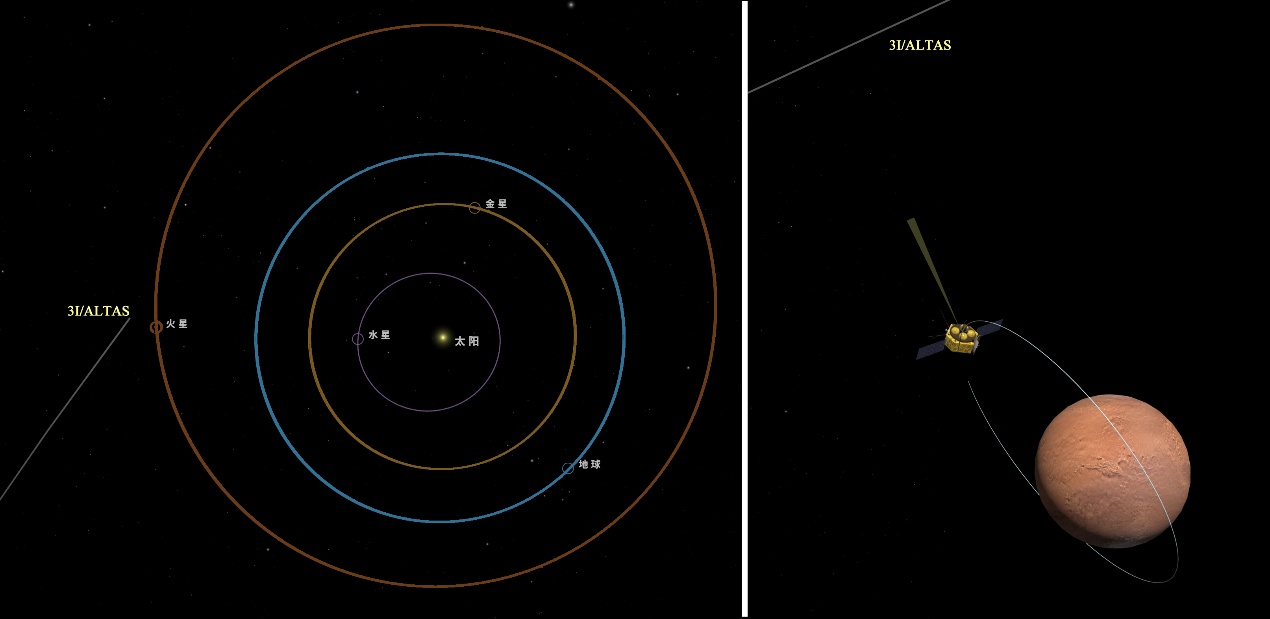
Core Viewpoint - The Tianwen-1 orbiter successfully observed the interstellar object ATLAS using a high-resolution camera, marking a significant achievement in space exploration [1] Group 1: Observation Details - The Tianwen-1 orbiter was approximately 30 million kilometers away from ATLAS during the observation, making it one of the closest spacecraft to observe this celestial body [1] - The high-resolution camera captured images showing distinct cometary features of ATLAS, including its nucleus and surrounding coma, with a diameter of several thousand kilometers [1] - Researchers created an animation of ATLAS's trajectory using a series of images taken over 30 seconds, enhancing the understanding of the object's movement [1] Group 2: Mission Status - The Tianwen-1 probe entered Mars orbit in February 2021 and has been operating stably for over four years, indicating good operational status [1]
天问一号成功观测到星际天体阿特拉斯
Zhong Guo Xin Wen Wang· 2025-11-06 00:17
Core Points - The Tianwen-1 orbiter successfully observed the interstellar object Atlas (3I/ATLAS) using a high-resolution camera, marking a significant achievement in space exploration [1][2] - The observation was conducted at a distance of approximately 30 million kilometers, making Tianwen-1 one of the closest spacecraft to observe this celestial body [1][3] Group 1: Observation Details - The high-resolution camera captured images showing distinct cometary features of Atlas, which has a diameter of several thousand kilometers [2] - The observation involved a series of images taken over 30 seconds, which were compiled into an animation to illustrate the object's trajectory [2] - The successful observation of Atlas serves as an important expansion task for Tianwen-1, providing technical experience for future asteroid exploration missions [3] Group 2: Scientific Significance - Atlas is the third known interstellar object to visit the solar system, believed to have formed around ancient stars in the Milky Way, with an estimated age of 3 to 11 billion years [3] - The object is considered a rare sample for studying the composition, evolution, and early stellar history of exoplanets, highlighting its significant scientific value [3] Group 3: Technical Challenges - The observation posed significant challenges due to the object's great distance (approximately 30 million kilometers), high relative speed (about 58 kilometers per second), and small size (nucleus diameter of about 5.6 kilometers) [4] - The Tianwen-1 team had to develop advanced imaging strategies and conduct extensive simulations to successfully capture images of such a faint target, which is 10,000 to 100,000 times dimmer than the Martian surface [7]
新华社权威快报|你好,阿特拉斯!天问一号成功观测星际天体
Xin Hua She· 2025-11-06 00:11
Core Points - The Tianwen-1 orbiter successfully observed the interstellar object ATLAS using a high-resolution camera, marking one of the closest observations of the object at approximately 30 million kilometers away [1] - The high-resolution camera captured images showing distinct cometary features of ATLAS, including its nucleus and surrounding coma, with a diameter of several thousand kilometers [1] - Researchers are utilizing a series of images taken over 30 seconds to create an animation that illustrates the motion trajectory of ATLAS, facilitating further in-depth studies of the object [1] Group 1 - The Tianwen-1 probe has been in stable operation for over four years since entering Mars orbit in February 2021, indicating its good operational status [2]
我国航天器首次观测到星际天体!天问一号传回新照片
Yang Shi Xin Wen· 2025-11-06 00:04
Core Insights - The Tianwen-1 orbiter successfully observed the interstellar object Atlas, marking the first time a Chinese spacecraft has observed such a celestial body [1] - Atlas is the third known interstellar object to visit the solar system, with an estimated age of 3 to 11 billion years, potentially older than the solar system itself, making it a rare sample for studying exoplanet composition and early stellar history [1] - The observation was a significant extension of the Tianwen-1 mission, providing valuable experience for future asteroid exploration with Tianwen-2 [1][2] Group 1 - The Tianwen-1 team began preparations for the Atlas observation in early September, facing challenges due to the object's distance of approximately 30 million kilometers and its high speed of about 58 kilometers per second [2] - The observation required advanced control of the orbiter's attitude and imaging strategy, as Atlas is significantly dimmer than Mars, being 10,000 to 100,000 times darker [2] - The high-resolution camera on Tianwen-1, originally designed for bright Mars surface imaging, was successfully adapted for this challenging observation task [2] Group 2 - The Tianwen-1 probe has been in stable operation since entering Mars orbit in February 2021, with a total operational duration of 4 years and 8 months [3]