天问一号探测器

Search documents
翟玉成:美国该卸下对华太空合作的包袱了
Huan Qiu Wang· 2025-12-23 23:05
Core Viewpoint - The article argues that it is time for the U.S. to lift the "Wolf Amendment," which has severely harmed U.S. space security and future collaboration with China in space exploration [1][2]. Group 1: Impact of the Wolf Amendment - The Wolf Amendment, enacted in 2011, prohibits any joint research activities between the U.S. and China related to NASA, effectively halting U.S.-China space cooperation and limiting academic exchanges [1][2]. - The amendment has led to significant restrictions, such as preventing Chinese students from obtaining visas to study in the U.S. and barring NASA researchers from responding to emails from Chinese domains [1][2]. Group 2: China's Achievements in Space - Over the past decade, China has made significant advancements in its space program, including the successful deployment of the BeiDou navigation system, the completion of the Tiangong space station, and the successful Mars missions with the Tianwen-1 and Zhurong rover [2]. - These achievements demonstrate China's growing capabilities in space and have altered the balance of power in space exploration between the U.S. and China [2]. Group 3: U.S. Domestic Reflection - There is a growing recognition among some U.S. voices that the Wolf Amendment has failed to achieve its intended goals of slowing China's space program and has instead hindered U.S. technological leadership in space [2][3]. - Former NASA Administrator Charles Bolden has pointed out that the amendment has not succeeded in its objectives, reflecting a shift in some U.S. perspectives on space cooperation with China [2]. Group 4: Need for Cooperation - The article emphasizes that both the U.S. and China, as major space powers, have mutual interests in space cooperation, including information sharing, debris mitigation, and rule-making [4]. - It advocates for the removal of barriers to cooperation, suggesting that genuine collaboration would benefit both nations and humanity as a whole [4].
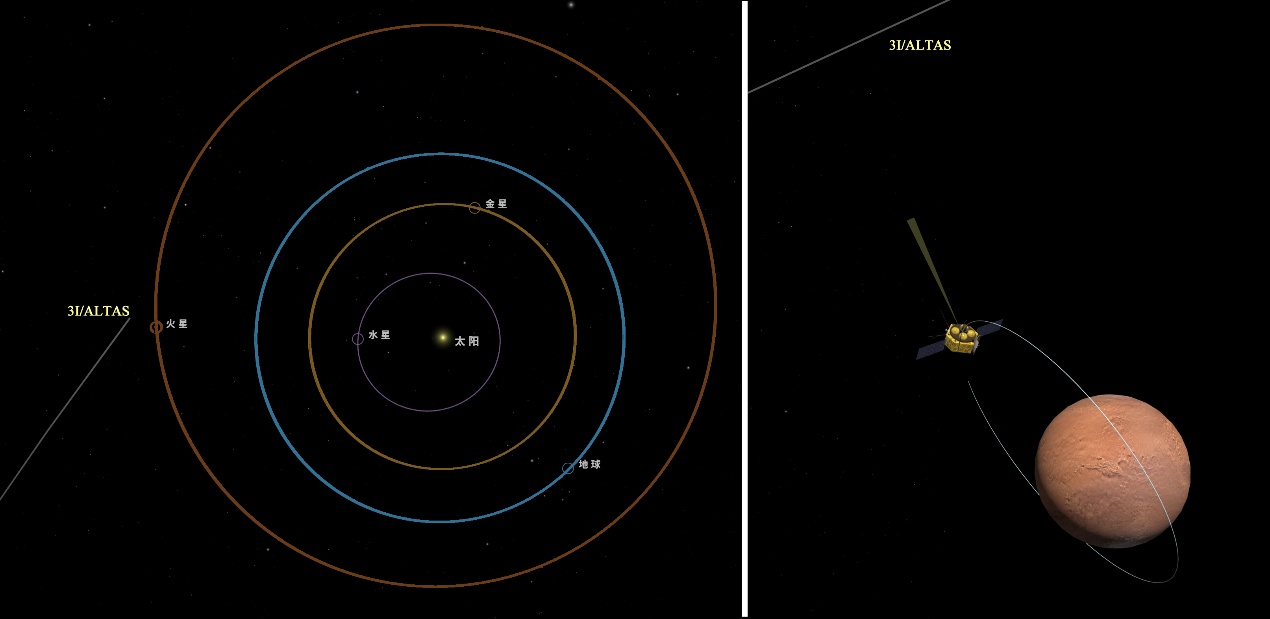
天问一号成功观测到星际天体阿特拉斯
财联社· 2025-11-06 00:19
Core Viewpoint - The successful observation of the interstellar object ATLAS by the Tianwen-1 orbiter represents a significant expansion of its mission capabilities, providing valuable data for future asteroid exploration by Tianwen-2 [2][8]. Group 1: Observation Details - The Tianwen-1 orbiter utilized a high-resolution camera to observe the interstellar object ATLAS from approximately 30 million kilometers away, marking one of the closest observations of this celestial body [2][8]. - The high-resolution camera captured images that clearly displayed the comet-like features of ATLAS, which has a diameter of several thousand kilometers [4]. - A series of images taken over 30 seconds were compiled into an animation to illustrate the motion trajectory of ATLAS, aiding in further research [4]. Group 2: Scientific Significance - ATLAS, discovered on July 1, 2025, by a telescope in Chile, is the third known interstellar object to visit the solar system, traveling on a hyperbolic trajectory [9]. - The object is estimated to be between 3 billion and 11 billion years old, potentially older than the solar system itself, making it a rare sample for studying the composition and evolution of exoplanets and early stellar history [9]. - The Tianwen-1 team began preparations for observing ATLAS in early September, facing challenges due to the object's great distance, high speed (approximately 58 km/s), and small size (nucleus diameter of about 5.6 km) [9]. Group 3: Technical Challenges and Solutions - The high-resolution camera on Tianwen-1 was originally designed for capturing bright Martian surfaces, making this the first attempt to photograph such a distant and faint target, which is 10,000 to 100,000 times dimmer than Martian surfaces [13]. - The Tianwen-1 team conducted extensive simulations and feasibility assessments to adapt the camera's capabilities for this challenging observation, ultimately achieving successful imaging of ATLAS [13]. - The mission has been operational since February 2021, maintaining a stable status for over 4 years and 8 months [14].


天问一号成功观测到星际天体阿特拉斯
Zhong Guo Xin Wen Wang· 2025-11-06 00:17
Core Points - The Tianwen-1 orbiter successfully observed the interstellar object Atlas (3I/ATLAS) using a high-resolution camera, marking a significant achievement in space exploration [1][2] - The observation was conducted at a distance of approximately 30 million kilometers, making Tianwen-1 one of the closest spacecraft to observe this celestial body [1][3] Group 1: Observation Details - The high-resolution camera captured images showing distinct cometary features of Atlas, which has a diameter of several thousand kilometers [2] - The observation involved a series of images taken over 30 seconds, which were compiled into an animation to illustrate the object's trajectory [2] - The successful observation of Atlas serves as an important expansion task for Tianwen-1, providing technical experience for future asteroid exploration missions [3] Group 2: Scientific Significance - Atlas is the third known interstellar object to visit the solar system, believed to have formed around ancient stars in the Milky Way, with an estimated age of 3 to 11 billion years [3] - The object is considered a rare sample for studying the composition, evolution, and early stellar history of exoplanets, highlighting its significant scientific value [3] Group 3: Technical Challenges - The observation posed significant challenges due to the object's great distance (approximately 30 million kilometers), high relative speed (about 58 kilometers per second), and small size (nucleus diameter of about 5.6 kilometers) [4] - The Tianwen-1 team had to develop advanced imaging strategies and conduct extensive simulations to successfully capture images of such a faint target, which is 10,000 to 100,000 times dimmer than the Martian surface [7]
创新中国开启关键五年——“十五五”科技坐标解读①
Ke Ji Ri Bao· 2025-10-27 01:40
Core Points - The 20th Central Committee's Fourth Plenary Session approved the "Suggestions on Formulating the 15th Five-Year Plan for National Economic and Social Development," outlining a strategic framework for the next five years [1] - Emphasis on accelerating high-level technological self-reliance and innovation as a key driver for new quality productivity [1][18] - The 15th Five-Year Plan is seen as a critical period for achieving a high level of technological self-reliance and building a strong technological nation [16] Group 1: Five-Year Plan Significance - The Five-Year Plan serves as a guiding star for long-term economic and social development, playing a crucial role in directing national economic growth and technological innovation [4][10] - Experts highlight the importance of the Five-Year Plan in establishing long-term goals and directions for economic and technological development, showcasing its continuity and innovation [4][10] - The plan has historically facilitated significant advancements in China's technological capabilities, transitioning from a follower to a leader in various fields [6][10] Group 2: Technological Advancements - China's global innovation index ranking has improved from 34th in 2012 to 10th in 2025, with high-level international journal papers and patent applications leading the world for five consecutive years [6] - The "14th Five-Year Plan" has positioned innovation-driven development at the core of national modernization, emphasizing original innovation and strengthening foundational research [10][12] - The plan has led to significant achievements in various sectors, including space exploration, electric vehicles, and deep-sea exploration, marking a period of remarkable technological progress [10][12] Group 3: Future Outlook - The 15th Five-Year Plan is expected to further enhance technological self-reliance and support the modernization of China through strategic innovation [15][16] - Experts stress the need for original innovation and the integration of technological and industrial innovation to meet new demands arising from demographic changes and economic transformation [16][18] - The upcoming five years are viewed as critical for seizing opportunities in the new technological revolution and enhancing national competitiveness in the global arena [16][18]

以包容合作、共同发展谱写时代新乐章(国际论坛)
Ren Min Ri Bao· 2025-05-18 22:02
Group 1 - The article emphasizes the importance of international cooperation, particularly between France and China, in addressing global challenges and fostering technological innovation [2][3] - The establishment of the Greater Bay Area International Vaccine Innovation Center in Shenzhen showcases the collaborative efforts in vaccine distribution and technology, highlighting the potential of cross-cultural partnerships [2] - China's significant market size, with over 1.4 billion people and more than 400 million middle-income individuals, positions it as a vital engine for global economic growth, contributing approximately 30% to global economic growth [3] Group 2 - The deepening cooperation between France and China, especially in third-party market collaborations, has shown substantial potential, with projects in Africa and Central and Eastern Europe [3] - The fourth round of third-party market cooperation projects signed in 2022 includes seven projects in infrastructure, environmental protection, and renewable energy, totaling over $1.7 billion [3] - The article advocates for a future where global development is characterized by collaboration rather than conflict, promoting a harmonious international community [4]