
智慧城轨

Search documents
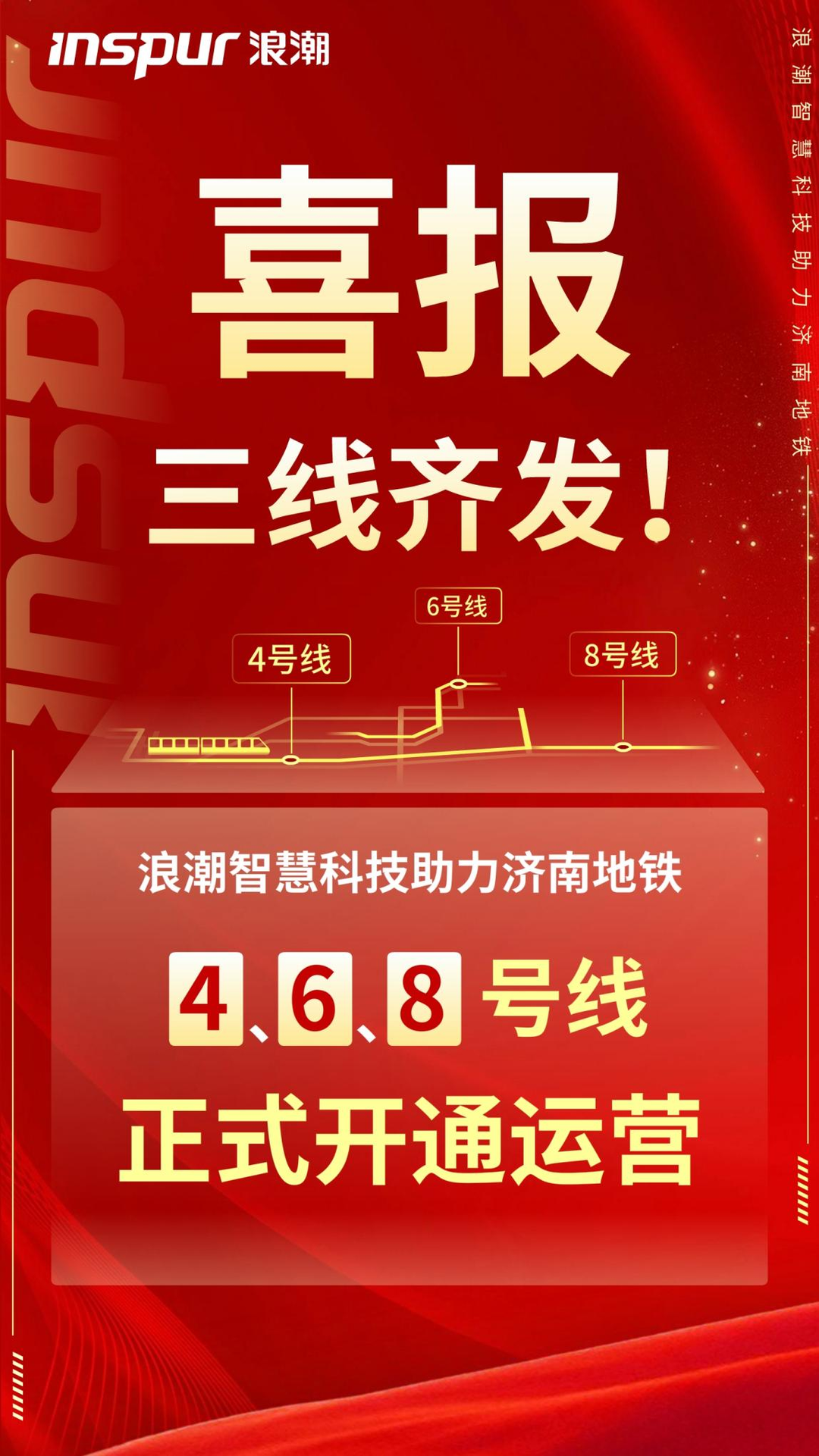
三线齐发!浪潮智慧科技助力济南地铁4、6、8号线正式开通运营,赋能交通强国建设
Qi Lu Wan Bao· 2025-12-30 09:01
Core Viewpoint - Inspur Smart Technology has successfully completed the construction of communication systems for the Jinan Metro lines 4, 6, and 8, which are now operational, significantly enhancing urban connectivity and alleviating traffic congestion in the city [3][5]. Group 1: Project Overview - The Jinan Metro lines 4, 6, and 8 officially commenced operations on December 27, marking a significant milestone in the city's transportation infrastructure [3]. - These lines serve as key east-west corridors across various districts, improving passenger flow and regional development [3]. Group 2: Technology and Innovation - Inspur has developed a comprehensive communication system that supports high-standard operations, including fully automated driving for lines 4 and 8, and autonomous driving for line 6 [5]. - The communication system integrates 13 subsystems, including 100G SPN transmission technology, 800M LTE-M mobile communication, and 5G private networks, ensuring a secure and high-capacity platform [5]. - The system supports SIL4 level fully automated operations and incorporates smart features such as intelligent video analysis and passenger travel big data [5][7]. Group 3: Company Strengths and Future Directions - Inspur's continuous investment in R&D and technological innovation has led to breakthroughs in key areas such as passenger information systems and smart operations within the smart rail industry [7]. - The successful delivery of the Jinan Metro project further validates the company's technical strength and service capabilities in the smart transportation sector [7]. - Looking ahead, Inspur aims to enhance digital empowerment and contribute to the intelligent, green, and autonomous development of China's rail transit [9].

从12公里到352公里,青岛地铁十年铺就城市发展黄金动脉
Qi Lu Wan Bao· 2025-12-15 13:34
Core Insights - Qingdao Metro has transformed from a simple transportation line to a vital economic and social connector over the past decade, significantly enhancing urban mobility and connectivity [1][2][12]. Group 1: Network Expansion and Connectivity - The metro network has expanded from 12 kilometers in 2015 to 352 kilometers, covering "seven districts and one city" [1][2]. - Daily passenger flow increased from under 100,000 to a record 2.35 million by May 2, 2024, with cumulative passenger volume expected to exceed 2.5 billion by December 2025 [1][2]. - The metro facilitates a "half-hour commute to the main city and an hour to the entire region," enhancing regional connectivity [2][3]. Group 2: Service Optimization and User Experience - Operational hours have extended from an initial 15 hours and 20 minutes to an average of 18 hours and 4 minutes, with plans for further extensions [4]. - Peak hour train intervals have been reduced from 8 minutes and 40 seconds to 2 minutes and 25 seconds, improving service efficiency [4]. - The integration of public transport services has been enhanced, with over 85 bus routes optimized to connect seamlessly with metro stations [4]. Group 3: Safety and Emergency Response - Qingdao Metro has achieved 3,642 days of safe operation, covering a distance equivalent to nearly 4,500 laps around the Earth [10]. - A comprehensive safety management system has been established, with 100% participation in hazard identification and resolution by frontline teams [10]. - The metro has implemented AI-driven safety measures, improving entry efficiency by 40% and enabling real-time risk assessment [10]. Group 4: Technological Innovation and Sustainability - The metro has adopted various green technologies, including a flywheel energy storage system and solar power projects, contributing to significant energy savings and carbon reduction [12]. - The introduction of digital payment systems, including the first nationwide "digital RMB offline payment" feature, has enhanced user convenience [9]. - The metro's commitment to sustainability is reflected in its achievements of saving 87.29 million kWh of electricity and reducing carbon emissions by 72,000 tons [12]. Group 5: Community Engagement and Social Responsibility - Qingdao Metro has established a volunteer service system, providing support for various community initiatives and events, including over 200 large-scale activities [6][7]. - The metro has received over 40,000 commendations from passengers, indicating high levels of customer satisfaction [7]. - Special services for vulnerable groups, such as the elderly and disabled, have been enhanced, including the introduction of an "app-based assistance" feature [7].

中国首部站台屏蔽门产品国家标准发布 方大集团下属企业主编
Zhong Zheng Wang· 2025-11-06 13:21
Core Points - The national standard "GB/T 46749-2025 Urban Rail Transit Platform Screen Door System" has been officially released, marking China's first national standard for platform screen door products, effective from May 1, 2026 [1][2] - The standard addresses key issues such as system integration complexity, environmental adaptability, and lifecycle reliability, providing comprehensive specifications for functionality, performance, interface requirements, testing methods, and inspection rules [1][2] Group 1 - The standard was approved for compilation by the Ministry of Housing and Urban-Rural Development in 2024, with Fangda Group as the main drafting unit [2] - The compilation process involved multiple stages including outline determination, draft preparation, opinion collection, review, and approval, culminating in a milestone national standard for the industry [2] - Fangda Group's leadership in the standard's development has been recognized for effectively addressing challenges in organization, technical requirements, and quality, receiving unanimous approval from relevant departments and experts [2] Group 2 - As the first national standard with both integrative and systematic characteristics in the platform screen door industry, it fills a significant gap, providing clear technical specifications for enterprises and promoting uniform product quality [2] - The implementation of the standard is expected to enhance safety levels in urban rail transit, particularly at station platforms, and strengthen the international competitiveness of enterprises [2] - The standard will play a foundational, strategic, and guiding role in upgrading industry technology, supporting the renovation of platform screen door systems, and advancing the "Strong Transportation Nation" strategy, aiding China's transition from a "Rail Transit Power" to a "Rail Transit Strong Power" [2]
