月球建城

Search documents
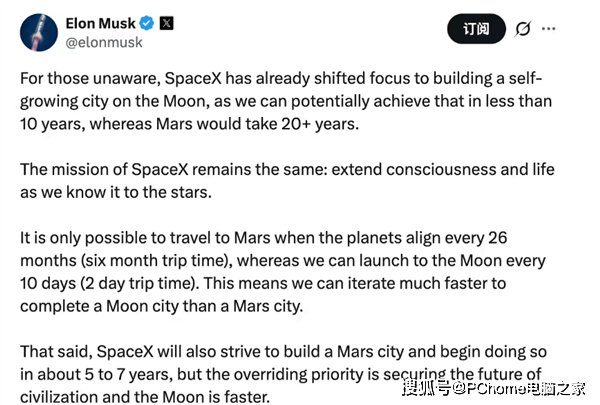
马斯克说10年内月球建城
Xin Lang Cai Jing· 2026-02-10 04:36
Core Viewpoint - Elon Musk announced plans for SpaceX to focus on building a self-sustaining city on the Moon within the next 10 years, prioritizing lunar exploration over Mars colonization, which is projected to take over 20 years [1] Group 1: Lunar City Development - SpaceX aims to achieve an unmanned lunar landing by March 2027, shifting its immediate focus to lunar city construction [1] - The company believes that building a city on the Moon can be accomplished more quickly than on Mars, with launch windows to the Moon available every 10 days compared to every 26 months for Mars [1] Group 2: Mars Colonization Plans - Despite the shift in focus to the Moon, SpaceX still plans to initiate its long-term Mars colonization efforts within the next 5 to 7 years [1] - The timeline for Mars colonization is significantly longer due to the limited launch opportunities and the extended travel time of approximately 6 months [1]
马斯克称有望10年内在月球上建造城市
Sou Hu Cai Jing· 2026-02-10 02:44
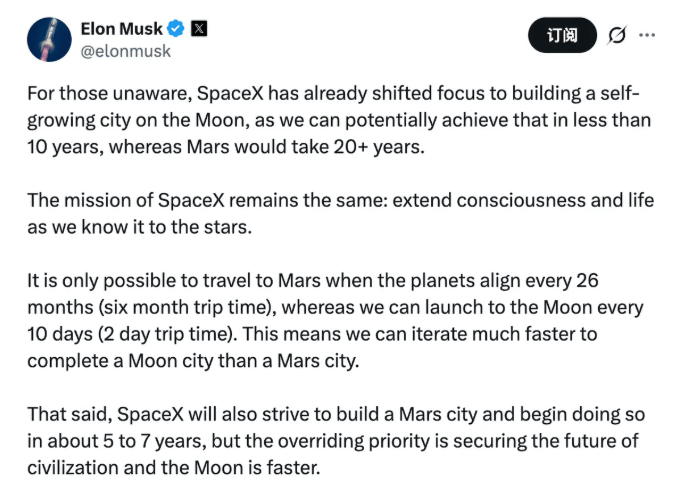
Group 1 - Elon Musk announced that SpaceX is shifting its strategic focus towards building a "self-sustaining city" on the Moon, with the goal expected to be realized in less than 10 years [1] - SpaceX still plans to initiate its long-awaited Mars colonization project within the next 5 to 7 years, but emphasizes that ensuring the "future of civilization" is a priority, and lunar landing can achieve this goal more quickly [2] - The frequency and travel time for missions to Mars and the Moon differ significantly; lunar missions can be launched every 10 days with a travel time of only 2 days, while Mars missions have a launch window every 26 months and take about 6 months to reach [2] Group 2 - SpaceX has indicated to investors that it will prioritize lunar landing projects while postponing attempts to reach Mars, aiming for an unmanned lunar landing by March 2027 [2] - The construction of space data centers and the advancement of lunar and Mars colonization plans require substantial funding; SpaceX is considering an initial public offering (IPO) in June, potentially raising up to $50 billion [2] - If successful, this IPO could become the largest in U.S. history, providing solid financial support for SpaceX's various space exploration initiatives [2]

叮咚买菜称品质标准不变,阿里新一代模型曝光,小红书或在研发剪辑类AI产品,马斯克称10年内有望实现月球建城,这就是今天的其他大新闻!
Sou Hu Cai Jing· 2026-02-09 17:44
Group 1 - Dingdong Maicai announced that its business and team are operating normally and will continue to provide high-quality products and services [2][4] - Dingdong Maicai will implement its ninth consecutive year of uninterrupted service during the Spring Festival, ensuring a stable consumer experience [4] - Meituan announced plans to acquire Dingdong Maicai for $717 million (approximately 4.978 billion RMB) [4] Group 2 - Alibaba's new generation model Qwen3.5 is expected to be released soon, featuring a new mixed attention mechanism and potential visual understanding capabilities [6] - The model may include at least a 2 billion parameter dense model and a 35 billion parameter MoE model, with expectations of open-sourcing during the Spring Festival [6] - Xiaohongshu is developing an AI video editing product called OpenStoryline, which allows users to generate videos through conversational prompts, enhancing content creation efficiency [8][9] Group 3 - Elon Musk stated that SpaceX aims to build a self-sustaining city on the Moon within the next 10 years, with a faster construction timeline compared to Mars [12] - Musk emphasized that lunar missions can occur every 10 days, while Mars missions are limited to every 26 months [12]


马斯克宣布重心转向月球建城,目标10年内实现
Sou Hu Cai Jing· 2026-02-09 03:26
Core Viewpoint - SpaceX has shifted its focus towards building a self-sustaining city on the Moon, aiming to achieve this goal within 10 years, while the Mars colonization plan is projected to take over 20 years to initiate [1] Group 1 - The strategic adjustment is based on considerations of technological feasibility and launch efficiency [2] - The timing for Mars missions is limited to every 26 months due to planetary alignment, requiring a 6-month journey, whereas lunar missions can occur every 10 days with a 2-day travel time [2] - This shift makes engineering validation, supply logistics, and personnel transport to the Moon more practical [2] Group 2 - SpaceX is participating in NASA's Artemis lunar program, prioritizing lunar missions [4] - The target for an unmanned lunar landing is set for March 2027, with ongoing testing of the relevant spacecraft [4]