木星冲日

Search documents
今天上演!行星之王冲日奇观
Xin Lang Cai Jing· 2026-01-10 05:04
Core Viewpoint - The article highlights the astronomical event of Jupiter's opposition, where Jupiter will be the brightest object in the winter night sky, providing a significant opportunity for stargazers to observe this phenomenon [1] Summary by Relevant Categories Astronomical Event - Jupiter's opposition will occur today, making it the brightest planet visible in the night sky [1] - The event is particularly notable as Jupiter will be approximately twice as bright as Sirius, the brightest star in winter [1] Orbital Mechanics - Jupiter takes about 11.86 years to complete one orbit around the Sun [1] - Earth catches up to Jupiter approximately every 399 days, resulting in the opposition phenomenon [1] Observational Conditions - The brightness of Jupiter during this event allows for easy identification even in areas with significant light pollution [1]
星空有约|2026年1月天象看点前瞻:超级月亮现身 木星冲日登场
Xin Hua She· 2025-12-30 07:40
Group 1 - The first astronomical event of 2026 is the "Supermoon" occurring on January 3, where the moon will appear in its most perfect round shape at 18:03 [1] - The Quadrantids meteor shower, one of the three major meteor showers in the Northern Hemisphere, will peak on January 4, characterized by medium-speed meteors and bright fireballs [1] - Observing the meteor shower may be challenging due to the bright moonlight from the full moon occurring simultaneously, making it less favorable for general public viewing [1] Group 2 - A lunar occultation of the star Xuanyuan 14 will take place on the night of January 6 to the early morning of January 7, visible in most northern regions of China [2] - Jupiter will reach opposition on January 10, becoming exceptionally bright at magnitude -2.7, making it easily visible to the naked eye [2] - Following the opposition, Jupiter will be accompanied by a nearly full moon at the end of January, creating a visually stunning "star-moon fairy tale" in the night sky [2]
想看流星雨许愿?专业机构有直播
Di Yi Cai Jing· 2025-12-27 04:12
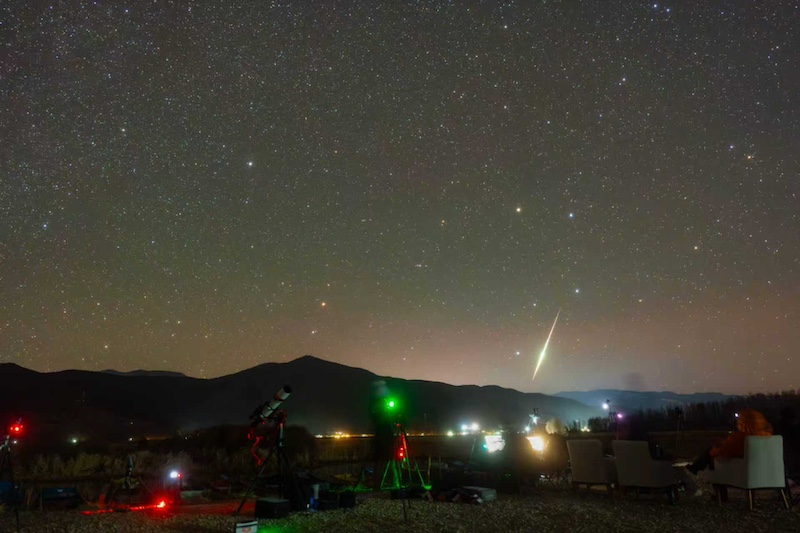
Group 1 - The Shanghai Planetarium has confirmed its celestial live broadcast plan for 2026, which includes the Perseids and Geminids meteor showers, as well as a live broadcast of Jupiter's opposition around January 10 [1][5] - The recent Geminids meteor shower live broadcast on December 13 and 14 attracted significant attention, with over 15 hours of streaming, showcasing the popularity of such events [1][6] - The Shanghai Planetarium prioritizes meteor showers with high visibility and favorable moon phases for live broadcasts, focusing on the Perseids and Geminids in the Northern Hemisphere [3][5] Group 2 - The live broadcast team, led by Wang Xiaofei, chose to stream from Lugu Lake in Yunnan due to its low light pollution and favorable viewing conditions, allowing for better visibility of the meteor shower [3][5] - The live broadcasts engage viewers by explaining the nature of meteor showers, their formation, and the unpredictability of their visibility, enhancing the educational aspect of the experience [3][5] - The Shanghai Planetarium plans to continue its celestial broadcasts, including a total solar eclipse in Spain next year, aiming to provide a variety of astronomical events for public enjoyment [5][6]