
未成年人违法治理

Search documents
未成年人涉“事”,不再是“小事”
Xin Lang Cai Jing· 2026-01-21 14:26
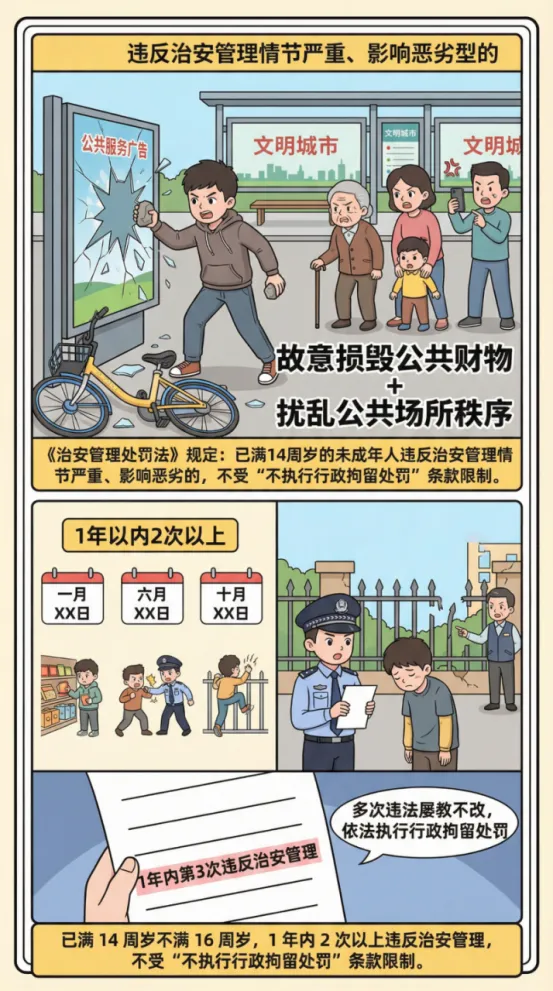
Group 1 - The new revised "Public Security Administration Punishment Law of the People's Republic of China" will take effect on January 1, 2026, introducing significant adjustments to the governance of juvenile offenses, particularly addressing school bullying and coercion of minors into compensated activities [1] - The new regulations eliminate the "zero-cost" perception of juvenile offenses, imposing detention for minors aged 14-16 who commit two offenses within a year or for those aged 14-18 who commit a serious first offense [1][4] - The law emphasizes the importance of corrective education measures for minors who do not comply with administrative detention, aiming to prevent a "one-time punishment" approach [1] Group 2 - The new law establishes a "zero tolerance" policy for school bullying, granting police direct intervention rights and enhancing collaboration between schools and law enforcement [4] - Acts of bullying, such as assault, insult, and intimidation, are classified as violations of public security management, with penalties and corrective education measures enforced by police [4] - Schools are held accountable for failing to report or address bullying incidents, with responsible personnel facing repercussions [4] Group 3 - The law imposes strict penalties for organizing or coercing minors into inappropriate paid activities, with detention ranging from 10 to 15 days and fines up to 5,000 yuan for serious offenses [6] - Lesser offenses may result in detention of up to 5 days or fines below 5,000 yuan [6] Group 4 - The law introduces more compassionate enforcement procedures, allowing suitable adults to be present during inquiries if guardians are unavailable [8] - Minors and their guardians have the right to request a hearing if detention is likely, ensuring the protection of their legal rights [8] Group 5 - The law emphasizes that youth should not use their age as an excuse for misconduct, reinforcing the idea that legal boundaries exist and must be respected [10] - It encourages schools and families to work together in legal education, fostering a culture of legal awareness among youth [10]

时隔近20年首次“大修”,应对新型社会治安问题 治安管理处罚法 哪些修订与你我密切相关(法治聚焦)
Ren Min Ri Bao· 2025-07-01 21:55
Core Viewpoint - The revised Public Security Administration Punishment Law will take effect on January 1, 2026, aiming to adapt to the changing social security landscape and improve legal frameworks for public security management [1][2]. Group 1: Key Changes in Law - The new law clarifies that actions taken to prevent ongoing illegal harm will not be penalized, promoting the concept of legitimate defense [2][3]. - For minors aged 14-16 and 16-18, the law now allows for detention in cases of serious initial violations, addressing concerns about repeat offenders [3][4]. - Specific provisions against bullying in schools have been established, mandating penalties for acts of bullying and requiring schools to report serious incidents [4]. Group 2: Animal Management Regulations - The law introduces penalties for failing to secure animals, leading to harm to others, including fines or detention [5][6]. - It also addresses the sale and breeding of dangerous animals, establishing a legal framework for enforcement [6]. Group 3: Record Management and Enforcement - The law stipulates that records of administrative violations can be sealed and not disclosed to any entity, enhancing privacy for individuals [7][8]. - It includes provisions for humane treatment of individuals facing detention, allowing for deferment under certain circumstances [7]. Group 4: New Offenses Added - New offenses have been added to the law, including actions that disrupt public transport, high-altitude throwing of objects, and unauthorized drone flights, which will now be subject to penalties [9]. - Other behaviors such as harassment, abuse of vulnerable individuals, and identity fraud have also been classified as punishable offenses [9].