机器人灵巧性

Search documents
如何用250美元低成本硬件,实现机器手类人灵巧操作?|Science Robotics
机器人大讲堂· 2026-02-01 04:06
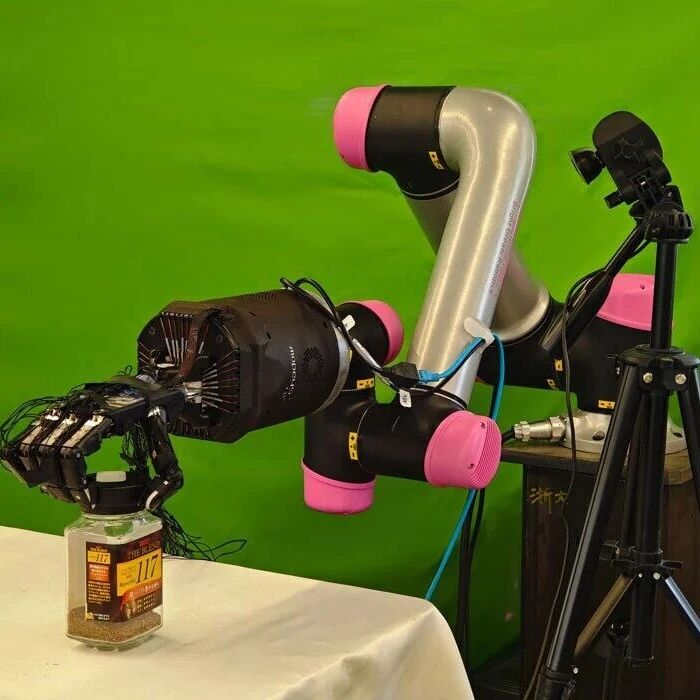
Core Insights - The article presents a groundbreaking study that challenges traditional beliefs in robotics, suggesting that high precision sensory systems are not necessary for achieving human-like dexterity in robots [1][4]. Group 1: Research Findings - A research team demonstrated that a robot hand could achieve approximately 85% success in complex tasks like opening bottle caps and turning faucets using only a monocular RGB camera and simple binary tactile sensors costing around $250 [3][16]. - The study indicates that the key to dexterity lies not in high-fidelity sensors but in how the robot's "brain" interprets and integrates sensory information [3][24]. Group 2: Hardware Simplification - The research challenges the conventional approach of enhancing robot capabilities through expensive, high-precision sensory hardware, which has proven costly and complex [4][7]. - Instead, the study employed a "sensory downgrade" experiment, simplifying visual input to a fixed-angle camera and tactile input to 20 binary switches, leading to unexpectedly superior performance in multi-finger dexterous tasks [10][7]. Group 3: Decoupling Perception and Control - The research draws inspiration from neuroscience, creating a "bionic brain" for robots that separates sensory processing and motor control, similar to human brain functions [11][12]. - The two-phase learning framework involves first teaching the robot to perceive through extensive video training and then training it to act based on the integrated sensory understanding [14][15]. Group 4: Performance Metrics - In rigorous testing, the robot hand exhibited an average success rate of about 85% across five core dexterous tasks, demonstrating its ability to adapt to various object shapes and materials [16][19]. - The system showed remarkable robustness, maintaining performance under different lighting conditions and demonstrating a high transferability of learned skills to new tasks [17][21]. Group 5: Cost and Accessibility - The total cost of the system is approximately $250, significantly lower than previous solutions that relied on high-precision sensors costing thousands of dollars [23][24]. - This research paves the way for the widespread adoption of dexterous robots in various sectors, as it eliminates the barriers of high costs and complexity [25][26].