机器人手

Search documents
如何用250美元低成本硬件,实现机器手类人灵巧操作?|Science Robotics
机器人大讲堂· 2026-02-01 04:06
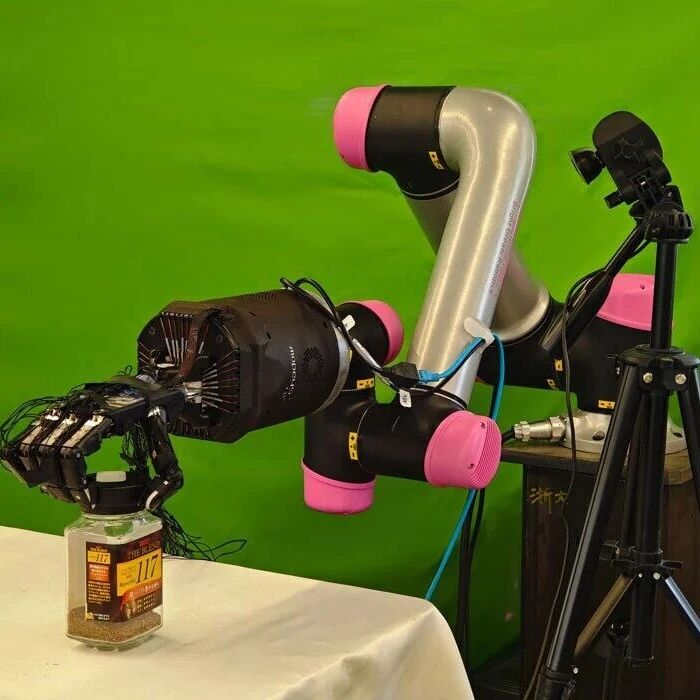
Core Insights - The article presents a groundbreaking study that challenges traditional beliefs in robotics, suggesting that high precision sensory systems are not necessary for achieving human-like dexterity in robots [1][4]. Group 1: Research Findings - A research team demonstrated that a robot hand could achieve approximately 85% success in complex tasks like opening bottle caps and turning faucets using only a monocular RGB camera and simple binary tactile sensors costing around $250 [3][16]. - The study indicates that the key to dexterity lies not in high-fidelity sensors but in how the robot's "brain" interprets and integrates sensory information [3][24]. Group 2: Hardware Simplification - The research challenges the conventional approach of enhancing robot capabilities through expensive, high-precision sensory hardware, which has proven costly and complex [4][7]. - Instead, the study employed a "sensory downgrade" experiment, simplifying visual input to a fixed-angle camera and tactile input to 20 binary switches, leading to unexpectedly superior performance in multi-finger dexterous tasks [10][7]. Group 3: Decoupling Perception and Control - The research draws inspiration from neuroscience, creating a "bionic brain" for robots that separates sensory processing and motor control, similar to human brain functions [11][12]. - The two-phase learning framework involves first teaching the robot to perceive through extensive video training and then training it to act based on the integrated sensory understanding [14][15]. Group 4: Performance Metrics - In rigorous testing, the robot hand exhibited an average success rate of about 85% across five core dexterous tasks, demonstrating its ability to adapt to various object shapes and materials [16][19]. - The system showed remarkable robustness, maintaining performance under different lighting conditions and demonstrating a high transferability of learned skills to new tasks [17][21]. Group 5: Cost and Accessibility - The total cost of the system is approximately $250, significantly lower than previous solutions that relied on high-precision sensors costing thousands of dollars [23][24]. - This research paves the way for the widespread adoption of dexterous robots in various sectors, as it eliminates the barriers of high costs and complexity [25][26].

外滩大会弹钢琴、迎宾互动 北京机器人企业秀出“含科量”
Xin Jing Bao· 2025-09-12 20:41
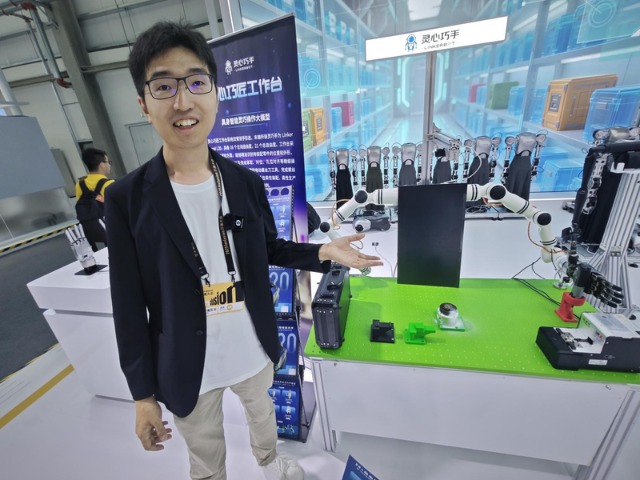
Group 1: Event Overview - The "2025 Inclusion·Bund Conference" was held from September 10 to 13 at the Shanghai Huangpu Expo Park, showcasing over 100 robots with various skills such as "egg shell carving" and disaster rescue [1] Group 2: Company Highlights - Lingxin Qiaoshou, a Beijing-based robotics company, showcased two robots that performed the conference theme song and AI music, highlighting their technological capabilities [2] - The company offers four types of dexterous hand products priced between 8,800 yuan and 99,999 yuan, with a new lower-cost model priced at 6,000 yuan, significantly cheaper than foreign counterparts [2] - Lingxin Qiaoshou's products are designed for various applications, including industrial and research fields, with major clients being leading industrial giants and humanoid robot companies [2] Group 3: Technological Innovations - The "Welcoming Robot" from Songyan Power, which won gold medals in gymnastics and long jump at the World Humanoid Robot Games, features over 30 degrees of freedom for facial expression control and voice interaction [4][5] - The robots demonstrated advanced capabilities in industrial inspection and emergency rescue scenarios, showcasing their potential as "super teammates" for rescue teams [6][7] Group 4: Competition and Performance - The robot skills competition featured various challenges, including navigating rugged terrain and performing precise industrial tasks, with robots displaying impressive movement control and environmental awareness [6][8] - The performance of the robots in high-risk scenarios, such as mining and explosive tasks, highlighted their ability to adapt and perform under challenging conditions [8]