机器人遥操作

Search documents
优必选机器人遥操作专利公布,可扩展遥操作场景适应性
Qi Cha Cha· 2025-11-05 03:19
Core Insights - Shenzhen Youbixuan Technology Co., Ltd. has recently published a patent application for "Robot Remote Operation Method, Device, Robot, and Computer Program Product" which is applicable in the field of robotics [1] Summary by Categories Patent Details - The patent application was filed on July 16, 2025, and is expected to be published on November 4, 2025, with a projected expiration date of July 16, 2045 [2] - The application number is CN202510979391.4, and the publication number is CN120886242A [2] - The patent is classified under IPC categories B25J9/16 and B25J13/08 [2] Technological Innovation - The method involves obtaining first target data, which can be collected from different motion capture devices, allowing the robot to determine control data for its joints based on corresponding mapping relationships [1] - This innovation enables compatibility with various motion capture devices for remote operation, enhancing system adaptability [1] - The approach reduces the need for reconfiguration of interfaces and mapping relationships when switching motion capture devices, thereby shortening development cycles and lowering costs [1]


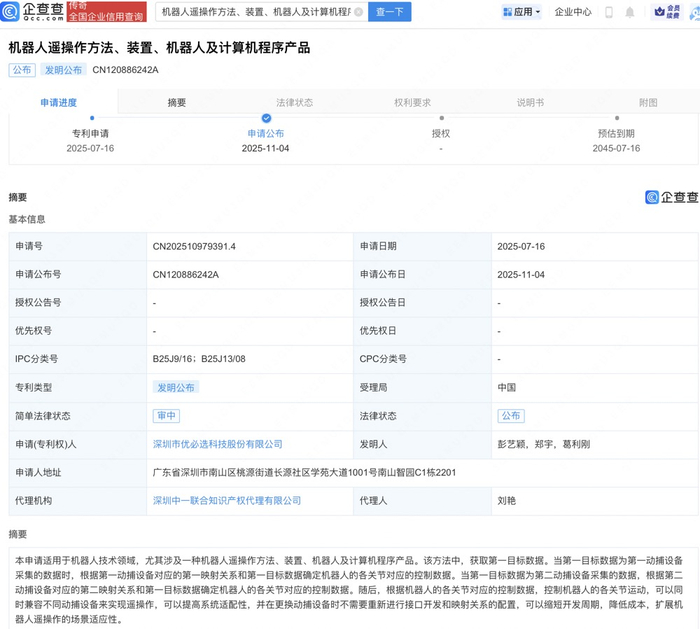
优必选公布机器人遥操作专利,可扩展遥操作场景适应性
Xin Lang Cai Jing· 2025-11-04 05:39
Core Viewpoint - Shenzhen Youbikong Technology Co., Ltd. has published a patent for a "robot remote operation method, device, robot, and computer program product," which enhances the adaptability and efficiency of robotic systems in remote operations [1] Summary by Relevant Sections - **Patent Details** - The patent is applicable in the field of robotic technology and involves obtaining first target data [1] - The method determines control data for the robot's joints based on data collected from different motion capture devices, utilizing corresponding mapping relationships [1] - **Technological Advantages** - The system can simultaneously accommodate different motion capture devices for remote operation, improving system adaptability [1] - It eliminates the need for re-developing interfaces and mapping configurations when switching motion capture devices, thereby shortening development cycles and reducing costs [1] - The technology expands the adaptability of robotic remote operations across various scenarios [1]
5000万元重奖重大产品研发,武汉光谷出台“脑机接口11条”;魔法原子发布首个面向行业应用的四足机器人丨智能制造日报
创业邦· 2025-10-11 03:19
Group 1 - Magic Atom launched its first industry-oriented quadruped robot, MagicDog Y1, which supports a moving load of 45kg and a maximum load of 150kg, with a top speed of 6m/s [2] - Wuhan East Lake High-tech Zone introduced "11 measures for brain-computer interface industry innovation development," providing substantial support for major product R&D, covering five key areas with specific initiatives [4] - Porsche's Cayenne electronic product manager confirmed that physical buttons and knobs will remain in their vehicles, including a volume knob, despite the presence of a 14.25-inch curved OLED touchscreen [5] Group 2 - Yushu Technology received authorization for a patent on immersive robot remote operation, which enhances operator feedback and control precision through real-time mapping and immersive feedback mechanisms [7]

新方向:机器人遥操作
Soochow Securities· 2025-08-03 04:23
Investment Rating - The report maintains an "Overweight" rating for the computer industry [1] Core Viewpoints - Robot teleoperation is defined as using remote control to map human actions onto machines across physical spaces [6] - The primary applications of robot teleoperation include human-machine task execution, safety assurance, and training data collection [7] - Current technical challenges in teleoperation include communication latency and tactile feedback [8] - Investment in robot teleoperation is seen as a means to accelerate the deployment of robots in various scenarios and to enhance safety measures [11] Summary by Sections 1. Definition of Robot Teleoperation - Robot teleoperation refers to the remote control method that allows human actions to be mirrored onto machines [6] 2. Main Purposes of Robot Teleoperation - Human-machine task execution is necessary as humanoid robots currently lack sufficient intelligence for autonomous task completion, especially in hazardous environments [7] - Safety assurance is critical due to potential hacking risks and algorithmic flaws that could lead to accidents [7] - Training data collection is essential for humanoid robots to learn physical actions through human demonstrations, which require teleoperation [7] 3. Current Technical Challenges in Teleoperation - Communication latency affects the real-time operation of teleoperation, particularly in long-distance tasks [8] - Tactile feedback devices are expensive, and the autonomous reasoning capabilities for tactile intelligence are still under development [8] 4. Main Methods of Teleoperation - Current mainstream teleoperation methods include VR controllers, motion capture devices, master-slave robotic arms, exoskeletons, and Cartesian coordinate controllers [9][10] 5. Investment Recommendations - The report suggests that robot teleoperation can facilitate the integration of robots into various applications and is crucial for collecting training data [11] - The market for teleoperation is promising, with a recommendation to focus on companies like Changhong Technology, which is developing remote control solutions for robots [11]