机构补仓

Search documents
百股获连续融资增持,量化拆解资金逻辑
Sou Hu Cai Jing· 2026-01-14 07:33
Core Viewpoint - The article discusses the significance of quantitative data in understanding stock price fluctuations and the underlying behaviors of different types of capital in the market, emphasizing the importance of data-driven strategies for investors. Group 1: Stock Price Fluctuations - Many stocks in the Shanghai and Shenzhen markets have seen continuous financing increases for over five days, with some experiencing net buying for more than ten days [1] - Stock price volatility often leads to emotional trading decisions, where investors struggle to hold onto profitable positions during fluctuations [3] - Each price movement is driven by capital dynamics, which can be better understood through quantitative data rather than intuition [6] Group 2: Quantitative Analysis of Capital Behavior - The article presents a quantitative analysis system that identifies trading behaviors, revealing the interactions between speculative capital and institutional investors [8] - The analysis distinguishes between "speculative capital accumulation" and "institutional shakeout," where institutions may intentionally adjust stock prices before accumulating shares [8] - Recognizing these patterns allows investors to understand the ongoing capital battles and maintain confidence in holding stocks despite volatility [8] Group 3: Efficient Investment Strategies - Long-term holding of stocks can yield positive results, but it is often inefficient during favorable market conditions; a more effective strategy involves participating in upward trends while minimizing exposure to corrections [9] - The article highlights five phases of opportunity between "shakeout" and "accumulation," which can lead to significant returns without enduring the full extent of price fluctuations [12] Group 4: Long-term Value of Quantitative Thinking - The difference in investment outcomes among individuals is attributed to systematic methodologies rather than luck, with quantitative data providing a framework for decision-making [13] - Quantitative analysis helps investors move beyond subjective judgments, revealing the true behaviors of capital and fostering a more rational understanding of market dynamics [13] - Over time, this approach can develop sustainable investment capabilities, reducing reliance on speculation and enhancing overall investment performance [13]


牛市新的机会,11个行业获融资买入!
Sou Hu Cai Jing· 2025-09-07 01:55
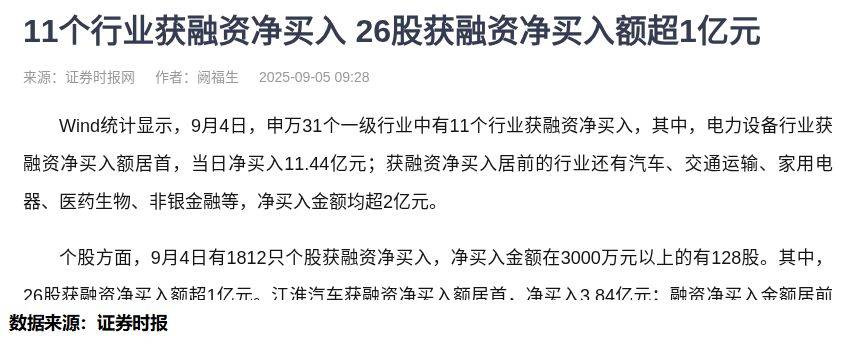
Group 1 - The electric power equipment industry has become a favorite among investors in September, with a net buying amount of 1.144 billion yuan, leading the market [1][2] - 26 stocks, including Jianghuai Automobile, saw over 100 million yuan in financing on a single day, indicating significant institutional interest [2] - The current market activity may reflect a strategic maneuver by institutions rather than genuine enthusiasm for the new energy sector [1][9] Group 2 - Historical context shows that market fluctuations often coincide with institutional strategies, such as the significant market movements in the second quarter of 2025 [3][4] - Institutions may engage in "smashing the market" to accumulate shares when they find their positions insufficient, leading to sudden market drops that are misinterpreted as external shocks [4][12] - The electric power equipment sector's current financing activity raises questions about whether it is a genuine value discovery or a prelude to another institutional shakeout [9][12] Group 3 - Case studies of Huadong Medicine and Shenzhou Cell illustrate the difference between genuine market adjustments and strategic institutional actions, with the latter often leading to significant price movements [6][8] - Data analysis reveals that Shenzhou Cell experienced notable institutional buying during its adjustment, while Huadong Medicine did not, resulting in divergent outcomes when the market rebounded [8] - The electric power equipment industry's recent activity may mirror past instances where institutions manipulated market perceptions to their advantage [12]