空头回补

Search documents
固定收益点评:债市可以乐观一点
Guohai Securities· 2026-03-05 10:05
1. Report Industry Investment Rating - Not provided in the content 2. Core Viewpoints - The report is overall optimistic about the bond market, especially the 30-year Treasury bonds [5][12]. - The callback risk of the bond market from March to April is not high [5][12]. - The 10-year China Development Bank bonds are more promising than the 10-year Treasury bonds [5][13]. - The 30-year Treasury bonds are expected to have an excessive decline in interest rates if product accounts gradually participate in the allocation [5][14]. 3. Summary by Relevant Catalogs Event - Amid geopolitical disturbances recently, the stock market is weak while the bond market is strong. As of March 4, the yield to maturity of the active 10-year Treasury bond has declined to around 1.79% [11]. Comment Low Callback Risk from March to April - The February PMI is lower than market expectations and has declined month-on-month. In the short term, fundamentals have limited suppressing effects on the bond market [5][12]. - Market expectations for loose monetary policy have risen. Investors expect reserve - requirement ratio cuts and interest rate cuts during the Two Sessions. As of March 3, the capital lending volume of large banks has rebounded to 5.63 trillion yuan after the holiday. The short - term interest rate was strong on March 4, with the TS contract main - continuous rising 5% on a single day [5][12]. - Attention should be paid to potential geopolitical fluctuations and the historical stock - bond calendar effect from March to April [5][12]. Preference for 10 - year China Development Bank Bonds over 10 - year Treasury Bonds - The liquidity of 10 - year Treasury bonds is under test. On March 4, the trading volume of the active 10 - year Treasury bond 250022 was only 354 transactions, while that of the 10 - year China Development Bank bond 250220 reached 2484 transactions [5][13]. - The tax spread between 10 - year China Development Bank bonds and 10 - year Treasury bonds has been widening since 2025. If the liability side of public funds eases and the bearish bond market expectation weakens, the tax spread of various maturities is expected to compress [5][13]. Optimism about 30 - year Treasury Bonds - As of the end of February, public funds only held 315 billion yuan of the secondary - market position of the active bond 2500006, while large banks held 633 billion yuan. If product accounts gradually participate in the allocation of ultra - long bonds, the interest rate of this variety will decline excessively [5][14]. - Banks will gradually reduce their willingness to lend bonds around mid - to - late March to optimize first - quarter statement indicators. Currently, the net borrowing volume of securities firms in 30 - year Treasury bonds is at a new high, and the subsequent decline will drive short - covering forces [5][14].
期棉收高 录得月度涨幅
Xin Lang Cai Jing· 2026-02-28 02:11
Futures Market - Cotton futures on the Intercontinental Exchange (ICE) rose, achieving a monthly increase due to unfavorable weather prospects in major U.S. production areas and short covering by traders [1] - The most actively traded May cotton futures contract increased by 0.25 cents or 0.38%, settling at 65.61 cents per pound, with a cumulative price increase of approximately 1% for the month [1] - The U.S. dollar index fell by 0.2%, making cotton priced in dollars more attractive to overseas buyers [2] Market Dynamics - Keith Brown & Co. indicated two favorable factors for cotton: potential adverse weather conditions and speculative net short positions nearing historical highs, suggesting a possible short covering rally in the upcoming month [2] - The U.S. Department of Agriculture (USDA) reported a net increase of 282,900 bales in U.S. cotton export sales for the week ending February 19, with current year cotton export sales netting 253,200 bales, a decrease of 46% from the previous week and 12% from the four-week average [2] - The next year's cotton export sales saw a net increase of 29,700 bales [2] Other Agricultural Markets - Concerns over military conflict risks between the U.S. and Iran led to short covering in other agricultural markets, with U.S. and European wheat futures reaching multi-month highs [2] - Oil prices increased by approximately 3%, with traders remaining cautious about potential supply disruption risks, which could reduce the attractiveness of cotton's substitute, polyester fiber [2] Inventory Data - As of February 26, ICE reported that the deliverable stock of No. 2 cotton contracts remained steady at 119,457 bales [3] Spot Market - On February 26, the Cotlook A Index was reported at 76.45 cents per pound, an increase of 60 points [4]
公募新规将至,有些机构已经提前动作
Sou Hu Cai Jing· 2026-02-28 01:59
Group 1 - The core viewpoint of the article emphasizes that market movements are often misleading, and understanding the underlying trading behaviors is crucial for making informed investment decisions [1][3][11] - The article discusses the concept of "profit-taking," where investors who have made gains begin to cash out, which can lead to market adjustments despite a seemingly stable or rising price [5][6][8] - It highlights the importance of quantitative data in identifying hidden trading behaviors, allowing investors to see beyond surface-level market trends and make better decisions [8][17] Group 2 - The article illustrates that during times of negative news, such as a significant drop in stock prices, it is essential to analyze the underlying trading actions, like "short covering," which indicates that larger investors may be positioning themselves for future gains [11][14] - It emphasizes that quantitative data can help investors avoid emotional reactions to market fluctuations, leading to more stable and sustainable investment strategies [17][18] - The article concludes that leveraging quantitative analysis can enhance investment capabilities by providing a clearer understanding of market dynamics and reducing reliance on subjective judgment [17]


CBOT小麦上涨,受空头回补提振
Xin Lang Cai Jing· 2026-02-27 00:49
Group 1 - The Chicago Board of Trade (CBOT) soft red winter wheat futures closed higher, marking the first increase of the week, primarily driven by short covering [1] - As of the close, wheat futures rose between 1.50 cents and 6 cents, with the March contract up 6 cents at 571.75 cents per bushel, the May contract up 4.75 cents at 574.50 cents per bushel, and the July contract up 4.25 cents at 582 cents per bushel [1] - The most actively traded May contract had a trading range between 567.75 cents and 575.75 cents [1] Group 2 - The estimated trading volume for the benchmark contract was 68,848 contracts, down from 73,451 contracts the previous trading day [1] - The open interest was 231,787 contracts, slightly up from 231,131 contracts the previous trading day [1]

比特币一度跳涨至6.6万美元 市场紧盯特朗普国情咨文演讲
Zhi Tong Cai Jing· 2026-02-25 04:10
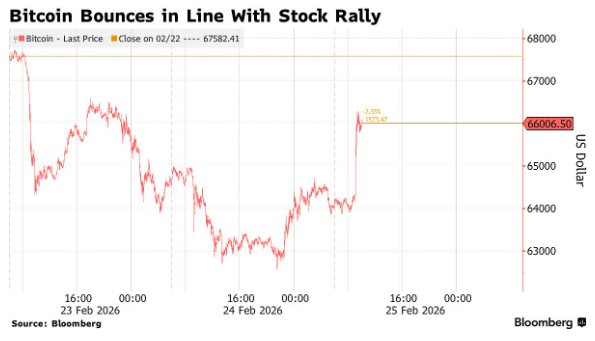
Group 1 - The cryptocurrency market experienced a rebound after a significant drop earlier in the week, with Bitcoin and Ethereum both rising over 3% during early Asian trading on Wednesday [1] - Bitcoin reached a peak increase of 3.52% to $66,300, marking its largest intraday gain since February 13, while Ethereum rose by 4.84% to $1,994 [1] - Smaller tokens also saw gains, with Solana increasing approximately 5.7% and Ripple rising by 1.35% [1] Group 2 - The recent surge in cryptocurrency prices coincided with a rise in the stock market ahead of President Trump's State of the Union address [3] - Following a Supreme Court ruling that limited Trump's ability to implement his proposed "reciprocal tariffs," cryptocurrency prices initially fell, but Trump later announced a 15% global tariff [3] - The increase in Bitcoin's price may be attributed to short covering and speculative long positions being established before the State of the Union address, according to Apollo Crypto's research head [3]
EasyMarkets易信:比特币8.5万美元反弹之路
Xin Lang Cai Jing· 2026-02-23 13:58
Core Insights - The article highlights a significant shift in the CME futures market, where large institutional investors, referred to as "smart money," are rapidly reducing their short positions in Bitcoin, indicating a potential market recovery phase [1][3]. Group 1: Market Dynamics - The latest CFTC report shows that institutional investors are strategically moving from net short to long positions, which aligns with patterns observed before major market rallies in 2023 and 2025 [1][3]. - Historical data indicates that similar short covering has previously supported Bitcoin's remarkable 190% increase in 2023 [1][3]. Group 2: Technical Analysis - Bitcoin is currently contesting the 200-week exponential moving average, approximately at $68,350, with signs of market selling pressure diminishing as the weekly RSI indicator has entered the oversold territory [1][3]. - If Bitcoin stabilizes at this critical support level and rebounds, the target price could reach the 100-week moving average at $85,000, potentially by April [1][3]. Group 3: Risk Considerations - Despite the optimistic outlook, there is a cautionary note regarding the potential for extreme volatility in the short term, especially if the 200-week moving average is breached, which could lead to a price retracement to the $40,000 to $50,000 range [2][4]. - The article emphasizes the need for investors to monitor the ongoing inflow of institutional funds to determine whether this is the start of a reversal or a complex bottoming process [2][4].
AI硬件一片大涨,能炒多高关键看一点
Sou Hu Cai Jing· 2026-02-23 02:42
Core Viewpoint - The A-share market is experiencing rapid fluctuations, particularly in the AI hardware sector, where segments like CPO and liquid-cooled servers have seen significant surges, leading to a volatile trading environment for investors [1] Group 1: Understanding Market Behavior - Many investors still perceive trading as a simple buy-sell dynamic, but through quantitative big data analysis, it can be categorized into four core behaviors: "bullish dominance," "profit-taking," "bearish dominance," and "short covering," which reflect the true intentions of capital [3] - The appearance of a stock may show steady price increases, but quantitative data can reveal that "profit-taking" behavior is dominant, indicating that funds are quietly cashing out profits rather than pushing the market higher [5] - Investors often misinterpret market signals, as seen when a friend entered the AI sector during a perceived strong uptrend, only to face losses due to underlying "profit-taking" actions that were not visible through price movements alone [5][7] Group 2: Recognizing Market Signals - Stocks may exhibit price stability during "profit-taking" events, but subsequent adjustments can occur, highlighting the importance of recognizing these behaviors to avoid being misled by superficial price trends [7] - Conversely, when negative news is released, a stock may rise instead of fall, indicating that the market has already priced in the bad news, with "short covering" behavior suggesting that funds are entering the market opportunistically [9] - A stock that opened significantly lower but showed signs of "short covering" over several days can lead to a subsequent price increase, demonstrating the value of understanding underlying trading behaviors [12] Group 3: Multi-Dimensional Market Analysis - Investors often face challenges in the market due to a narrow focus on price movements, neglecting other critical dimensions such as capital flow and behavioral patterns [14] - The value of quantitative big data lies in its ability to deconstruct the market from multiple perspectives, enabling investors to develop a probability-based mindset and reduce the influence of subjective emotions [14] - Establishing an independent judgment system based on quantitative analysis is essential for long-term survival in the market, moving beyond simplistic notions of "up is good, down is bad" [14]

AI风起搅动市场,数据看清真实脉络
Sou Hu Cai Jing· 2026-02-21 23:52
Core Insights - The article emphasizes that the core of the market lies not in the news but in the actual trading behaviors, which can be better understood through quantitative data analysis [1][20]. Group 1: Trading Characteristics Behind Price Movements - The article discusses how price increases can be misleading, as they may be driven by "profit-taking" behaviors, indicating that the enthusiasm of major funds is declining despite rising prices [6][10]. - Quantitative data reveals that even during price increases, if "profit-taking" dominates trading, it suggests that the market may soon experience volatility due to the participation of less informed investors [7][10]. Group 2: Trading Logic Under Illusions of Prosperity - It is common for prices to rise while the underlying trading data shows "profit-taking," indicating that funds are cashing out, which can lead to unexpected price fluctuations [7][10]. - The article highlights that relying solely on news and price trends can mislead investors, as quantitative data can provide a clearer picture of the actual trading dynamics [10]. Group 3: Details of Trading During Price Declines - During price declines, the initial reaction is often panic; however, quantitative data may indicate "short covering," suggesting that previously bearish investors are re-entering the market [12][15]. - The presence of "short covering" during price drops indicates that there is still active participation from funds, contrary to the belief that investors are retreating due to negative news [15][18]. Group 4: Cognitive Upgrade Through Quantitative Data - The article asserts that ordinary market participants often fall into the trap of being swayed by news and emotions, leading to impulsive decisions [20][21]. - The core value of quantitative data lies in its ability to help investors see beyond subjective biases, allowing for a more rational understanding of market dynamics and fostering a more stable investment mindset [20][21].
美元上涨0.9%,有望创下十月以来最佳单周表现
Xin Lang Cai Jing· 2026-02-20 15:47
Core Viewpoint - The US dollar is experiencing a tactical rebound due to reduced bets on Federal Reserve rate cuts and increased demand for safe-haven assets amid geopolitical tensions [1][4]. Group 1: Market Sentiment and Federal Reserve Expectations - Market pricing for Federal Reserve rate cuts is currently at 58 basis points, with a shift towards a bullish sentiment for the dollar [2][5]. - Traders are reassessing the Fed's policy path, leading to a decrease in expectations for significant rate cuts, which has contributed to a 0.9% increase in the Bloomberg Dollar Spot Index this week, potentially marking its best weekly performance since October [2][5]. - Recent military deployments by the US in the Gulf region have further supported the dollar, as market participants perceive a higher likelihood of conflict between the US and Iran [2][5]. Group 2: Changes in Market Dynamics - The market sentiment has notably shifted compared to previous months when the dollar was under pressure due to expectations of further rate cuts and uncertainties surrounding US trade policies [2][5]. - The dollar recorded its largest decline in eight years in 2025, but recent Federal Reserve meeting minutes indicate a more cautious stance on rate cuts, with officials suggesting that borrowing costs may need to rise if inflation remains high [2][5]. - A significant drop in initial jobless claims has further weakened the rationale for aggressive easing policies, leading traders to adjust their expectations for rate cuts to approximately 58 basis points, down from 63 basis points [2][5]. Group 3: Positioning and Market Reactions - Positioning data shows that speculative traders hold a net short position in the dollar of about $19.9 billion, the most bearish level since June [3][6]. - The options market has turned more bullish, with short-term positioning reaching the most favorable outlook for the dollar since November [3][6]. - The Japanese yen has declined by 1.8% to around 155.50 yen per dollar, while the euro has dropped by 1% to 1.1750 dollars [3][6].
传媒板块掀涨停潮,交易真相藏细节
Sou Hu Cai Jing· 2026-02-19 23:34
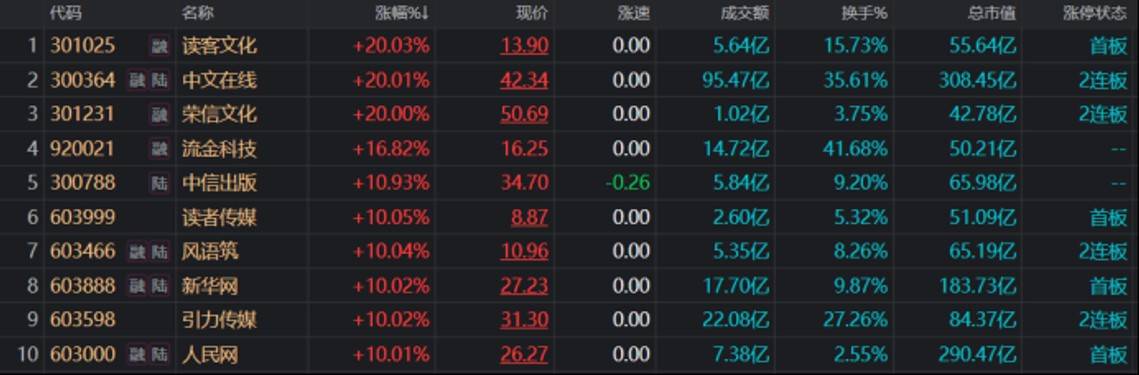
Group 1 - The media sector has seen a significant surge, with multiple stocks experiencing strong performance and daily trading volume exceeding 180 billion, marking a near two-year high in market share [1] - Investors are cautioned to look beyond surface-level market enthusiasm and focus on the underlying trading intentions of capital, as the direction of the market is primarily driven by actual fund movements rather than mere news or hype [1] - Quantitative data analysis is highlighted as a valuable tool for investors to gain insights into market dynamics, helping them to avoid subjective biases and understand the true intentions of capital [1] Group 2 - The article emphasizes the importance of recognizing "profit-taking" signals when prices are rising, as this indicates that previous investors may be cashing out, which can lead to a slowdown in price momentum [2] - A case study illustrates that during a period of price increase, five out of eight trading days were dominated by "profit-taking" behavior, suggesting that despite rising prices, significant capital was exiting the market, leading to potential corrections [5] - The concept of "short covering" is introduced as another critical signal, indicating that previously bearish investors are starting to buy back, which can stabilize or reverse downward price trends [5][6] Group 3 - The article provides examples of "short covering" where, despite price declines, the majority of trading days showed signs of buying activity from short sellers, indicating a potential rebound in prices [11] - Quantitative data is presented as a means to objectively assess market conditions, allowing investors to see behind price movements and avoid being influenced by emotional reactions to market fluctuations [14] - The use of quantitative analysis is portrayed as a way to equip investors with a clearer understanding of market realities, enabling them to make more informed decisions without relying on complex terminology or gut feelings [14]