震仓

Search documents
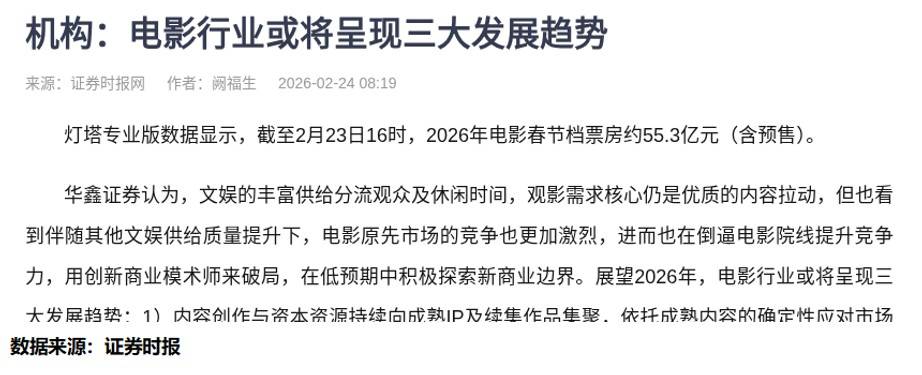
春节档票房亮眼,量化看清不炒影视股的逻辑
Sou Hu Cai Jing· 2026-02-24 12:22
Core Insights - The article emphasizes the importance of understanding real trading behaviors rather than just surface-level market trends, highlighting that true investment success relies on analyzing quantitative data instead of relying on intuition or popular news [1][17]. Group 1: Market Trends and Investment Behavior - The film industry is experiencing trends such as the rise of IP sequels, the use of AI technology for cost reduction, and diversification in cinema experiences, with projections indicating that the box office for the 2026 Spring Festival will exceed 55.3 billion [1]. - The article warns against being misled by superficial market excitement, using the example of the solid-state battery concept stock that saw a 6.9% increase in one day, followed by a two-month period of only a 10% gain, illustrating the volatility and potential pitfalls of emotional trading [3][6]. Group 2: Quantitative Analysis - Quantitative data can reveal the underlying dynamics of market movements, with two key indicators: "dominant momentum" reflecting various trading behaviors and "institutional inventory" indicating the level of institutional participation in trading [6][11]. - Identifying key trading signals through quantitative analysis can help investors distinguish between genuine market declines and "shakeouts," where weak hands are removed from the market to facilitate future price increases [7][11]. Group 3: Trading Logic and Market Psychology - Stocks that perform well often require repeated "shakeouts" to clear out less committed investors, allowing for smoother upward movements. Recognizing these signals can help investors stay aligned with market trends [14]. - The article suggests that many investors struggle in the current market not due to its inherent difficulty, but because they continue to rely on outdated methods such as following news and price movements, which can lead to emotional decision-making [17][18]. Group 4: Building Investment Confidence - The use of objective data can help investors maintain a rational mindset, reducing the influence of emotions on decision-making. This approach allows for a clearer understanding of market dynamics beyond just price movements [18]. - The article concludes that successful investing does not require extensive expertise but rather the ability to utilize tools that eliminate emotional biases, emphasizing the importance of understanding the true nature of trading behaviors [18].

生鲜赛道迎整合,炒购并必看资金行为
Sou Hu Cai Jing· 2026-02-19 01:16
Group 1 - Meituan plans to acquire Dingdong Maicai's core operating entity for approximately 5 billion RMB, highlighting the competitive landscape in the fresh food e-commerce sector, which is characterized by high frequency demand and strong traffic potential, but also faces challenges such as high wastage and low profit margins [1] - The industry has transitioned from a phase of traffic expansion to a period of stock competition, where resource integration among leading platforms is seen as a key direction for improving industry efficiency [1] - The impact of news events on market behavior is often indirect, but changes in industry dynamics will ultimately be reflected in trading behaviors, emphasizing the importance of focusing on real capital movements rather than short-term news effects [1] Group 2 - "Speculative capital grabbing" is identified as a typical behavior in capital competition, where the overlap of institutional inventory and speculative capital movements indicates mutual interest in specific targets [3] - This behavior is not isolated, as similar patterns can be observed before the market trends of various targets, providing clear signals for monitoring capital movements [3] - After the emergence of speculative capital grabbing, the targeted stocks may not perform immediately and could experience several days of adjustment due to the ensuing competition between institutions and speculators [5] Group 3 - The value of quantitative big data lies in its ability to penetrate superficial stock price fluctuations and reveal the underlying essence of capital competition, helping participants avoid being misled by short-term volatility [7] - Stocks with long-term potential often exhibit repeated "shakeout" behaviors, where institutions aim to accumulate sufficient shares by clearing floating capital through price fluctuations, indicating a long-term investment intention [8] - The observation of similar behavioral logic across different stocks reinforces the effectiveness of quantitative big data in capturing common capital behaviors rather than random fluctuations of individual stocks [10] Group 4 - In a complex market environment, ordinary participants may be swayed by news and price movements, leading to emotional judgments, while quantitative big data offers an objective perspective focused on real capital behaviors [10] - Quantitative tools enable the identification of stocks that attract capital attention and help clarify the underlying layout logic behind price fluctuations, establishing a more stable decision-making framework [10] - The consistent patterns in capital behavior provide a roadmap for navigating market changes, suggesting that leveraging quantitative big data can lead to clearer investment directions [10]

融资资金持续布局,量化拆解震荡背后的玄机
Sou Hu Cai Jing· 2026-01-19 04:17
Core Viewpoint - The article emphasizes the importance of quantitative data in understanding market dynamics and avoiding subjective biases in investment decisions. It highlights how many investors fall into traps during volatile markets, often driven by emotions rather than data-driven insights [1][3][10]. Group 1: Market Dynamics - Recent statistics show that 167 stocks in the Shanghai and Shenzhen markets have experienced net financing inflows for over five consecutive days, with many leading stocks seeing net inflows for more than ten days [1]. - Investors often react to such data with either a rush to buy popular stocks or skepticism about potential manipulation, reflecting a gap between subjective perceptions and actual market behavior [1][10]. Group 2: Quantitative Data Insights - The article introduces two core indicators from quantitative data: the "dominant momentum" which reflects four trading behaviors (buying, profit-taking, short-selling, and covering), and "institutional inventory" which indicates the activity level of large funds [6]. - When the dominant momentum shows a "covering" behavior while institutional inventory remains active, it signals that large funds are quietly accumulating positions, which is a key indicator of market strength [7]. Group 3: Historical Performance and Probability Advantage - An analysis of a specific stock in the solid-state battery sector revealed that there were nine instances of "shock warehouse" signals since the second quarter of last year, with six of these signals marking local lows, indicating a higher probability of successful investment compared to random timing [11]. - The article argues that quantitative data provides a probability-based approach to identify better entry points, contrasting with the often misguided timing of average investors who rely on gut feelings [14]. Group 4: Rational Trading Mindset - The current market environment is characterized by an overload of information, leading to emotional trading behaviors such as impulsive buying during rallies and panic selling during corrections [15]. - The article advocates for a shift towards a rational trading mindset, where the focus is on the sustained activity of large funds rather than merely the stocks being bought, to differentiate between genuine long-term investments and short-term speculation [15][16].

全球暴跌背后:机构震仓的7次机会
Sou Hu Cai Jing· 2025-11-18 07:29
Group 1 - The article discusses the recent market turmoil, highlighting the significant drop in major indices and cryptocurrencies, indicating a familiar yet unique crisis scenario [1][3] - It emphasizes the importance of understanding market dynamics beyond surface-level price movements, suggesting that true investment opportunities lie in comprehending institutional behaviors [4][6] - The concept of "震仓" (shakeout) is introduced, illustrating how large funds manipulate stock prices to induce panic selling and acquire shares at lower prices [6][12] Group 2 - The article presents a quantitative perspective on institutional trading behaviors, noting that a well-developed quantitative system can reveal underlying market patterns and signals [7][10] - It highlights the correlation between the frequency of shakeouts and a stock's potential, suggesting that more shakeouts indicate stronger institutional interest and capability [12][16] - The piece concludes by asserting that while macroeconomic events serve as a backdrop, the real narrative is driven by institutional actions, with quantitative data providing the clearest insights into market sentiment [19]
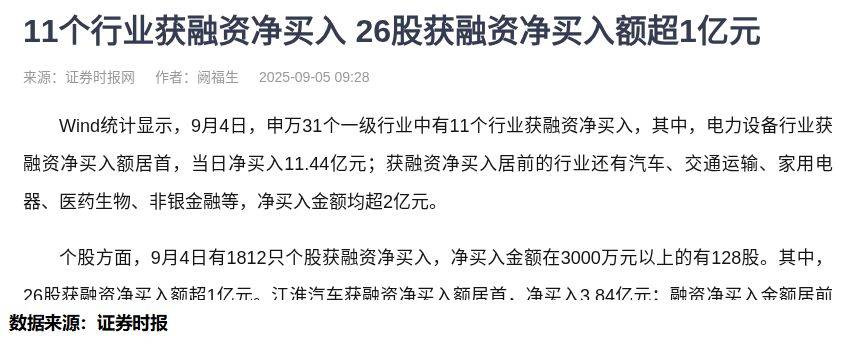
牛市新的机会,11个行业获融资买入!
Sou Hu Cai Jing· 2025-09-07 01:55
Group 1 - The electric power equipment industry has become a favorite among investors in September, with a net buying amount of 1.144 billion yuan, leading the market [1][2] - 26 stocks, including Jianghuai Automobile, saw over 100 million yuan in financing on a single day, indicating significant institutional interest [2] - The current market activity may reflect a strategic maneuver by institutions rather than genuine enthusiasm for the new energy sector [1][9] Group 2 - Historical context shows that market fluctuations often coincide with institutional strategies, such as the significant market movements in the second quarter of 2025 [3][4] - Institutions may engage in "smashing the market" to accumulate shares when they find their positions insufficient, leading to sudden market drops that are misinterpreted as external shocks [4][12] - The electric power equipment sector's current financing activity raises questions about whether it is a genuine value discovery or a prelude to another institutional shakeout [9][12] Group 3 - Case studies of Huadong Medicine and Shenzhou Cell illustrate the difference between genuine market adjustments and strategic institutional actions, with the latter often leading to significant price movements [6][8] - Data analysis reveals that Shenzhou Cell experienced notable institutional buying during its adjustment, while Huadong Medicine did not, resulting in divergent outcomes when the market rebounded [8] - The electric power equipment industry's recent activity may mirror past instances where institutions manipulated market perceptions to their advantage [12]