量化大数据

Search documents
公募新规将至,有些机构已经提前动作
Sou Hu Cai Jing· 2026-02-28 01:59
Group 1 - The core viewpoint of the article emphasizes that market movements are often misleading, and understanding the underlying trading behaviors is crucial for making informed investment decisions [1][3][11] - The article discusses the concept of "profit-taking," where investors who have made gains begin to cash out, which can lead to market adjustments despite a seemingly stable or rising price [5][6][8] - It highlights the importance of quantitative data in identifying hidden trading behaviors, allowing investors to see beyond surface-level market trends and make better decisions [8][17] Group 2 - The article illustrates that during times of negative news, such as a significant drop in stock prices, it is essential to analyze the underlying trading actions, like "short covering," which indicates that larger investors may be positioning themselves for future gains [11][14] - It emphasizes that quantitative data can help investors avoid emotional reactions to market fluctuations, leading to more stable and sustainable investment strategies [17][18] - The article concludes that leveraging quantitative analysis can enhance investment capabilities by providing a clearer understanding of market dynamics and reducing reliance on subjective judgment [17]


智驾芯片融资提速,新热点又要来了?
Sou Hu Cai Jing· 2026-02-27 13:16
Group 1 - The core viewpoint of the article highlights the accelerated financing pace in the intelligent driving chip sector, with three companies successfully completing new rounds of equity financing, including NIO's chip subsidiary raising over 2.2 billion yuan [1] - The global automotive chip market is expected to exceed 170 billion yuan by 2030, with domestic manufacturers poised to leverage their leading position in the new energy vehicle sector [1] - Many market participants tend to rely on superficial indicators such as hot concepts, performance, and price trends, which can lead to misjudgments; a focus on quantitative big data is essential to understand the underlying market logic [1] Group 2 - A common misconception among market participants is that they primarily judge based on whether a sector is a hot area, performance quality, or price levels, which often leads to inaccuracies [3] - The core driver of price movements is the behavior of large institutional funds rather than superficial performance or concepts; when a stock enters a consolidation phase after adjustments, it may not signal a bottom if institutional participation is lacking [3] - Quantitative big data tools can capture the "institutional inventory" data, which reflects the trading activity of institutional funds, indicating their level of engagement in the market [3] Group 3 - Stocks that enter a consolidation phase after adjustments can have vastly different outcomes based on the activity level of institutional inventory; active institutional participation often indicates a long-term investment strategy [6] - Stocks experiencing wide fluctuations may mislead investors; if institutional inventory data declines during price oscillations, it suggests weakening institutional interest, making any price increases likely unsustainable [8] - The continuous tracking of institutional inventory data provides objective evidence of changes in core trading behaviors, helping to avoid common cognitive biases in market judgments [13] Group 4 - Some stocks may show clear signs of price breakdown, causing concern among participants; however, active institutional inventory data can indicate that such price movements are part of a broader trading strategy rather than a lack of interest [10] - The core value of institutional inventory data lies in its ability to reflect the trading intentions of large funds, with sustained activity signaling long-term planning rather than short-term fluctuations [10] - In the complex market landscape, focusing on the behavior of core trading entities is crucial for understanding market dynamics, with quantitative big data serving as a reliable alternative to subjective assessments [13]

行情在消息情绪,看清机构行为不踩坑
Sou Hu Cai Jing· 2026-02-27 07:52
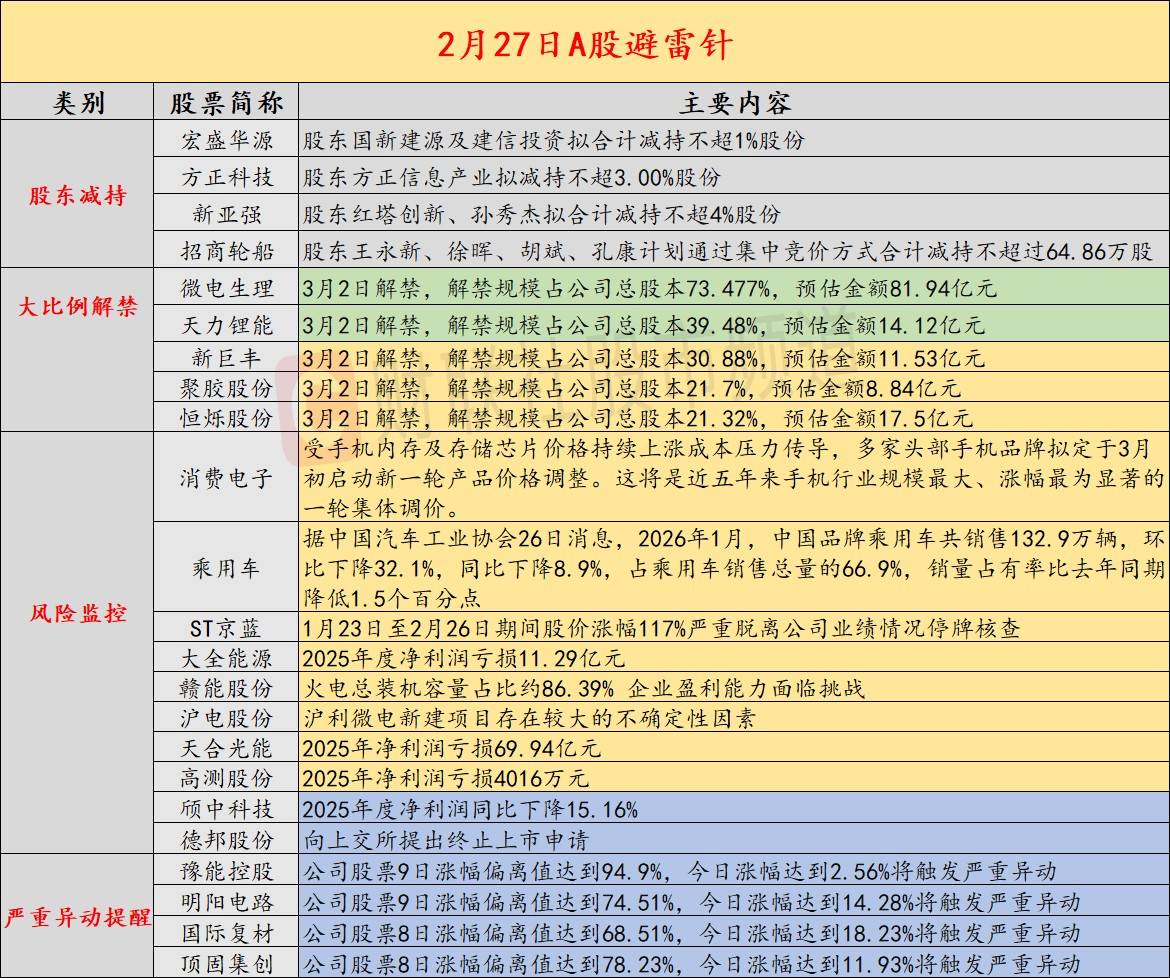
Core Viewpoint - The article emphasizes that market movements are influenced more by underlying trading behaviors rather than just news events, suggesting that a quantitative data approach can help investors understand the true market dynamics [1]. Group 1: Market Dynamics - Various smartphone brands are planning to adjust product prices due to rising costs from memory and storage chips, marking the largest price increase in the smartphone industry in five years [2]. - In the automotive sector, Chinese brand passenger car sales in January 2026 reached 1.329 million units, a decrease of 32.1% month-on-month and 8.9% year-on-year, with a market share drop of 1.5 percentage points [2]. Group 2: Shareholder Actions - Shareholders of Hongsheng Huayuan and Fangzheng Technology plan to reduce their stakes by up to 1% and 3% respectively [2]. - A significant share unlock is expected for several companies on March 2, including: - China Merchants Shipping with a 64.86% unlock, estimated at 81.94 billion [2]. - Weidian Physiotherapy with a 73.477% unlock, estimated at 14.12 billion [2]. - New Giant Hand with a 30.88% unlock, estimated at 11.53 billion [2]. - JuJiao Co. and HengLian Co. with unlocks of 21.7% and 21.32%, estimated at 8.84 billion and 17.5 billion respectively [2]. Group 3: Trading Behavior Insights - The article introduces four core trading behaviors identified through quantitative data: - "Bullish Dominance" indicates active buying [4]. - "Profit Taking" shows that previous investors are cashing out [4]. - "Bearish Dominance" reflects a tendency for investors to sell [4]. - "Short Covering" indicates that previously exited investors are re-entering the market [4]. Group 4: Behavioral Analysis - The article discusses how "Profit Taking" can mislead investors into thinking a stock is still on an upward trend when in fact, funds are exiting [6]. - Conversely, "Short Covering" can lead to price increases despite negative news, as funds may be entering the market during panic selling [10]. - Quantitative data can reveal these hidden behaviors, allowing investors to make more informed decisions and avoid emotional reactions to market fluctuations [13].
奢品巨头重新布局,消费赛道要复苏?
Sou Hu Cai Jing· 2026-02-26 14:58
Group 1 - The luxury goods sector is experiencing a dichotomy between subjective biases and quantitative facts, as evidenced by LVMH's consideration of selling non-core beauty brands while simultaneously launching a high-end lipstick line [1] - The market's perception of the beauty segment is polarized, with some investors believing it is declining while others see opportunities due to LVMH's entry, highlighting the confusion caused by subjective judgments [1][2] - The true intentions of market players are often obscured, similar to how stock movements can mislead investors, emphasizing the need for a deeper understanding of trading behaviors [2][10] Group 2 - Quantitative data can reveal critical insights into market dynamics, such as the "dominant momentum" and "institutional inventory," which reflect core trading behaviors and institutional participation [4] - Analyzing stocks through quantitative metrics can clarify whether price movements are genuine recoveries or mere traps for retail investors, thus eliminating guesswork [4][6] - The distinction between subjective and quantitative analysis is crucial, as the former relies on experience and can be misled by market noise, while the latter focuses on actual trading actions and trends [10] Group 3 - LVMH's strategy of selling non-core brands is not a retreat from the beauty sector but a focus on high-margin products, aligning with the broader trend of resource optimization in investment strategies [6][10] - The ability to discern institutional actions through quantitative data can help investors navigate complex market environments and establish a sustainable investment framework [10]

ETF鲸吞千亿融资,大A玩法变化很大
Sou Hu Cai Jing· 2026-02-26 14:06
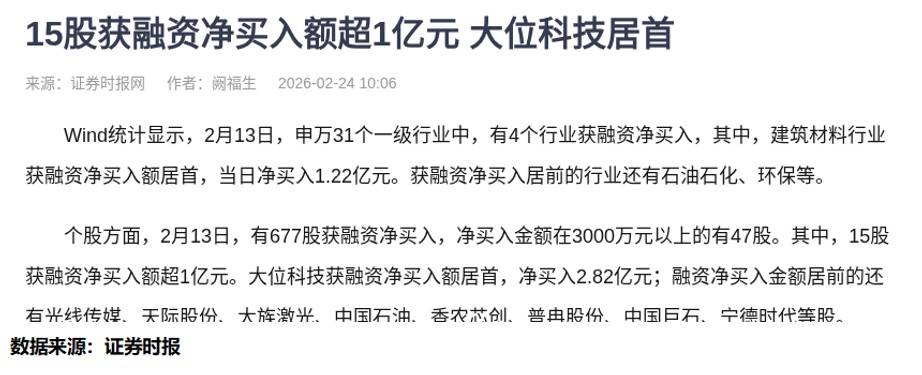
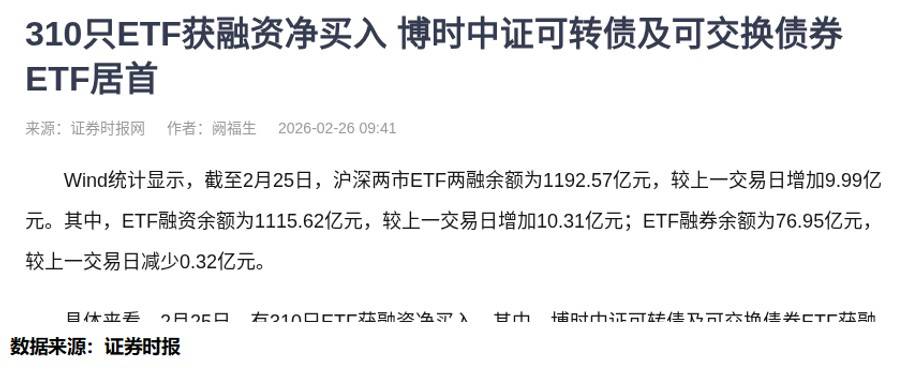
Core Insights - The market is experiencing a structural change, with the balance of ETF margin trading in the Shanghai and Shenzhen markets exceeding 119 billion yuan, reflecting a nearly 10 billion yuan increase from the previous trading day [1] - Quantitative data is providing a new perspective on trading behaviors, focusing on the real participation characteristics of core funds rather than just price fluctuations [1] Group 1: Absence of Core Fund Participation - A rebound characterized by a double bottom pattern often leads to optimistic market sentiment, but quantitative data shows a lack of core fund participation during these rebounds, indicating a lack of sustained momentum [3][5] - The absence of core trading characteristics during price rebounds suggests that these movements are merely short-term fluctuations without long-term viability [5] Group 2: False Low Points in Downtrends - Investors often expect a rebound after significant declines, but quantitative data reveals that subsequent rebounds lack core fund activity, indicating they are driven by scattered short-term trading rather than sustained interest from core funds [8] - The absence of core fund participation during these rebounds leads to a continuous resetting of perceived low points, creating a "lower low" trend [8] Group 3: Resilience During Price Adjustments - During price adjustments following new highs, core fund trading characteristics remain active, suggesting that short-term price drops are more likely to be phase corrections rather than trend reversals [11] - Relying solely on price movements can lead investors to exit during consolidation phases, missing potential trend continuations [11] Group 4: Consistency in Behavior Amidst Fluctuations - In a fluctuating market, core fund participation remains active during multiple price adjustments, which can mislead investors into making premature exit decisions based on traditional price analysis [14] - The sustained involvement of core funds during price fluctuations indicates that traditional shape judgments may overlook the underlying funding behavior, leading to missed opportunities [14] Group 5: Value of Quantitative Data - The core value of quantitative data lies in its focus on changes in trading behavior rather than price movements, providing a more objective observation dimension for investors [15] - When core fund trading characteristics are present, short-term price fluctuations are unlikely to alter the overall trend, while their absence suggests that price changes may not be sustainable [15]
港股IPO热涌,AH影响如何关键是机构态度
Sou Hu Cai Jing· 2026-02-26 12:25
Group 1 - The core viewpoint of the article highlights the recent surge in IPO activity in the Hong Kong stock market, with 24 companies successfully listed and fundraising exceeding last year's figures by over 10 times, indicating Hong Kong's status as a global capital hub [1] - The article emphasizes the importance of understanding the true attitude of capital behind market movements, rather than being swayed by surface-level news [1][3] - It discusses the concept of "institutional inventory" as a quantitative measure of capital participation, illustrating that a lack of institutional involvement can lead to poor performance of seemingly promising stocks [4][7] Group 2 - The article points out that market reactions to news often lag behind actual capital movements, suggesting that institutions may be active before news catalysts become apparent [11][14] - It explains that significant market events may not directly cause stock performance but rather serve as catalysts for previously established institutional positions [15][17] - The value of quantitative data is emphasized as a tool to discern underlying market logic, helping investors avoid being misled by superficial news and focus on genuine capital behavior [10][17]

海外市场波谲云诡,有一个数据是定心丸
Sou Hu Cai Jing· 2026-02-24 17:22
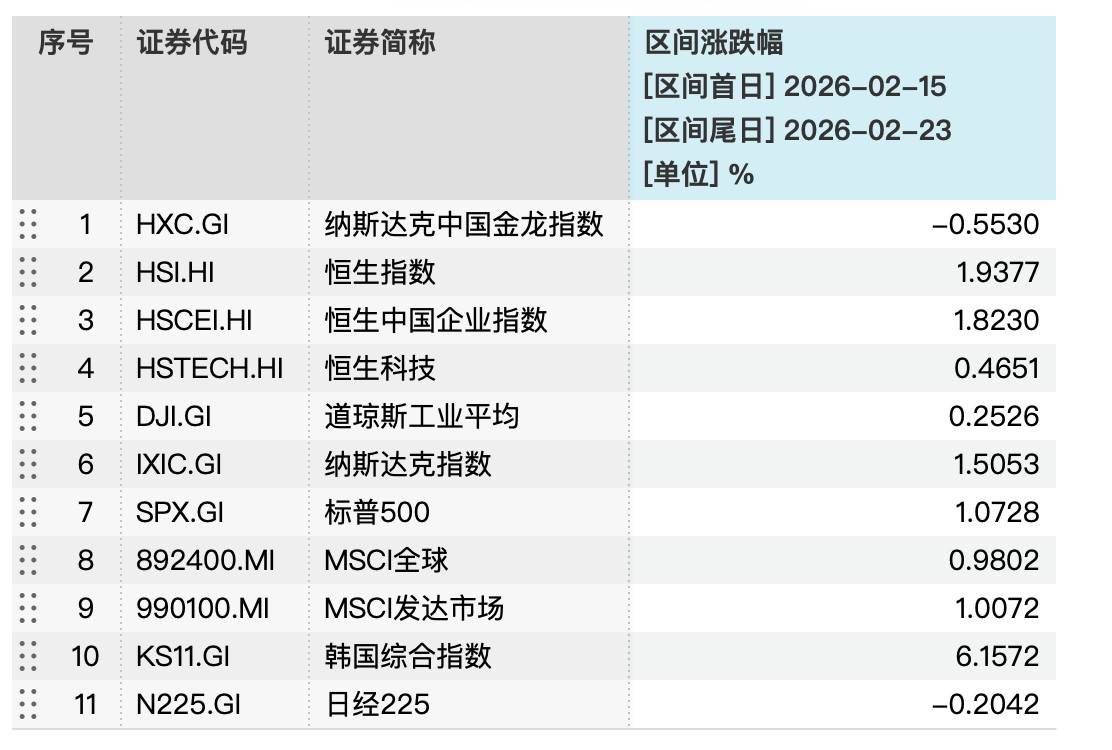
Group 1 - The article emphasizes the importance of not being swayed by news and emotional reactions in investment decisions, advocating for the use of quantitative data to guide actions [1][2][6] - It highlights that market movements are often influenced by underlying fund activities rather than surface-level news, suggesting that investors should focus on data to avoid making impulsive decisions [1][6] - The concept of "institutional inventory" is introduced, indicating that even during price declines, active institutional participation can signal a potential rebound, contrasting with situations where institutions withdraw [6][9] Group 2 - The article warns against the misconception that price rebounds are always reliable indicators of future performance, stressing the need to verify institutional involvement before making investment decisions [9][14] - It discusses the pitfalls of chasing rebounds without understanding the underlying support from institutional funds, which can lead to losses if the rebound lacks solid backing [14] - The narrative concludes by advocating for a disciplined investment approach that relies on quantitative data to maintain a stable mindset and avoid emotional trading [12][14]
IPO提速,大A能接得住吗?
Sou Hu Cai Jing· 2026-02-24 12:42
Group 1 - The A-share IPO market is showing clear signs of recovery, with the number of projects under review increasing by over 146% compared to the same period last year, while the number of terminated reviews has decreased by over 85% [1] - New quality productivity-related sectors have become the core focus for the year, indicating a shift in investment strategies [1] - The maturity of quantitative big data technology allows for precise capture of the true intentions of funds, moving beyond mere speculation based on market trends [1] Group 2 - The article emphasizes the importance of recognizing the consensus among different types of funds, as this often leads to above-average performance of related stocks [1] - Quantitative tools can help identify signals of active trading behavior, such as "speculative capital rushing to buy," which indicates a consensus among funds [5][9] - The article illustrates that even before a stock shows significant price movement, quantitative data can reveal active trading behaviors, suggesting potential value [9][14] Group 3 - The article discusses the commonality of fund logic across different industries, asserting that similar trading traces are left when two types of funds reach consensus, regardless of industry attributes [12] - It highlights that the use of quantitative tools can provide clarity on trading behaviors, helping investors avoid being misled by short-term price fluctuations [7][16] - The current warming of the IPO market and focus on new quality productivity sectors present opportunities for investors to leverage quantitative tools for better decision-making [16]
春节档票房亮眼,量化看清不炒影视股的逻辑
Sou Hu Cai Jing· 2026-02-24 12:22
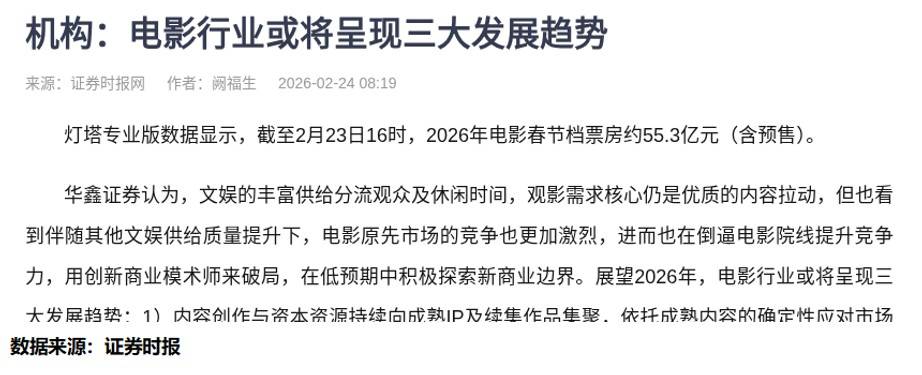
Core Insights - The article emphasizes the importance of understanding real trading behaviors rather than just surface-level market trends, highlighting that true investment success relies on analyzing quantitative data instead of relying on intuition or popular news [1][17]. Group 1: Market Trends and Investment Behavior - The film industry is experiencing trends such as the rise of IP sequels, the use of AI technology for cost reduction, and diversification in cinema experiences, with projections indicating that the box office for the 2026 Spring Festival will exceed 55.3 billion [1]. - The article warns against being misled by superficial market excitement, using the example of the solid-state battery concept stock that saw a 6.9% increase in one day, followed by a two-month period of only a 10% gain, illustrating the volatility and potential pitfalls of emotional trading [3][6]. Group 2: Quantitative Analysis - Quantitative data can reveal the underlying dynamics of market movements, with two key indicators: "dominant momentum" reflecting various trading behaviors and "institutional inventory" indicating the level of institutional participation in trading [6][11]. - Identifying key trading signals through quantitative analysis can help investors distinguish between genuine market declines and "shakeouts," where weak hands are removed from the market to facilitate future price increases [7][11]. Group 3: Trading Logic and Market Psychology - Stocks that perform well often require repeated "shakeouts" to clear out less committed investors, allowing for smoother upward movements. Recognizing these signals can help investors stay aligned with market trends [14]. - The article suggests that many investors struggle in the current market not due to its inherent difficulty, but because they continue to rely on outdated methods such as following news and price movements, which can lead to emotional decision-making [17][18]. Group 4: Building Investment Confidence - The use of objective data can help investors maintain a rational mindset, reducing the influence of emotions on decision-making. This approach allows for a clearer understanding of market dynamics beyond just price movements [18]. - The article concludes that successful investing does not require extensive expertise but rather the ability to utilize tools that eliminate emotional biases, emphasizing the importance of understanding the true nature of trading behaviors [18].
融资资金扎堆,别被走势骗了
Sou Hu Cai Jing· 2026-02-24 03:17
Core Viewpoint - The article emphasizes the importance of understanding the true trading intentions of funds, particularly institutional investors, rather than relying solely on personal intuition or market trends when making investment decisions [1]. Group 1: Misjudging Market Trends - Investors often rely on personal feelings to determine market highs and lows, leading to premature selling or buying decisions [3]. - The article illustrates that stock price movements are dictated by the trading intentions of funds, especially institutional participation, rather than mere price trends [3]. - An example is provided where a stock doubled in price within three months, and despite price corrections, institutional inventory data indicated continued participation, suggesting that these corrections were normal rather than signals of a market peak [3]. Group 2: Misinterpretation of Price Corrections - A common mistake is to sell off stocks after they reach new highs and begin to correct, assuming the market has peaked [5]. - The article highlights that during price corrections, institutional inventory data remained active, indicating ongoing institutional interest and suggesting that these corrections were merely consolidations for future gains [5]. - Investors who sell during these corrections may miss out on significant future profits [5]. Group 3: Risks of Bottom Fishing - The belief that a stock must rebound after a significant drop leads many investors to attempt bottom fishing, often resulting in losses [7]. - The article notes that many rebounds are not supported by institutional buying, making them unreliable and prone to further declines [7]. - An example is given of a stock that continued to decline despite apparent short-term rebounds, illustrating the dangers of following market sentiment without institutional backing [7]. Group 4: Misreading Rebounds After Declines - Investors often mistake short-term rebounds following significant declines as signs of a market reversal, leading to hasty buying decisions [9]. - The article points out that during these rebounds, institutional inventory data showed no signs of active participation, indicating that these movements were merely emotional responses rather than genuine reversals [9]. - This misinterpretation can result in investors being trapped in further downtrends after buying into these false signals [9]. Group 5: Establishing Probability-Based Thinking - The article advocates for a shift from intuitive decision-making to a data-driven approach that focuses on the participation of institutional investors [12]. - By utilizing quantitative data, investors can better understand the true market dynamics and improve their decision-making processes [12]. - The emphasis is on developing a systematic investment strategy based on objective data rather than subjective feelings, which can enhance long-term investment success [12].