机构资金流入

Search documents
招金黄金2026年1月21日涨停分析:黄金期货新高+资源布局+机构资金流入
Xin Lang Cai Jing· 2026-01-21 03:42
Group 1 - The core viewpoint of the news is that Zhaojin Gold (SZ000506) experienced a trading halt on January 21, 2026, with a closing price of 19.33 yuan, reflecting a 10.02% increase and a total market capitalization of 17.958 billion yuan [1] Group 2 - The reasons for Zhaojin Gold's trading halt include the new highs in gold futures, resource layout, and inflow of institutional funds. The company primarily focuses on gold mining and sales, with gold sales accounting for 98.37% of its revenue. The recent surge in gold prices has significantly benefited the company [2] - In 2026, the company plans to enhance exploration efforts to increase resource reserves, particularly focusing on the exploration rights of the Beidao Kaxishan area. It will also cautiously evaluate external acquisition opportunities to improve resource security, which is favorable for the company's long-term development [2] - The gold sector has attracted market attention due to rising gold prices, leading to increased investor interest in gold-related stocks. Data from Tonghuashun indicates significant capital inflow into the gold sector, with Zhaojin Gold's segment also favored by investors [2] - On January 20, 2026, Zhaojin Gold was listed on the "Dragon and Tiger List" due to net buying from institutions and foreign capital, indicating a clear inflow of funds. The trading volume on that day was 1.677 billion yuan, with total purchases of 334 million yuan and total sales of 518 million yuan, suggesting positive market sentiment towards the company's future [2] - From a technical perspective, if the stock's MACD indicator formed a golden cross or if the K-line broke through significant resistance levels, such as the upper Bollinger Band, it would attract more technical investors, further driving up the stock price [2]

沪指创近十年新高,A股总市值首超百万亿!这个板块成最大功臣,还有多少资金在路上?
Mei Ri Jing Ji Xin Wen· 2025-08-18 10:13
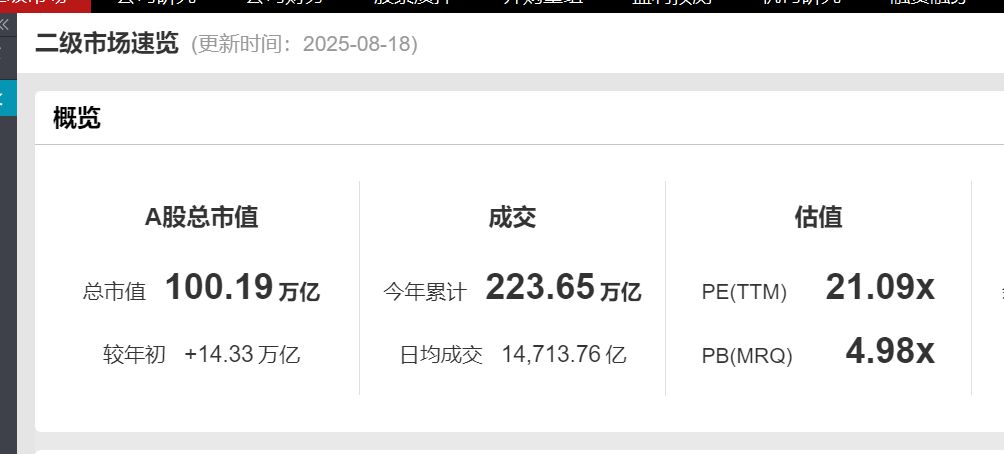
Core Viewpoint - The A-share market has reached a historic milestone, with the total market capitalization surpassing 100 trillion yuan for the first time, driven by significant increases in various sectors, particularly the information technology sector [1][8]. Market Performance - On August 18, the Shanghai Composite Index opened high and broke through the previous high of 3731.69 points, marking a ten-year high since August 2015 [1]. - The total market capitalization of A-shares reached 100.19 trillion yuan, an increase of 14.33 trillion yuan since the beginning of the year [1]. - The total trading volume for the year has reached 223.65 trillion yuan, with an average daily trading volume of 1.47 trillion yuan [1]. Sector Performance - The information technology sector has seen a market capitalization increase of 11.55% since August, making it the largest contributor to the overall market capitalization growth [7]. - Other sectors such as materials and industrials also experienced significant growth, with market capitalization increases of 7.10% and 6.54%, respectively [7]. - The financial sector maintained a strong position with a market capitalization of 177.02 trillion yuan, reflecting a 3.39% increase [7]. Investor Behavior - There is a notable influx of retail investors into the market, although their overall participation remains cautious due to a prevailing "fear of heights" sentiment [8][9]. - New individual investor accounts have shown marginal improvement since May, but the absolute numbers remain low, indicating a lack of significant capital inflow from retail investors [8][9]. - The trend of "capital migration" among residents is expected to continue, with a decrease in the attractiveness of low-interest savings and financial products, potentially leading to increased investment in the stock market [10]. Future Outlook - Institutional funds are anticipated to continue flowing into A-shares, with foreign capital shifting from net selling to net buying [10]. - The report suggests focusing on three investment directions: technology sectors such as consumer electronics and AI software, new consumption trends, and thematic investments like commercial aerospace and brain-computer interfaces [10].