极化效应

Search documents
上海财经大学:《智能经济:中国发展新形态——智能经济生态观察与智能生态基础理论预研报告》
欧米伽未来研究所2025· 2026-03-07 14:33
Core Viewpoint - The report redefines the concept of "smart economy" as "capability economy," marking a significant shift from previous narratives that viewed it merely as an advanced stage of the digital economy or as AI empowering traditional industries [2][3]. Policy Narrative and National Strategy - The report outlines a clear trajectory of policy evolution in China's AI strategy, highlighting key milestones from 2017 to 2026, culminating in the recognition of "building a new form of smart economy" as a national development coordinate [4][6]. Industry Classification - The report introduces the concept of a "fourth industry," asserting that AI-driven smart technology has the potential to become an independent sector, distinct from traditional primary, secondary, and tertiary industries [7]. AI Industry Landscape - The report describes the competitive landscape of China's AI industry, characterized by a "four big + six small tigers" model, indicating a shift towards international capability output [8]. Characteristics and Mechanisms of Smart Economy - The report identifies 20 fundamental characteristics of the smart economy, including the potential for exponential productivity liberation and the risk of a "fifth decoupling" between humans and labor [9][10]. Governance Framework - The report proposes a governance framework consisting of 21 principles aimed at ensuring that AI development is human-centered and addresses global public affairs, social responsibility, and ethical considerations [11]. Conclusion - The report emphasizes that the future of the smart economy will be shaped by market forces and collective choices, highlighting the importance of institutional design and social consensus alongside technological breakthroughs [12].


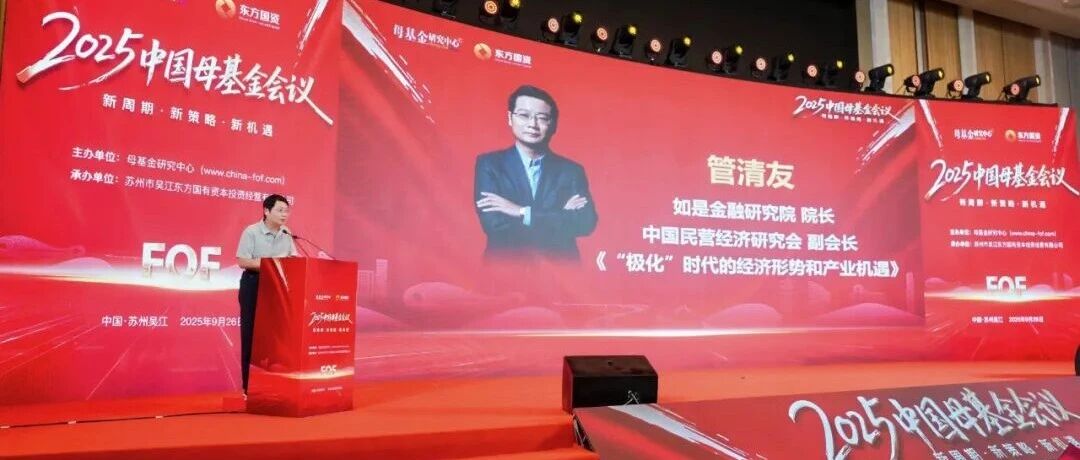
管清友:“极化”时代下的投资新机遇
母基金研究中心· 2025-10-26 10:35
Group 1 - The event "2025 China Fund of Funds Conference" was successfully held in Suzhou, gathering over 200 representatives from government, industry associations, and leading investment institutions to discuss the future of the Chinese fund of funds industry [1] - The keynote speech by Guan Qingyou highlighted the current economic situation and industry opportunities, emphasizing the significant changes in both internal and external environments [2][3] Group 2 - The concept of "great contention" reflects the profound changes in the global landscape, with the VC/PE industry facing unprecedented challenges and complexities [3][4] - The U.S. bond market has seen significant sell-offs, while global central banks, including China's, are increasing gold reserves, indicating a shift in investment strategies [4] - China is becoming a crucial hub for global manufacturing, with a unique industrial ecosystem that integrates various sectors [5] Group 3 - The "polarization effect" is intensifying, leading to extreme disparities in wealth and opportunities, with only a small percentage of entities benefiting from economic growth [6][7] - The VC/PE industry is undergoing deep adjustments, with state-owned capital now accounting for two-thirds of the total limited partners, reflecting a survival of the fittest scenario [6][7] Group 4 - Structural prosperity is emerging in specific sectors, presenting significant opportunities for those with foresight and high cognitive abilities [8][9] - The year 2025 is anticipated to be a pivotal turning point, particularly in technology sectors such as AI, military, and robotics, which are expected to experience substantial growth [8][9] Group 5 - Three types of companies are identified as key investment opportunities: rainforest-type enterprises (large internet platforms), oasis-type enterprises (smaller innovative firms), and meadow-type enterprises (resilient companies with core technologies) [9]