
核军备控制

Search documents
炒作新核导条约,鲁比奥又想拉中国下水
Xin Lang Cai Jing· 2026-02-07 04:16
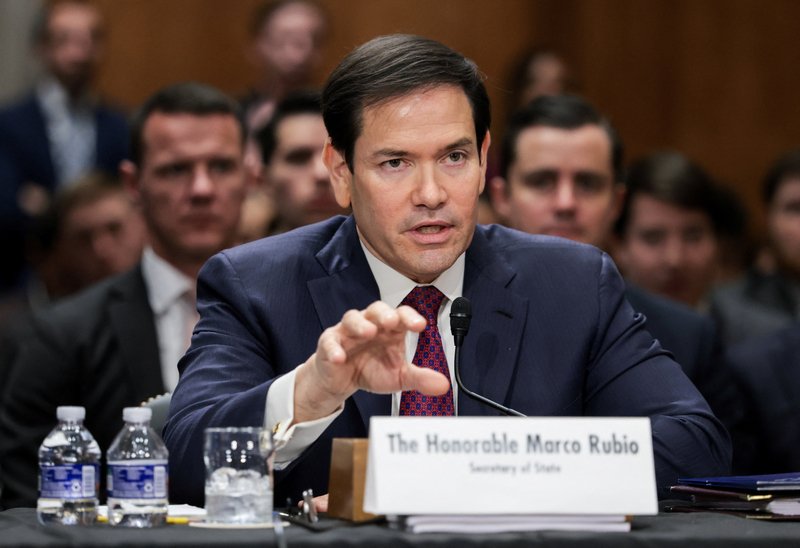
Core Viewpoint - The expiration of the New START treaty has prompted the U.S. to call for trilateral arms control talks involving China and Russia, with U.S. officials accusing China of expanding its nuclear arsenal and asserting that any future arms control agreements must include China [1][2]. Group 1: U.S. Position on Arms Control - U.S. Secretary of State Rubio claims that the traditional bilateral arms control framework between the U.S. and Russia is outdated due to China's rapid and opaque nuclear expansion [2]. - Rubio emphasizes that future arms control must encompass both China and Russia, as articulated by former President Trump, indicating that other nations also bear responsibility for ensuring strategic stability [2][4]. - The U.S. plans to negotiate from a position of strength, asserting that Russia and China should not expect the U.S. to remain passive while they expand their nuclear capabilities [4]. Group 2: China's Response - China's disarmament ambassador, Shen Jian, rebuts U.S. claims, stating that the U.S. comments are irresponsible and that China will not participate in nuclear disarmament talks at this stage [1]. - A spokesperson from the Chinese embassy in the U.S. argues that the U.S. demand for China to join the nuclear disarmament process is unreasonable and unrealistic, asserting that China maintains its nuclear arsenal at the minimum level necessary for national security [4]. Group 3: New START Treaty Context - The New START treaty, signed in 2010 and extended in 2021, officially expired on February 5, 2026, raising concerns about a potential nuclear arms race between the U.S. and Russia [5]. - Despite the treaty's expiration, reports indicate that the U.S. and Russia have agreed to continue high-level military contacts and discuss potential alternatives to the New START treaty [5]. - The U.S. European Command has stated that maintaining military dialogue is crucial for global stability and peace, emphasizing the importance of strength and transparency in reducing conflict [5].

美国务院称日本主导核不扩散 或制衡首相官邸人士拥核论
Xin Lang Cai Jing· 2025-12-20 10:53
Group 1 - The core viewpoint of the article highlights the U.S. State Department's response to comments from Japanese officials regarding the necessity for Japan to possess nuclear weapons, emphasizing Japan's role as a leader in nuclear non-proliferation and arms control [1] - The U.S. official stated that the intention behind the comments is likely to counter the pro-nuclear sentiment in Japan, reinforcing the importance of maintaining a strong nuclear deterrent for the protection of allied nations, including Japan [1] - The U.S. will continue to uphold the most powerful, reliable, and modernized nuclear deterrent in the world, as part of its commitment to its allies [1]
美俄唯一生效核军控条约即将到期,双方互放重启核试验狠话!
Jin Shi Shu Ju· 2025-11-17 00:08
Core Points - The escalating threats of nuclear tests between the U.S. and Russia have raised global concerns about a new arms race, particularly with the New START treaty set to expire on February 4 [1][5] - The New START treaty limits the number of deployed strategic nuclear warheads to 1,550 for both countries, and there has been no significant progress towards a new agreement [1][5] - Despite ongoing tensions, both nations appear to be adhering to the treaty's limits on strategic nuclear weapons [6] Group 1 - The U.S. and Russia have exchanged provocative statements regarding nuclear tests, with Trump ordering the first U.S. nuclear test in 30 years following Putin's missile test announcement [1] - Trump expressed a positive response to Putin's proposal to extend the New START treaty, but no formal negotiations have taken place since then [3][5] - The U.S. Secretary of State indicated that discussions about potential dialogue regarding the treaty are ongoing, despite Russia's suspension of a key monitoring mechanism [5][6] Group 2 - Experts are concerned that the absence of a new agreement could lead to dangerous miscalculations, as it would be the first time in decades that the U.S. and Russia could deploy long-range nuclear weapons without constraints [6] - Some experts believe that a political agreement to maintain the treaty's limits on deployed warheads could be achieved relatively quickly [6] - There is increasing pressure from Republican officials against extending the treaty, with some arguing that it restricts U.S. modernization of nuclear forces [7][8]
热点问答|“普特会”能为俄乌冲突按下“暂停键”吗?
Xin Hua She· 2025-08-15 14:05
Core Points - The upcoming meeting between Presidents Putin and Trump is primarily focused on addressing the Ukraine crisis and the potential for a ceasefire [1][2] - Trump has expressed skepticism about the meeting's success, estimating only a "25% chance" of achieving a positive outcome, but believes there is a willingness from Putin to reach an agreement [1] - The discussions may involve complex issues, including territorial disputes, although Trump has indicated that the current meeting will not directly address territorial divisions [3][4] Group 1: Ukraine Crisis - The meeting aims to explore solutions to the Ukraine issue, with both sides having engaged in prior discussions [2] - Trump has emphasized the importance of a follow-up meeting involving Ukrainian President Zelensky if progress is made [1] - Both Russia and Ukraine have stated they will not make concessions on territorial issues, complicating the potential for a resolution [5] Group 2: US-Russia Relations - The meeting marks the first face-to-face encounter between US and Russian leaders since June 2021, amidst ongoing sanctions and strained relations due to Russia's military actions in Ukraine [6] - Both leaders have expressed goodwill, with Putin acknowledging US efforts to resolve the Ukraine crisis and Trump showing appreciation for Putin's statements [7] - Discussions may also extend to arms control and bilateral cooperation in economic and global security matters [7]
普京赞扬特朗普,暗示俄美或达成核军控协议
Jin Shi Shu Ju· 2025-08-14 14:45
Group 1 - Russian President Vladimir Putin praised the Trump administration's "positive" efforts to end the Russia-Ukraine conflict and hinted at a potential nuclear arms control agreement during the upcoming summit in Alaska [1] - Putin indicated that the talks with the U.S. aim to create conditions for long-term peace between the two countries and globally [1] - The New START treaty, which limits the nuclear arsenals of both nations, is set to expire in February 2026, raising concerns about future arms control agreements [1] Group 2 - Earlier this month, Trump ordered two nuclear submarines to be strategically deployed near Russia in response to provocative statements from Dmitry Medvedev, highlighting the tense relations between the two countries [2] - The summit will include a one-on-one conversation between the two presidents, followed by a working lunch, focusing on the Russia-Ukraine conflict and economic cooperation [2] - European leaders expressed cautious optimism after discussions with Trump, who agreed on the need for an immediate ceasefire and emphasized Ukraine's role in future negotiations [4]
伊朗驻国际原子能机构代表:伊朗方面表示,美国的打击对核军备控制造成了不可挽回的损害。
news flash· 2025-06-23 09:36
Core Viewpoint - Iran's representative to the International Atomic Energy Agency stated that U.S. actions have caused irreparable damage to nuclear arms control [1] Group 1 - The Iranian side emphasizes the negative impact of U.S. strikes on nuclear arms control efforts [1]
伊朗方面表示,美国的打击对核军备控制造成了不可挽回的破坏。
news flash· 2025-06-23 09:33
Core Viewpoint - Iran claims that the U.S. strikes have caused irreparable damage to nuclear arms control [1] Group 1 - The U.S. actions are perceived by Iran as detrimental to the stability of nuclear agreements [1] - Iran emphasizes the long-term consequences of these strikes on international nuclear non-proliferation efforts [1]
俄罗斯准备与美国就新的核协议进行谈判
news flash· 2025-04-24 12:13
Core Points - Russia is prepared to resume nuclear arms control negotiations with the United States, which were suspended two years ago [1] - The Secretary of the Russian Security Council, Shoigu, indicated that the Trump administration has shown willingness to restore dialogue on strategic stability [1] - New negotiations must address issues such as NATO expansion, the U.S. global missile defense system, and the deployment of ground-based, intermediate-range, and short-range missiles [1]