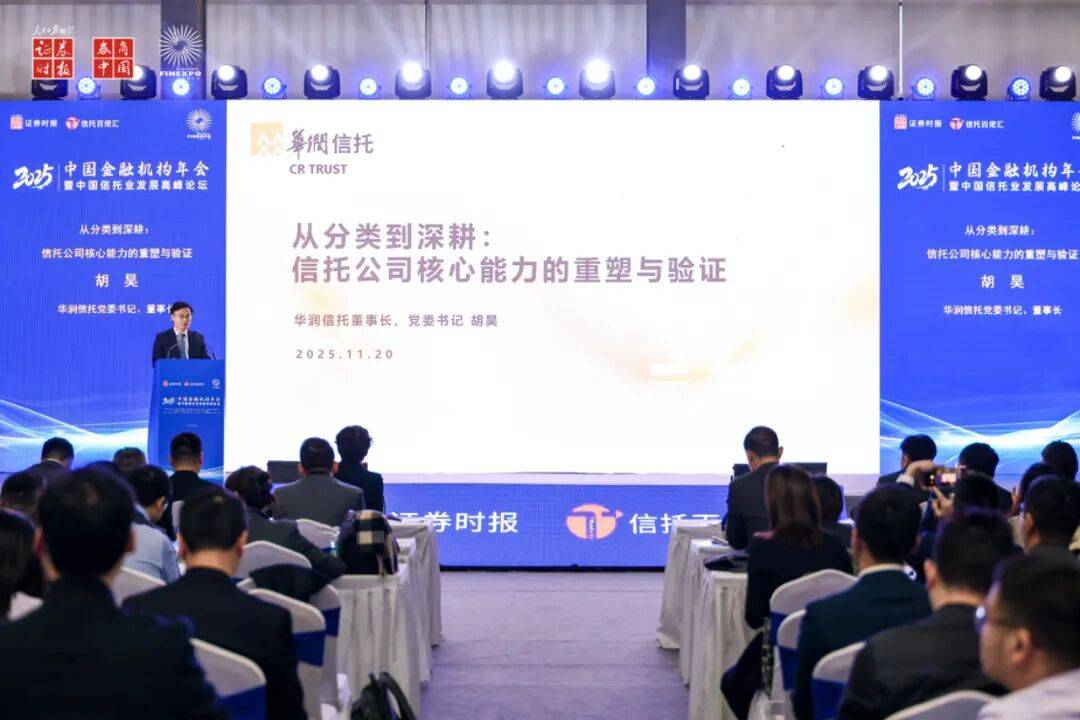
核心能力系统性重塑

Search documents
华润信托党委书记、董事长胡昊: 信托业转型进入核心能力系统性重塑新阶段
Zheng Quan Shi Bao Wang· 2025-12-08 23:28
Core Viewpoint - The trust industry is undergoing a significant transformation, entering a new phase of systematic restructuring of core capabilities, driven by a coherent policy framework that outlines a transition from classification to deep cultivation and quality enhancement [1] Group 1: Value Restructuring - The focus of value restructuring is to anchor on the essence of trusteeship, shifting from a previous emphasis on "profit creation" to a comprehensive upgrade that embodies the political and people-oriented nature of finance [1] Group 2: Business Restructuring - Business restructuring is essential for implementing value restructuring, guided by the new "three-category" regulations and the draft of the Asset Management Trust Management Measures, which provide a clear blueprint for deep cultivation in three major business areas [2] - In the asset management trust sector, the new regulations create a fair competitive environment, raising the bar for trust companies' investment research capabilities amid a low-interest-rate environment and increasing investor demand for stable returns, risk hedging, and long-term value [2] - The asset service trust sector aims to upgrade from single services to extended scenarios, while the public welfare and charity trust sector is developing a diverse service system supported by policies and practical exploration [2] Group 3: Organizational Restructuring - Organizational restructuring is necessary to meet transformation demands, focusing on enhancing four key capabilities: 1. Strengthening investment research capabilities to establish a shared mechanism for public and private investment research, aiming for comprehensive market coverage and cross-category synergy [2] 2. Enhancing operational service capabilities through optimized standard processes and extended service scenarios to improve efficiency in account management, fund settlement, and information disclosure [2] 3. Reinforcing risk management capabilities by embedding risk control into all aspects of business decision-making, product design, and post-investment management [2] 4. Boosting technological innovation capabilities by leveraging digital transformation to build intelligent service platforms and optimize system support [2]
华润信托董事长胡昊:信托业转型进入核心能力系统性重塑的新阶段
Sou Hu Cai Jing· 2025-12-04 14:40
Core Viewpoint - The speech emphasizes the transformation of the trust industry, moving from mere business adjustments to a systematic reshaping of core capabilities, driven by recent policies and the need to enhance quality over quantity in the context of building a financial powerhouse [2][3]. Group 1: Transformation of the Trust Industry - The current transformation of the trust industry is characterized by a shift from quantitative expansion to qualitative improvement, focusing on core capabilities and adhering to policies [2]. - The core tasks of transformation include returning to the essence of trust, reshaping core capabilities, and fulfilling the political and social responsibilities of finance [2]. Group 2: Four Dimensions of Reshaping - The four dimensions of reshaping are value, business, organization, and spirit, which collectively support the construction of core capabilities aligned with the role of trustees [3]. - Value reshaping involves deepening three role positions: being a long-term partner to the real economy, a faithful steward of people's wealth, and a foundational platform for social trust [3]. - Business reshaping focuses on three main areas: asset management trusts, asset service trusts, and public welfare trusts, with an emphasis on differentiated products and services [3][4]. Group 3: Organizational and Cultural Restructuring - Organizational restructuring aims to create an agile and efficient system that enhances four key capabilities: investment research, operational service, risk management, and technological innovation [4]. - Cultural restructuring integrates a trust culture that emphasizes honesty, prudence, and compliance, ensuring that every employee embodies the trust culture [4]. Group 4: Measuring Success and Future Collaboration - The effectiveness of the reshaping efforts will be measured against regulatory requirements and the ability to gain professional trust from clients, as well as resilience through market cycles [7]. - The ultimate goal is to build a collaborative ecosystem with banks, brokerages, and insurance companies, enhancing the overall financial service capability and trust's unique role in supporting national strategies and the real economy [7].