楼市与车市关系

Search documents
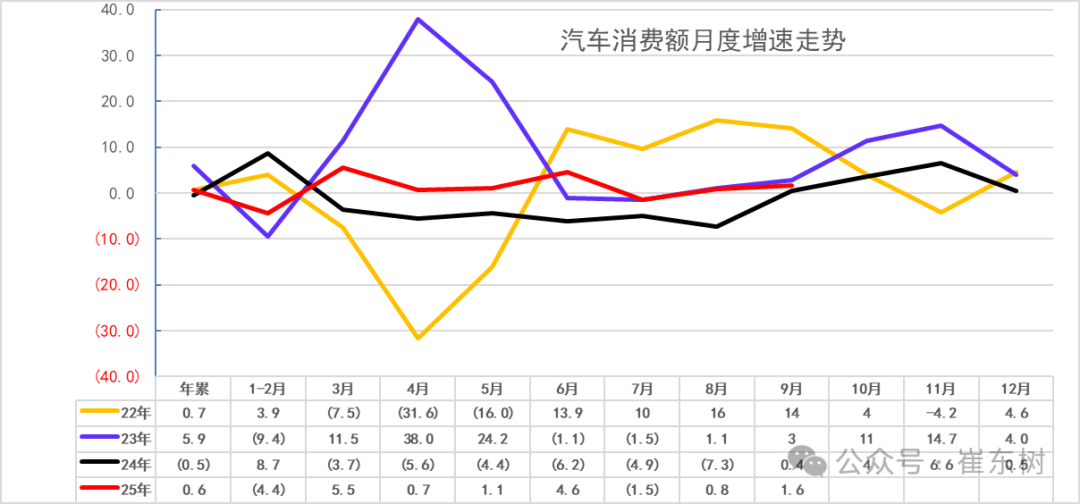
崔东树:1—9月汽车消费额同比增1% 车市需要有持续政策支持
智通财经网· 2025-10-20 22:37
Core Insights - The automotive industry in China is experiencing a strong recovery, driven by the implementation of vehicle replacement policies and a significant increase in new energy vehicle production [1][2][5] Group 1: Automotive Consumption - In September 2025, the total retail sales of consumer goods reached 41,971 billion yuan, with automotive consumption accounting for 4,711 billion yuan, a year-on-year increase of 2% [1][28] - From January to September 2025, total retail sales of consumer goods amounted to 365,877 billion yuan, growing by 4.5%, while automotive consumption reached 35,923 billion yuan, a year-on-year increase of 1% [1][28] - Since the decline of the real estate market in 2021, automotive consumption has risen from 3.94 trillion yuan in 2020 to 5.03 trillion yuan in 2024, indicating a recovery from previous stagnation [5][26] Group 2: Automotive Production - In September 2025, automotive production reached 3.23 million units, a year-on-year increase of 14%, with new energy vehicles accounting for 1.58 million units produced, up 20% [1][19] - From January to September 2025, total automotive production was 24.05 million units, an 11% increase year-on-year, with new energy vehicles at 1.096 million units, a 30% increase [1][19] - The penetration rate of new energy vehicles in September 2025 reached 49%, up from 46% in the same period last year [1][19] Group 3: Investment Trends - In the first nine months of 2025, automotive investment grew by 19.2%, significantly outpacing the overall industrial investment growth of 6.4% [21][22] - The automotive investment in 2025 is at its highest level in six years, indicating a strong recovery in the sector [22] Group 4: Economic Context - The external environment remains complex, with challenges such as unilateralism and protectionism impacting supply chains, while domestic economic recovery is still fragile [2] - The automotive industry is expected to face significant pressure in 2026, necessitating long-term supportive policies to sustain growth [2][26]