汽车投资

Search documents
瑞达期货铝类产业日报-20251118
Rui Da Qi Huo· 2025-11-18 08:18
1. Report Industry Investment Rating No information provided. 2. Core Viewpoints of the Report - For alumina, the fundamentals may be in a stage where supply slightly converges and demand remains generally stable. The current oversupply situation may improve with production control. Suggest light - position short - term long trades at low prices, while controlling the rhythm and trading risks [2]. - For electrolytic aluminum, the fundamentals may be in a stage of temporary supply - demand stability with a slight accumulation of social inventory. The option market sentiment is bullish, and the implied volatility slightly decreases. Suggest light - position range - bound trading, while controlling the rhythm and trading risks [2]. - For cast aluminum alloy, the fundamentals may be in a stage of supply convergence and slightly reduced demand. Suggest light - position range - bound trading, while controlling the rhythm and trading risks [2]. 3. Summary According to Relevant Catalogs 3.1 Futures Market - **Aluminum Futures**: The closing price of the Shanghai aluminum main contract was 21,465 yuan/ton, down 260 yuan; the main - second - contract spread was - 60 yuan, up 80 yuan; the main contract holding volume was 356,547 lots, down 34,312 lots; the net holding of the top 20 in Shanghai aluminum was 19,360 lots, down 5,102 lots; the Shanghai - London ratio was 7.65, up 0.05; the Shanghai Futures Exchange inventory was 114,899 tons, up 1,564 tons; the Shanghai Futures Exchange warehouse receipt was 69,484 tons, up 4,742 tons [2]. - **Alumina Futures**: The closing price of the alumina futures main contract was 2,780 yuan/ton, down 37 yuan; the main - second - contract spread was - 61 yuan, up 21 yuan; the main contract holding volume was 405,009 lots, up 14,515 lots [2]. - **Cast Aluminum Alloy Futures**: The closing price of the cast aluminum alloy main contract was 20,730 yuan/ton, down 260 yuan; the main - second - contract spread was - 105 yuan, down 45 yuan; the main contract holding volume was 13,191 lots, down 508 lots; the Shanghai Futures Exchange registered warehouse receipt was 59,431 tons, unchanged; the Shanghai Futures Exchange inventory was 65,119 tons, up 779 tons [2]. 3.2 Spot Market - **Aluminum Spot**: The price of Shanghai Non - ferrous A00 aluminum was 21,460 yuan/ton, down 170 yuan; the price of Yangtze River Non - ferrous AOO aluminum was 21,590 yuan/ton, down 140 yuan; the Shanghai Wumao aluminum premium/discount was - 40 yuan/ton, down 20 yuan; the LME aluminum premium/discount was - 38.42 dollars/ton, down 10.37 dollars; the basis of electrolytic aluminum was - 5 yuan, up 90 yuan [2]. - **Alumina Spot**: The spot price of alumina in Shanghai Non - ferrous was 2,775 yuan/ton, down 5 yuan; the basis of alumina was - 5 yuan, up 32 yuan [2]. - **Cast Aluminum Alloy Spot**: The average price (tax - included) of ADC12 aluminum alloy ingots nationwide was 21,450 yuan/ton, down 100 yuan; the basis of cast aluminum alloy was 720 yuan, up 10 yuan [2]. 3.3 Upstream Situation - **Alumina**: The national alumina production was 799.90 million tons, up 7.42 million tons; the national alumina capacity utilization rate was 86.96%, down 1.31 percentage points; the demand for alumina (electrolytic aluminum part) was 704.31 million tons, down 21.49 million tons; the supply - demand balance of alumina was 46.85 million tons, up 18.12 million tons; the export volume of alumina was 25 million tons, up 7 million tons; the import volume of alumina was 6 million tons, down 3.44 million tons [2]. - **Aluminum Scrap**: The average price of crushed raw aluminum in Foshan metal scrap was 17,000 yuan/ton, down 200 yuan; the average price of crushed raw aluminum in Shandong metal scrap was 16,600 yuan/ton, down 150 yuan; China's import volume of aluminum scrap and fragments was 155,414.40 tons, down 17,195.97 tons; China's export volume of aluminum scrap and fragments was 68.54 tons, up 15.31 tons [2]. 3.4 Industry Situation - **Electrolytic Aluminum**: The social inventory of electrolytic aluminum was 59.70 million tons, up 3.10 million tons; the import volume of primary aluminum was 246,797.10 tons, up 31,034.96 tons; the export volume of primary aluminum was 28,969.92 tons, up 3,365.58 tons; the total production capacity of electrolytic aluminum was 4,523.20 million tons, unchanged; the production of electrolytic aluminum was 590 million tons, up 35.18 million tons; the export volume of unwrought aluminum and aluminum products was 98.24 million tons, down 0.12 million tons [2]. - **Aluminum Products and Alloys**: The production of aluminum products was 590 million tons; the production of recycled aluminum alloy ingots was 60.83 million tons, down 4.82 million tons; the export volume of aluminum alloy was 2.35 million tons, down 0.56 million tons; the production of aluminum alloy was 177.60 million tons, unchanged [2]. 3.5 Downstream and Application - **Automobile**: The monthly automobile production was 327.90 million vehicles, up 5.25 million vehicles; in 2025, the automobile investment growth rate reached 17.5%; in October 2025, automobile production was 328 units, up 11% year - on - year; new energy vehicle production was 171 units, up 19% year - on - year, with a penetration rate of 52%; fuel vehicle production was 157 units, up 4% year - on - year; from January to October 2025, automobile production was 2,733 units, up 11% year - on - year; new energy vehicle production was 1,267 units, up 28% year - on - year, with a penetration rate of 46%; fuel vehicle production was 1,465 units, unchanged year - on - year [2]. - **Real Estate**: The national real estate climate index was 92.43, down 0.34 [2]. 3.6 Option Situation - The 20 - day historical volatility of Shanghai aluminum was 11.83%, up 1.08 percentage points; the 40 - day historical volatility of Shanghai aluminum was 10.23%, up 0.42 percentage points; the implied volatility of the Shanghai aluminum main contract at - the - money was 11.16%, down 0.0051; the call - put ratio of Shanghai aluminum options was 1.34, up 0.1024 [2]. 3.7 Industry News - **Federal Reserve News**: Fed Vice - Chair Jefferson said the downside risk of employment has increased but reiterated the need for more cautious policy adjustment; Fed Governor Cook denied fraud accusations; Fed Chair candidate Hasset said the job market signals are confusing and AI may suppress recruitment demand; Fed Governor Waller supported a 25 - basis - point rate cut in December [2]. - **Fiscal Revenue and Expenditure**: From January to October this year, the national fiscal revenue was 18.65 trillion yuan, up 0.8% year - on - year; in October, the national fiscal revenue was 2.26 trillion yuan, up 3.2% year - on - year; from January to October, the national fiscal expenditure was 22.58 trillion yuan, up 2% year - on - year [2]. - **Automobile Industry**: In October, new energy vehicle exports were 256,000 units, up 15.4% month - on - month and 99.9% year - on - year; from January to October, new energy vehicle exports were 2.014 million units, up 90.4% year - on - year [2].
10月汽车消费额同比降7%
第一财经· 2025-11-17 09:50
Group 1 - The core viewpoint of the article highlights a decline in automotive consumption in October 2025, with a total consumption amount of 425.5 billion yuan, representing a year-on-year decrease of 7% [1] - From January to October, the total automotive consumption reached 4,000.9 billion yuan, showing a slight year-on-year decline of 0.2% [1] - Despite the drop in consumption, automotive production and investment have experienced year-on-year growth, with production reaching 27.33 million vehicles, an increase of 11% [1] Group 2 - Automotive investment has seen a significant year-on-year growth rate of 17.5%, marking a historical high for the period from January to October in recent years [1] - The investment growth in the automotive sector is notably higher than that of other manufacturing industries [1]


10月汽车消费额同比降7%
Di Yi Cai Jing· 2025-11-17 09:10
Group 1 - The core viewpoint of the article indicates a decline in automotive consumption in October 2025, with a total consumption amount of 425.5 billion yuan, representing a year-on-year decrease of 7% [1] - From January to October, the total automotive consumption reached 4,000.9 billion yuan, showing a slight year-on-year decline of 0.2% [1] - Despite the drop in consumption, automotive production and investment have experienced year-on-year growth, with production volume reaching 27.33 million vehicles, an increase of 11% [1] Group 2 - Automotive investment has seen a significant year-on-year growth rate of 17.5%, marking a historical high for the period from January to October in recent years [1] - The investment growth in the automotive sector is notably higher than that of other manufacturing industries [1]
现代汽车:计划从2026年至2030年在韩国投资862亿美元
Ju Chao Zi Xun· 2025-11-16 08:40
Core Insights - The chairman of Hyundai Motor Group announced plans to invest 125 trillion Korean won (approximately 86.2 billion USD) in South Korea from 2026 to 2030 [1] - The company aims to double its export volume of electric vehicles and hybrid vehicles by 2030 [1] Investment Plans - Hyundai Motor Group's investment of 125 trillion Korean won is set for the period from 2026 to 2030 [1] - This significant investment reflects the company's commitment to expanding its operations and capabilities in the automotive sector [1] Export Goals - By 2030, Hyundai plans to increase its export volume of electric and hybrid vehicles by more than 100% [1] - This goal indicates a strategic focus on enhancing the company's presence in the global electric vehicle market [1]
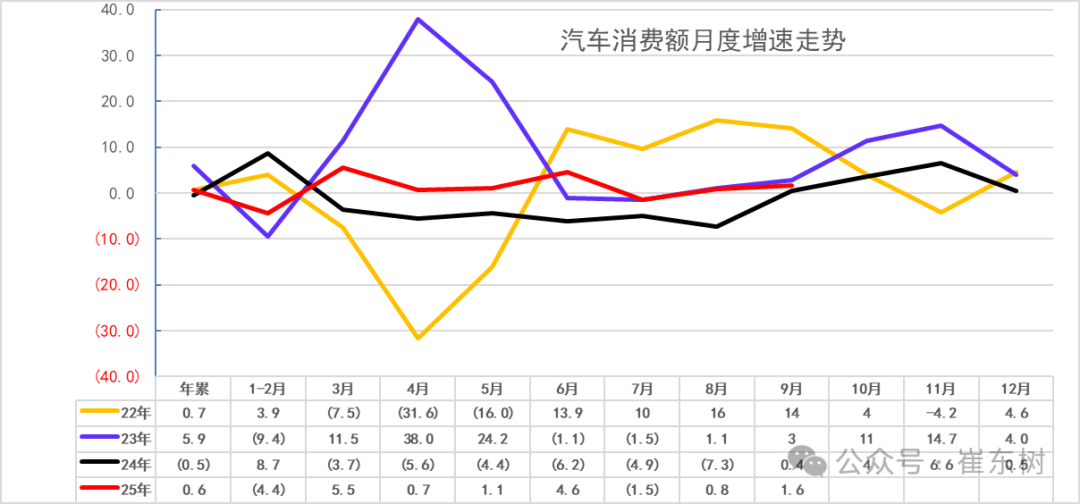
崔东树:1—9月汽车消费额同比增1% 车市需要有持续政策支持
智通财经网· 2025-10-20 22:37
Core Insights - The automotive industry in China is experiencing a strong recovery, driven by the implementation of vehicle replacement policies and a significant increase in new energy vehicle production [1][2][5] Group 1: Automotive Consumption - In September 2025, the total retail sales of consumer goods reached 41,971 billion yuan, with automotive consumption accounting for 4,711 billion yuan, a year-on-year increase of 2% [1][28] - From January to September 2025, total retail sales of consumer goods amounted to 365,877 billion yuan, growing by 4.5%, while automotive consumption reached 35,923 billion yuan, a year-on-year increase of 1% [1][28] - Since the decline of the real estate market in 2021, automotive consumption has risen from 3.94 trillion yuan in 2020 to 5.03 trillion yuan in 2024, indicating a recovery from previous stagnation [5][26] Group 2: Automotive Production - In September 2025, automotive production reached 3.23 million units, a year-on-year increase of 14%, with new energy vehicles accounting for 1.58 million units produced, up 20% [1][19] - From January to September 2025, total automotive production was 24.05 million units, an 11% increase year-on-year, with new energy vehicles at 1.096 million units, a 30% increase [1][19] - The penetration rate of new energy vehicles in September 2025 reached 49%, up from 46% in the same period last year [1][19] Group 3: Investment Trends - In the first nine months of 2025, automotive investment grew by 19.2%, significantly outpacing the overall industrial investment growth of 6.4% [21][22] - The automotive investment in 2025 is at its highest level in six years, indicating a strong recovery in the sector [22] Group 4: Economic Context - The external environment remains complex, with challenges such as unilateralism and protectionism impacting supply chains, while domestic economic recovery is still fragile [2] - The automotive industry is expected to face significant pressure in 2026, necessitating long-term supportive policies to sustain growth [2][26]