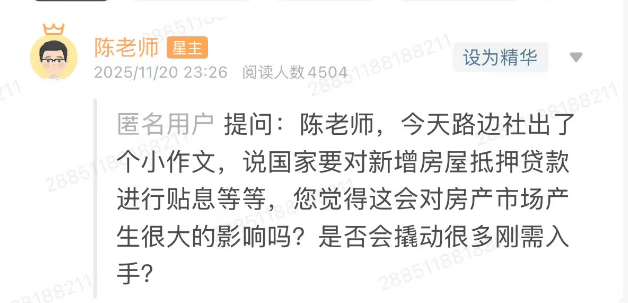
楼市贴息

Search documents
出乎意料的信号,即将要定向放给楼市的水有多大
Sou Hu Cai Jing· 2025-11-24 14:41
Core Viewpoint - The article discusses the potential introduction of new real estate support policies in China, focusing on interest subsidies and reduced deed taxes, as a response to the current economic conditions affecting the banking sector and real estate market [1][27]. Group 1: Interest Rate and Banking Sector - Interest subsidies are proposed as a solution instead of direct interest rate cuts due to the narrowing interest margins of major banks, which are all below the survival line of 1.5% [6][27]. - The current interest margins for major banks are: Industrial and Commercial Bank of China (1.28%), China Construction Bank (1.36%), Bank of China (1.26%), and Agricultural Bank of China (1.3%) [6]. - The cost of interest subsidies must be sourced externally, likely from fiscal deficits, as direct funding from taxpayers or limited bond issuance imposes constraints [7][27]. Group 2: Economic Implications - The article emphasizes that the effectiveness of interest subsidies will primarily benefit first-time homebuyers by reducing their overall financial burden, thus supporting the real estate market [17][27]. - For investors, the article notes that real interest rates remain high due to negative inflation, making it less attractive for them to expand their asset portfolios [26][27]. - The real interest rate is calculated as nominal interest minus the inflation rate, with current conditions indicating a real interest rate of approximately 4%, the highest in two decades [26][27]. Group 3: Monitoring and Data Tracking - To assess the impact of potential interest subsidies, monitoring fiscal deficit sizes and the central bank's balance sheet is crucial, as these will indicate the actual scale of monetary easing [15][27]. - The article suggests that tracking these data points will provide insights into the future direction of the real estate market [15][27].