
模拟芯片复苏

Search documents
模拟芯片复苏?德州仪器预计Q1营收环比增长,为十六年来首次
Hua Er Jie Jian Wen· 2026-01-28 06:36
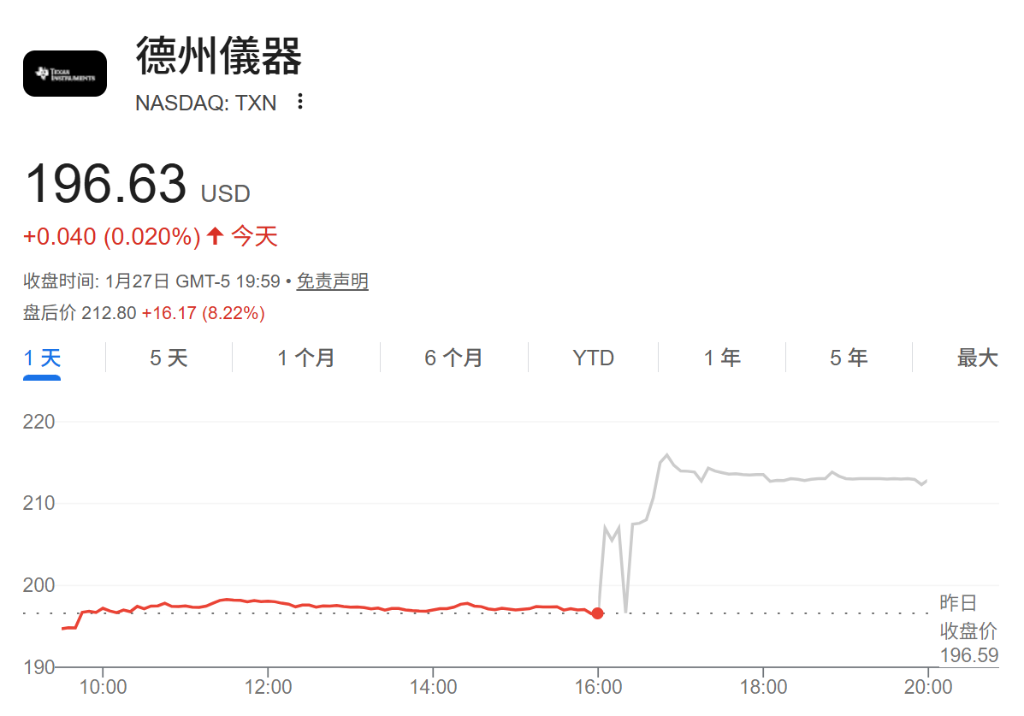
德州仪器给出一份罕见的季度环比增长展望,强化了模拟芯片需求正在修复的预期,并直接推升股价。 德州仪器周二盘后跳涨8%。公司财报给出乐观指引,预计第一季度营收为43.2亿至46.8亿美元,按指引中值计算,将高于第四季度营收44.2亿美 元。 财报数据方面,德州仪器第四季度营收44.2亿美元,大体与一致预期接近。每股收益为1.27美元,较一致预期低2美分。 公司在财报中表示,该每股收益"包含了6美分的下调",而这一项并未纳入公司最初的业绩指引之中。 对多头而言,自由现金流仍是估值框架的关键变量。 Matthew Prisco表示,这份财报支持公司明年产生90亿至100亿美元自由现金流的观点,这是其看多逻辑的核心组成部分。 谨慎者则更多从节奏与确定性出发。Stacy Rasgon指出,今年资本市场开支应会下降,这将有利于自由现金流,但他同时认为复苏并非"火箭式"上 行,短期改善的含金量需要结合订单结构进一步观察。 Rasgon强调,"不少上行来自短交期订单",这意味着对后续趋势的可见度有限,也存在需求被提前透支、从而影响未来业绩弹性的风险。 这一"跨年环比增长"的信号在该公司历史上并不常见。Cantor Fitzg ...


模拟芯片复苏,纳芯微A+H着陆
Bei Jing Shang Bao· 2025-12-28 12:52
Core Viewpoint - The semiconductor industry is experiencing a recovery, particularly in the analog chip segment, as major companies signal price increases due to rising demand from sectors like industrial control and automotive, as well as AI data centers [3][4]. Group 1: Price Increases and Demand Recovery - Major semiconductor manufacturers, including Analog Devices and Texas Instruments, have announced price hikes for their products, with increases ranging from 10% to 30% starting in February 2026 [3]. - The price increases are driven not only by cost factors but also by a recovery in downstream demand, particularly in industrial control and automotive sectors, indicating a potential turning point in the industry cycle [3][4]. Group 2: Company Performance and Market Position - Naxin Micro, a company focused on chip design and sales, recently listed on the Hong Kong Stock Exchange, becoming one of the few domestic analog chip companies to achieve dual listing [3][4]. - According to Frost & Sullivan, Naxin Micro ranks fifth among Chinese analog chip manufacturers by revenue in 2024 and is the only top ten domestic player focusing on sensors, signal chain chips, and power management chips [3]. Group 3: Market Growth and Investment - The domestic automotive analog chip market is expected to grow at a compound annual growth rate (CAGR) of 18% from 2025 to 2029, with the market size projected to surpass that of consumer electronics by 2029 [4]. - Naxin Micro's market share in automotive analog chips is anticipated to increase from 1.8% in 2024 to 2.8% in 2026, driven by the rise in new energy vehicle penetration and smart electric vehicle acceleration [4]. Group 4: Fundraising and Strategic Initiatives - Naxin Micro plans to use the funds raised from its IPO to enhance its technical capabilities, expand its product portfolio, and grow its international sales network [5]. - The company has secured cornerstone investment agreements with several major entities, including those affiliated with BYD and Xiaomi, indicating strong market confidence in Naxin Micro's growth prospects [4][5]. Group 5: Financial Performance - Naxin Micro reported a significant revenue increase of 79.49% year-on-year, reaching 1.524 billion yuan in the first half of 2025, although it still recorded a net loss of 78 million yuan [6]. - The company's gross margin improved to 35.97% in Q2, reflecting a trend towards operational recovery, although profitability has not yet been achieved [6].

模拟芯片复苏的重磅信号! 电动汽车与智驾驱动增长 亚德诺(ADI.US)Q4营收大增26%
Zhi Tong Cai Jing· 2025-11-25 13:45
Core Viewpoint - Analog Devices, Inc. (ADI) has reported strong financial results, indicating a robust recovery in demand for analog chips, particularly driven by electric vehicles and industrial applications, as well as the integration of generative AI into various sectors [1][3][5]. Financial Performance - For Q4, ADI reported total revenue of approximately $3.076 billion, representing a year-over-year growth of 26%, exceeding Wall Street's expectations by about $60 million [2]. - The company's adjusted earnings per share (EPS) for Q4 were $2.26, reflecting a 35% year-over-year increase and surpassing analyst expectations by approximately $0.03 [2]. - For the first quarter of fiscal year 2026, ADI expects revenue to reach $3.1 billion, exceeding the average analyst forecast of $2.98 billion, with an anticipated adjusted EPS of $2.29, higher than the expected $2.18 [1][2]. Market Segments - All end markets showed growth, with electric vehicles and smart driving significantly contributing to revenue increases [2][3]. - Breakdown of Q4 performance by market: - Industrial revenue was approximately $1.43 billion, a 34% year-over-year increase, though slightly below market expectations [2]. - Communication revenue was about $390 million, up 37% year-over-year, slightly above expectations [2]. - Automotive revenue reached approximately $852 million, significantly exceeding expectations and showing a 19% year-over-year growth [2]. - Consumer electronics revenue grew by 7% to $408 million, slightly above market expectations [2]. Industry Outlook - The analog chip industry is experiencing a comprehensive recovery, driven by increasing demand in key markets such as automotive and industrial sectors, alongside the growing integration of AI functionalities in consumer electronics [3][5]. - ADI's CEO highlighted the company's strong performance as a testament to its business model's resilience and commitment to delivering value to shareholders [3]. - Citigroup has expressed a bullish long-term outlook on ADI, rating it as a preferred stock in the semiconductor sector, with a target price of $290 within 12 months [5].

全球科技业绩快报:德州仪器2Q25
Haitong Securities International· 2025-07-23 12:44
Investment Rating - The report does not explicitly state an investment rating for Texas Instruments, but it highlights strong performance and positive outlooks for revenue and EPS growth in the upcoming quarters, suggesting a favorable view of the company's prospects [1][4]. Core Insights - Texas Instruments reported a strong 2Q25 performance with revenue of $4.45 billion, exceeding market expectations, and an EPS of $1.46, also above consensus estimates. The guidance for 3Q25 indicates revenue between $4.5-4.8 billion and EPS of $1.36-$1.6, reflecting a cautious outlook due to tariff uncertainties and market conditions [1][7][10]. - The company noted that the recovery in analog chips is on track, but concerns about tariffs and geopolitical issues may lead to fluctuations in future performance. The outperformance in 2Q25 was attributed to pre-stocking by clients amid tariff uncertainties [1][10]. Summary by Sections Financial Performance - In 2Q25, Texas Instruments achieved a 9% quarter-over-quarter growth and a 16% year-over-year growth in revenue. Key segments showed robust performance: analog chips grew 18% year-over-year, embedded processing increased by 10%, and other businesses rose by 14% [2][8]. - Gross profit reached $2.58 billion with a gross margin of 58%, reflecting a 110 basis points increase quarter-over-quarter. Operating profit was $1.6 billion, with a 35% operating margin, and net profit was $1.3 billion, resulting in an EPS of $1.41, slightly above initial guidance [2][8]. Capital Management - Texas Instruments reported an operating cash flow of $1.9 billion in 2Q25, totaling $6.4 billion over the past 12 months. Capital expenditures were $1.3 billion, with a total of $4.9 billion in the last year. The company returned $6.7 billion to shareholders over the past 12 months through dividends and stock repurchases [3][9]. - The balance sheet remains strong, with cash and short-term investments totaling $5.4 billion and total debt at $14.15 billion, with an average interest rate of 4% [3][9]. Outlook - For 3Q25, Texas Instruments expects revenue in the range of $4.45-4.8 billion and EPS between $1.36-$1.6, with a tax rate of 12%-13%. The company anticipates a cooling in the industrial market after a strong 2Q and a delayed recovery in the automotive sector [4][10]. - The company emphasizes its focus on long-term value creation through investments in manufacturing capabilities, product diversification, and disciplined capital allocation to drive free cash flow growth [4][10].