歧视性贸易措施

Search documents
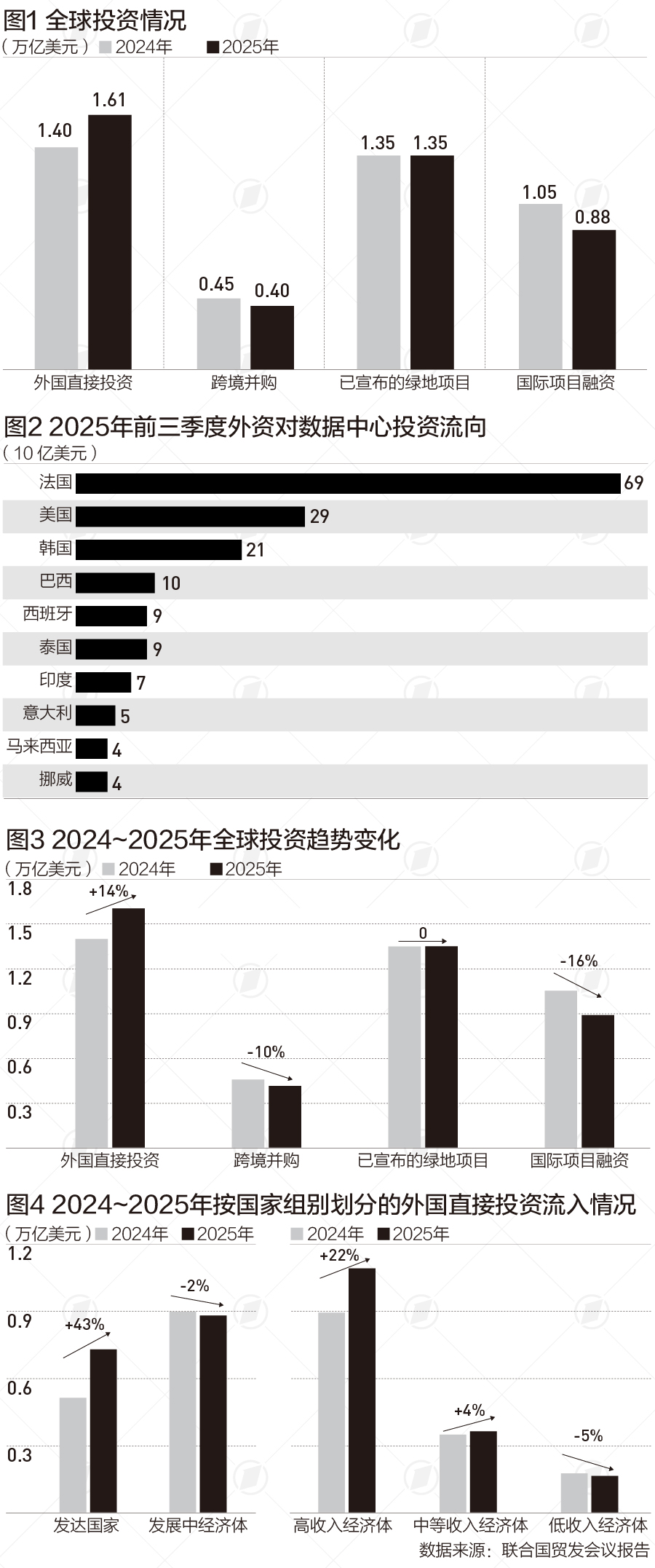
2025年全球FDI结束连续两年低迷,投资分布不均加剧
Di Yi Cai Jing· 2026-01-29 12:16
Core Insights - The UNCTAD report forecasts a 14% increase in global foreign direct investment (FDI) by 2025, reaching $1.6 trillion, ending a two-year decline [1] - The recovery in global investment flows is primarily driven by over $140 billion from financial centers, indicating a disparity in actual investment growth [1][2] - Investment distribution is increasingly uneven, with significant inflows into semiconductors and data centers, while traditional manufacturing continues to see reduced investment [1][11] Investment Trends - FDI growth is largely attributed to multinational companies reallocating funds through financial centers rather than corresponding to real investments in projects or infrastructure [2] - Major investment types such as greenfield investments, project financing, and cross-border mergers and acquisitions are mostly in negative growth, with international project financing in infrastructure declining by 16% [2][3] - Developed economies saw a 43% increase in FDI, totaling $728 billion, driven by cross-border mergers and the economic recovery in countries like Germany, France, and Italy [2][3] Sector-Specific Insights - The competition in artificial intelligence is leading to a concentration of FDI in data centers and semiconductors, with greenfield investment projects related to data centers increasing by $125 billion [11] - Traditional manufacturing and renewable energy sectors are experiencing a decline in FDI, with greenfield investment projects in industries like textiles and electronics decreasing by 25% [11] - The report highlights that the majority of new data center projects are concentrated in developed countries, with emerging markets like Brazil, Thailand, India, and Malaysia also becoming significant players [11] Future Outlook - The report anticipates that financing conditions may ease in 2026, potentially increasing FDI liquidity, although actual project activity may remain subdued [12] - Strategic sectors, particularly data centers and semiconductors, are expected to support continued capital expenditure growth, albeit with geographic and sectoral concentration [12] - The global economic growth rate is projected to slow to 2.6% in 2026, impacting infrastructure and industrial investment in developing countries [14] Trade and Regulatory Environment - Rising global tariffs, particularly in manufacturing, have increased from 1.9% in 2024 to 4.7% last year, creating uncertainty that may suppress investment [14] - Since 2020, approximately 18,000 discriminatory trade measures have been introduced globally, with a significant impact on compliance costs for small exporters [15] - The expansion of service exports and South-South trade is seen as a positive factor for global investment, with service exports expected to grow by 9% in 2025 [16]