外国直接投资(FDI)

Search documents
CCI clears MUFG’s ₹39,618 crore Shriram Finance deal, largest FDI in financial sector
BusinessLine· 2026-03-25 16:45
Core Insights - The Competition Commission of India (CCI) has approved Mitsubishi UFJ Financial Group (MUFG) Bank's ₹39,618 crore ($4.4 billion) investment in Shriram Finance Ltd, marking the largest foreign direct investment in India's non-banking financial company (NBFC) sector [1][2] Investment Details - MUFG's investment involves acquiring a 20% stake in Shriram Finance, surpassing the previous record of ₹26,853 crore for RBL Bank by 47% [2] - The deal is expected to close by early April 2026, following approvals from the Reserve Bank of India (RBI) and shareholders [4] Financial Impact - The ₹39,618 crore investment is projected to increase Shriram Finance's Tier-1 capital adequacy ratio from approximately 20% to over 35%, enhancing its balance sheet and reducing funding costs [4] - This capital infusion will enable Shriram Finance to compete more effectively with major banks like HDFC Bank and ICICI Bank in various lending sectors, including MSME loans and affordable housing [5] Strategic Positioning - The partnership positions Shriram Finance favorably in the electric vehicle (EV) financing market, particularly for three-wheelers and small commercial vehicles, leveraging MUFG's expertise in green finance [6] - Shriram Finance's enhanced capital base provides a competitive edge in pricing and growth, potentially reshaping the NBFC landscape and offering advantages over competitors reliant on domestic funding [7] Future Outlook - Analysts anticipate that the MUFG investment will not only serve as a capital boost but also trigger a re-rating of Shriram Finance, leading to potential credit upgrades and improved returns as funding costs decrease [8]



瑞银:降金界控股(03918)目标价至6.4港元 VIP业务需求现复苏迹象
智通财经网· 2026-03-25 03:39
Core Viewpoint - UBS reported that the performance of NagaCorp (03918) in the second half of last year met expectations, but VIP business demand was pressured due to the crackdown on scam centers and tensions at the Cambodia-Thailand border [1] Group 1: Business Performance - The management indicated that after the ceasefire agreement in December, VIP business demand has shown signs of recovery [1] - The company plans to continue expanding its marketing team this year to attract international clients [1] Group 2: Market Conditions - Foreign Direct Investment (FDI) continues to flow into Cambodia, and the upcoming visa exemption trial between China and Cambodia is expected to boost demand from Chinese travelers [1] Group 3: Financial Guidance - The company guided for capital expenditures of approximately $170 million by 2026, primarily for renovations of Naga 1 and Naga 2, as well as the launch of smart gaming table technology [1] - Operating expenses are expected to record low to mid-single-digit growth [1] - The management did not provide updates on the timeline and scale for the development of Naga 3 [1] Group 4: Risk Management - Despite geopolitical turmoil, the management expects limited impact on operations [1] - The company will continue to adopt a prudent dividend policy to maintain financial flexibility in response to risks and the final plans for Naga 3 and capital expenditures [1]
印度放宽对中国等邻国的直接投资限制
日经中文网· 2026-03-24 08:00
Group 1 - The Indian government is easing restrictions on foreign direct investment (FDI) to enhance integration with global supply chains and improve competitiveness as a manufacturing base [2][5] - Investments from neighboring countries with a stake of less than 10% will no longer require government approval, indicating a shift in policy towards improving relations with China following past border conflicts [2][4] - The government aims to make decisions on investment proposals from bordering countries within 60 days, focusing on sectors such as production materials, electronic components, photovoltaic panel materials, and semiconductor materials [2][4] Group 2 - The increase in FDI is expected to supplement domestic capital and support the "Atmanirbhar Bharat" initiative, which aims to accelerate overall economic growth in India [5]
斯里兰卡2025年吸引外资10.63亿美元
Shang Wu Bu Wang Zhan· 2026-02-26 16:44
Group 1 - The core viewpoint of the article is that Sri Lanka's Board of Investment (BOI) projects a foreign direct investment (FDI) of $1.0628 billion for the year 2025, with manufacturing leading the sectors [1] - The manufacturing sector is expected to attract $486 million, followed by the infrastructure sector with $404.6 million, primarily from a port container terminal project amounting to $275.3 million [1] - The services sector is projected to receive $168.1 million in FDI [1] Group 2 - In terms of source countries, Singapore ranks first with an investment of $319 million, followed by India with $214 million and France with $122 million [2]
《中国双向投资报告2025》发布:亚洲发展中经济体仍是全球最大FDI流入量接收地
Mei Ri Jing Ji Xin Wen· 2026-02-05 12:06
Group 1 - The report indicates that global Foreign Direct Investment (FDI) has been declining since 2024, with a fragmented distribution of investment regions. Developed economies are the main source of outward direct investment, while developing economies in Asia are the largest recipients of global FDI, accounting for 40% of total inflows [1][2] - In 2024, FDI inflows to developing economies in Asia decreased by 3% to $605 billion, yet the region remains the largest recipient of global FDI [1] - Digital economy investments are emerging as a significant driver of growth and transformation, with announced greenfield project values in the digital sector reaching $76 billion in 2024, a 107% increase year-on-year [1] Group 2 - The report highlights three major trends: the coexistence of economic hegemony and countries' investment incentive policies, the decline in international FDI alongside the rise in digital economy investments, and the increasing share of service sector investments alongside rapid growth in Asian manufacturing investments [2] - China is becoming increasingly attractive to foreign investment due to its efforts to enhance openness, lower barriers for foreign capital, and promote regional trade agreements like RCEP and the upgraded China-ASEAN Free Trade Area [2] - In 2024, China ranked as the third-largest recipient of foreign investment globally, with an FDI inflow of $116.24 billion, despite a decrease in the scale of foreign capital utilization [3]
Govt mulling proposal to raise FDI ceiling in public sector banks to 49%: DFS secretary Nagaraju
MINT· 2026-02-02 12:25
Core Viewpoint - The Indian government is considering increasing the foreign direct investment (FDI) limit in public sector banks (PSBs) from 20% to 49% to attract foreign investors and enhance the capital base of these banks [1][2]. Group 1: FDI Limit Considerations - The finance ministry is still deliberating on raising the FDI limit in PSBs to 49%, with inter-ministerial consultations ongoing [2]. - The government must retain at least 51% ownership in PSBs, meaning any decision on FDI will have to keep this requirement in mind [3]. - Currently, the FDI limit for private-sector banks is 74%, with up to 49% allowed through the automatic route without prior government or RBI approval [3]. Group 2: Current Foreign Investment Landscape - As of June 30, 2025, foreign institutional holdings in the top six PSBs range from 4.55% to 11.38%, indicating minimal foreign investment in these banks [5]. - The union government’s shareholding in 12 PSBs has remained stable since 2020, although some banks have seen a decline in government holdings due to issuing new shares for capital [4]. Group 3: Future Capital Needs and Strategies - A higher FDI limit is expected to attract more capital, enabling PSBs to expand operations and achieve the scale of major banks like State Bank of India or HDFC Bank [6]. - To raise capital, PSBs are anticipated to launch qualified institutional placements (QIPs) worth approximately ₹50,000 crore in FY27, an increase from the ₹45,000 crore expected in FY26 [6]. Group 4: Strategic Sales and Banking Reforms - The government plans to invite financial bids for the strategic sale of IDBI Bank, aiming to complete the process within the current fiscal year [7]. - A high-level committee on banking is proposed to explore policy and regulatory changes to support India's Vision 2047, which aims for the country to become a $30-trillion economy [8][9].
2025年全球FDI结束连续两年低迷,投资分布不均加剧
Di Yi Cai Jing· 2026-01-29 12:16
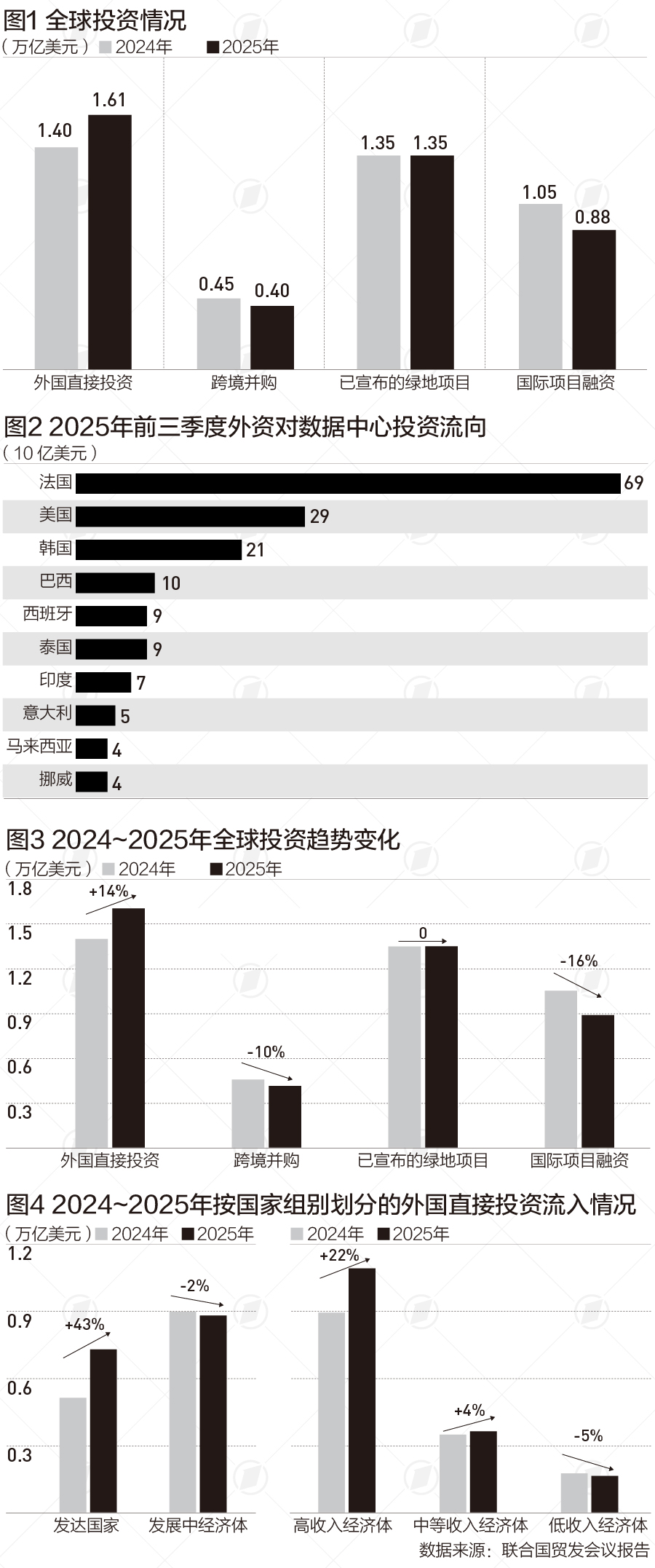
Core Insights - The UNCTAD report forecasts a 14% increase in global foreign direct investment (FDI) by 2025, reaching $1.6 trillion, ending a two-year decline [1] - The recovery in global investment flows is primarily driven by over $140 billion from financial centers, indicating a disparity in actual investment growth [1][2] - Investment distribution is increasingly uneven, with significant inflows into semiconductors and data centers, while traditional manufacturing continues to see reduced investment [1][11] Investment Trends - FDI growth is largely attributed to multinational companies reallocating funds through financial centers rather than corresponding to real investments in projects or infrastructure [2] - Major investment types such as greenfield investments, project financing, and cross-border mergers and acquisitions are mostly in negative growth, with international project financing in infrastructure declining by 16% [2][3] - Developed economies saw a 43% increase in FDI, totaling $728 billion, driven by cross-border mergers and the economic recovery in countries like Germany, France, and Italy [2][3] Sector-Specific Insights - The competition in artificial intelligence is leading to a concentration of FDI in data centers and semiconductors, with greenfield investment projects related to data centers increasing by $125 billion [11] - Traditional manufacturing and renewable energy sectors are experiencing a decline in FDI, with greenfield investment projects in industries like textiles and electronics decreasing by 25% [11] - The report highlights that the majority of new data center projects are concentrated in developed countries, with emerging markets like Brazil, Thailand, India, and Malaysia also becoming significant players [11] Future Outlook - The report anticipates that financing conditions may ease in 2026, potentially increasing FDI liquidity, although actual project activity may remain subdued [12] - Strategic sectors, particularly data centers and semiconductors, are expected to support continued capital expenditure growth, albeit with geographic and sectoral concentration [12] - The global economic growth rate is projected to slow to 2.6% in 2026, impacting infrastructure and industrial investment in developing countries [14] Trade and Regulatory Environment - Rising global tariffs, particularly in manufacturing, have increased from 1.9% in 2024 to 4.7% last year, creating uncertainty that may suppress investment [14] - Since 2020, approximately 18,000 discriminatory trade measures have been introduced globally, with a significant impact on compliance costs for small exporters [15] - The expansion of service exports and South-South trade is seen as a positive factor for global investment, with service exports expected to grow by 9% in 2025 [16]
波黑2025年前三季度外国直接投资锐减近3.5亿马克,区域投资环境面临挑战
Shang Wu Bu Wang Zhan· 2026-01-27 15:57
Group 1 - The core point of the article highlights a significant decline in foreign direct investment (FDI) in Bosnia, with a reduction of nearly 350 million marks in the first three quarters of 2025 compared to the previous year [1] - In the first nine months of the previous year, Bosnia attracted 1.05 billion marks in FDI, down from 1.393 billion marks in the same period the previous year [1] - The main sources of investment in Bosnia were Germany (265 million marks), Croatia (223 million marks), and Slovenia (155 million marks), with Serbia and Austria also contributing significantly [1] Group 2 - The decline in FDI is not unique to Bosnia but is a common trend across the Western Balkans, attributed to economic stagnation in major EU investor countries and a shift of investments to more competitive destinations outside Europe [2] - Compared to Serbia, Bosnia has not attracted a large amount of FDI previously, making the current decline's impact on economic growth relatively limited [2] - There is a call for Bosnia to focus on attracting investments that align with economic transformation goals, particularly in high-value sectors to create sustainable, high-quality jobs and enhance overall economic competitiveness [2]
2025年阿联酋吸引FDI超450亿美元
Shang Wu Bu Wang Zhan· 2026-01-26 10:56
Core Insights - The UAE is projected to attract over $45 billion in foreign direct investment (FDI) by 2025, representing a nearly 50% year-on-year increase, while global FDI is expected to decline by 11% during the same period [1] Group 1 - The UAE has captured more than half of the investment inflows in the Middle East [1] - The UAE ranks second globally in the number of greenfield investment projects, only behind the United States [1]
2025年全球FDI增长14% 联合国机构报告:欧盟增长56%
Di Yi Cai Jing· 2026-01-21 12:01
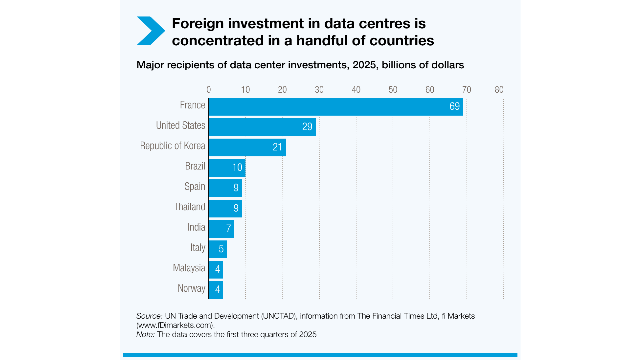
Group 1 - The UNCTAD report indicates that global foreign direct investment (FDI) is projected to grow by 14% to reach $1.6 trillion by 2025, primarily driven by capital flows through global financial centers, while actual investment activities remain weak [1] - The report highlights that over $140 billion of the FDI growth is attributed to flows between global financial centers, suggesting that without these "pipeline flows," global FDI would only increase by approximately 5% [1] Group 2 - FDI inflows to the EU are expected to rise by 56% in 2025, with developed economies seeing a 43% increase to $728 billion, largely due to cross-border mergers and acquisitions, particularly in Germany, France, and Italy [2] - North America’s FDI inflows remain stable, with a 2% increase in the US, while FDI to developing countries has decreased by 2% to approximately $877 billion [2] - Cross-border merger and acquisition activity has declined by 22% to $132 billion, although there has been significant growth in the semiconductor and telecommunications sectors [2] Group 3 - Data centers are reshaping the global investment landscape, accounting for over 20% of total greenfield project investments in 2025, with announced investments exceeding $270 billion, primarily in France, the US, and South Korea, as well as emerging markets like Brazil, India, Thailand, and Malaysia [3] Group 4 - Newly announced semiconductor projects have increased in value by 35%, but the number of projects in tariff-affected and globally value chain-intensive industries has dropped significantly by 25%, particularly in textiles, electronics, and machinery [5] - The number of international infrastructure projects has decreased by 10%, largely due to investors reassessing income risks and regulatory uncertainties, leading to a sharp decline in renewable energy investments [5] - The report warns of increasing downside risks for the future, with potential moderate growth in global FDI in 2026 if financing conditions ease and cross-border mergers increase, despite ongoing geopolitical tensions and economic fragmentation [5]