
殡葬行业公益属性

Search documents
殡葬行业回归公益属性 “三张清单”遏制乱收费
Xin Lang Cai Jing· 2026-01-31 21:33
Core Viewpoint - The newly revised "Funeral Management Regulations" emphasize the public welfare nature of the funeral industry and aim to standardize funeral service fee management to alleviate the financial burden on the public and meet the demand for dignified funerals [1][2]. Group 1: Overview of the Notification - The notification combines problem-oriented and goal-oriented approaches to address issues in funeral service fees, establishing a categorized fee policy and a fee directory list [2][3]. - It introduces a "three-list" system (basic service project list, non-basic project list, and fee directory list) and implements three management methods (government guidance price, reference price range, and price difference) to promote reasonable pricing and standardization in the funeral industry [2][3]. Group 2: Key Content of the Notification - The notification includes six main aspects: 1. Strengthening fee management for funeral services by differentiating between basic and non-basic projects [3]. 2. Clarifying the principles for setting funeral service fee standards, including the establishment of benchmark fees and floating ranges [3][4]. 3. Enhancing price guidance for funeral products through centralized procurement and clear pricing strategies [3]. 4. Establishing a regular evaluation system for fee policies to ensure timely adjustments [3]. 5. Creating a comprehensive fee directory and public disclosure system for funeral services [3]. 6. Regulating fee behaviors by increasing oversight of funeral service providers and addressing violations [3]. Group 3: Specific Measures for Funeral Services - The notification specifies three areas for strengthening management of funeral service fees: 1. Classifying service fee items into basic and non-basic categories, with basic services defined at the national level and non-basic services determined by local needs [4]. 2. Implementing government guidance pricing for basic services while allowing local authorities to set reference price ranges for non-basic services [4][5]. 3. Establishing clear cost structures for services to ensure reasonable fee standards and prevent overcharging [5]. Group 4: Guidance on Funeral Products Pricing - The notification emphasizes a comprehensive management approach for funeral products: 1. Implementing centralized procurement to reduce costs and ensure the availability of affordable funeral products [6]. 2. Guiding reasonable pricing for funeral products through defined price differences and encouraging transparency in pricing [6]. 3. Mandating funeral service providers to publicly disclose pricing information for funeral products to promote informed consumer choices [6].
以“公益属性”刚性约束管住“天价殡葬”
Xin Lang Cai Jing· 2026-01-09 00:11
Core Viewpoint - The revised "Funeral Management Regulations" emphasizes the public welfare nature of the funeral industry, aiming to transform it into a non-profit sector dedicated to promoting social welfare and benefiting the public [1][2]. Summary by Sections Regulatory Changes - The new regulations, effective from March 30, 2026, represent a comprehensive revision of the original regulations established in July 1997, focusing on clarifying management requirements, basic public services, and enhancing regulatory oversight [1]. Public Welfare Emphasis - The regulations explicitly state that the funeral industry should not be a domain for profit-making by a few individuals but should serve the public good, addressing issues such as high funeral costs and monopolistic practices [2]. Implementation Mechanisms - The regulations introduce a detailed system for managing funeral services, categorizing them into basic and non-basic projects, with the government setting prices for basic services to ensure affordability and dignity for all citizens [3]. Governance and Accountability - A clear governance framework is established, delineating responsibilities among various departments such as civil affairs, market regulation, and health, to avoid the previous issues of fragmented management and lack of accountability [3]. Execution and Local Adaptation - The success of the regulations relies on effective execution and the development of localized implementation plans and pricing standards to ensure that the principles of public welfare translate into actionable public services [4].
新修订的《殡葬管理条例》进一步完善顶层设计 切实减轻群众负担提升“民生温度”
Yang Shi Wang· 2026-01-08 03:54
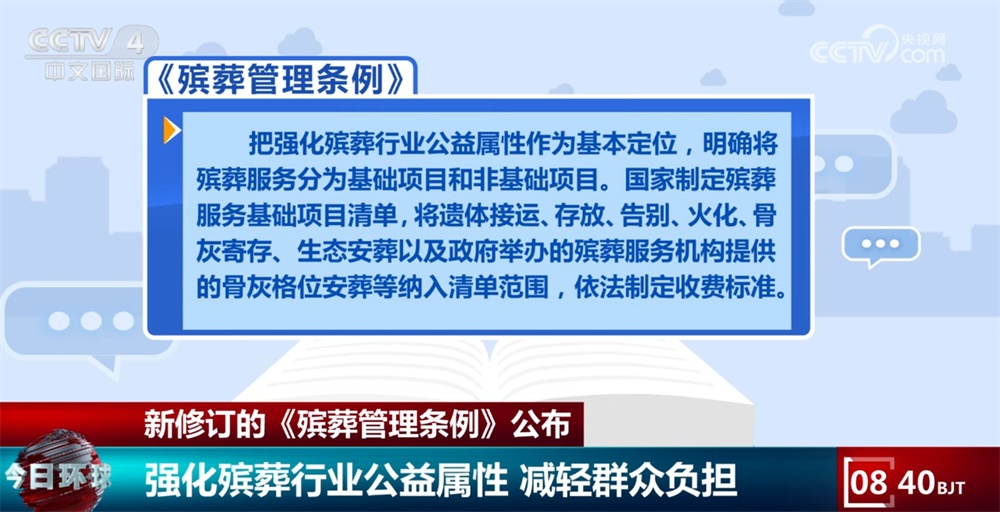
Core Viewpoint - The newly revised "Funeral Management Regulations" aim to enhance the public welfare attributes of the funeral industry and address emerging issues in the sector, effective from March 30 of this year [1]. Group 1: Public Welfare and Service Classification - The revised regulations classify funeral services into basic and non-basic projects, with a national list of basic funeral services including body transportation, storage, farewell ceremonies, cremation, ash storage, ecological burial, and government-provided burial services [2]. - All provinces have established lists for both basic and non-basic funeral service projects, with examples such as the Wuhan Wuchang Funeral Home offering 15 service items, including 6 basic services with fee exemptions for certain items [4]. Group 2: Non-Profit Structure and Land Use - The regulations prohibit the establishment of new profit-oriented funeral service institutions, mandating that new funeral service organizations be government-run and non-profit [5]. - New funeral facilities must acquire land use rights through allocation according to national regulations [5]. Group 3: Responsibilities and Service Provision - The regulations clarify the responsibilities of relevant departments in funeral management, stating that medical institutions' morgues cannot be outsourced and should only provide temporary storage for bodies [6][7]. - There is an emphasis on expanding ecological burial services, such as sea burials and tree burials, to meet the growing public demand for environmentally friendly options [9].

如何实现收费更透明、监管更到位、安葬更生态?——新修订的《殡葬管理条例》看点解析
Xin Hua She· 2026-01-08 02:10
Core Viewpoint - The newly revised "Funeral Management Regulations" aims to enhance transparency in fees, strengthen regulation, and promote ecological burial practices, effective from March 30, 2026, providing a legal framework for the funeral industry and addressing public concerns [1]. Group 1: Strengthening the Public Welfare Attribute of the Funeral Industry - The core principle of the revised regulations is to reinforce the public welfare attribute of the funeral industry, with multiple institutional designs to ensure its implementation [2]. - Over 6,000 public cemeteries have been established nationwide, covering over 80% of districts in 29 provinces, and 23,200 service fee items have been canceled [2]. - The regulations explicitly state the public welfare nature of the funeral industry, which was not clearly defined in the original regulations, thus providing a stronger legal basis for its enforcement [2]. Group 2: Enhancing Funeral Service Supply and Fee Management - The regulations categorize funeral services into basic and non-basic projects, with a national list defining essential services such as body transport, storage, and ecological burial [3]. - Local governments are authorized to adjust the list of basic services according to local needs, while non-basic service fees will be strictly regulated [3]. - The regulations aim to make funeral service fees more transparent, thereby reducing the financial burden on the public [3]. Group 3: Establishing a Comprehensive Regulatory System - The regulations emphasize a multi-departmental approach to regulation, clarifying the roles of various government departments involved in funeral management [6]. - A new chapter on "supervision and management" has been added, requiring local governments to create a comprehensive regulatory checklist for funeral activities [6]. - The introduction of credit regulation and social supervision mechanisms aims to enhance the regulatory framework and ensure compliance with the public welfare attribute [7]. Group 4: Promoting Civilized and Modern Funeral Practices - The regulations advocate for ecological burial practices and civilized memorial services, aligning with environmental trends and cultural values [8]. - The inclusion of ecological burial methods in the basic service list and the encouragement of green funeral products aim to reduce environmental impact [8]. - Local governments may provide subsidies for ecological burial practices, enhancing public acceptance and recognition of these methods [8]. Group 5: Addressing Challenges in Funeral Practices - The regulations highlight the role of community organizations in promoting civilized and frugal funeral practices, while also regulating excessive spending and commercialization in online memorial services [10]. - The emphasis on grassroots governance and the regulation of online platforms aims to ensure that funeral services adhere to cultural and ethical standards [10]. - The revised regulations are expected to have a profound impact on promoting spiritual and ecological civilization in the country [10].
强化公益属性 减轻群众负担 新修订的《殡葬管理条例》“新”在哪?
Yang Shi Wang· 2026-01-07 20:26
Core Viewpoint - The newly revised "Funeral Management Regulations" aims to enhance the public welfare aspect of the funeral industry, reduce the financial burden on families, and clarify service charges, set to take effect on March 30, 2026 [1][2][12]. Group 1: Strengthening Public Welfare in the Funeral Industry - The revised regulations emphasize the public welfare nature of the funeral industry, categorizing services into basic and non-basic projects, with a national list of basic services established [1][4]. - Basic services include body transportation, storage, farewell ceremonies, cremation, ash storage, ecological burial, and government-provided burial services [4][12]. - New funeral service institutions must be non-profit and government-run, prohibiting the establishment of for-profit funeral service entities [2][12]. Group 2: Clear Fee Structure and Management - The regulations implement a clear management system for funeral service fees, ensuring transparency on what services incur charges and their respective costs [3][4]. - A national list of basic service items will be created, with local governments allowed to add items based on regional needs, while prohibiting charges for services not on the list [4][5]. - Price monitoring and strict management will be enforced to prevent excessive charges, with penalties for unauthorized fee increases [4][10][12]. Group 3: Promoting Ecological Burial Practices - The regulations encourage the adoption of ecological burial methods, such as sea burials, tree burials, and grassland burials, to meet public demand for environmentally friendly options [6][7]. - Local governments are incentivized to provide subsidies for implementing ecological burial practices [6][7]. - The regulations advocate for burial methods that occupy less land and promote the use of environmentally friendly funeral products [7][12]. Group 4: Comprehensive Regulatory Framework - The revised regulations clarify the responsibilities of various government departments in overseeing the funeral industry, ensuring a comprehensive regulatory framework [9][10]. - Local governments are required to create a regulatory checklist covering all aspects of funeral activities, utilizing modern technology for monitoring compliance [10][12]. - Social oversight is encouraged, with mechanisms in place for addressing public concerns regarding funeral services [10][12].
如何实现收费更透明、监管更到位、安葬更生态?
Xin Lang Cai Jing· 2026-01-07 17:12
Core Viewpoint - The newly revised "Funeral Management Regulations" will take effect on March 30, 2026, marking a comprehensive update since the original regulations were enacted in 1997, aimed at protecting public rights, standardizing funeral activities, and promoting the healthy development of the funeral industry [1] Group 1: Strengthening the Public Welfare Attribute of the Funeral Industry - The core principle of the revised regulations is to enhance the public welfare attribute of the funeral industry, supported by multiple institutional designs [2] - Over 6,000 public cemeteries have been established nationwide, covering more than 80% of counties in 29 provinces, and 23,200 service fee items have been eliminated [2] - The regulations explicitly state the public welfare attribute as the primary legislative purpose, ensuring it is a guiding principle for subsequent management [2] Group 2: Enhancing Basic Funeral Service Supply - The regulations categorize funeral services into basic and non-basic projects, with a national list defining essential services such as body transportation, storage, farewell ceremonies, cremation, and ecological burial [3] - Local governments are authorized to adjust the list of basic services based on regional needs, while non-basic service fees will be strictly regulated [3] - This approach aims to extend basic services throughout the entire funeral process and accommodate diverse public needs [3] Group 3: Strengthening Funeral Service Fee Management - The regulations mandate that funeral service fee policies be formulated by relevant government departments, ensuring transparency and legal compliance in pricing [3] - It prohibits the establishment of fee items outside the defined list, promoting a transparent pricing structure [3] Group 4: Strengthening Funeral Facility Management - New funeral service institutions must be government-run and non-profit, preventing the establishment of for-profit funeral service providers [4] - The regulations emphasize the need for government support in land use, construction, and investment for funeral facilities [4] Group 5: Establishing a Comprehensive Regulatory System for the Funeral Industry - The regulations clarify the roles of various government departments in funeral management, establishing a comprehensive regulatory framework [5] - It introduces a chapter on "Supervision and Management," requiring local governments to create a regulatory checklist covering all aspects of funeral activities [6] - The regulations incorporate credit supervision, social oversight, and industry self-discipline to enhance regulatory effectiveness [6] Group 6: Strengthening Legal Responsibilities - The regulations enhance legal responsibilities, detailing administrative penalties and criminal sanctions to ensure compliance and protect public rights [7] - This multi-departmental collaboration aims to address enforcement challenges in funeral management [7] Group 7: Promoting Civilized and Modern Funeral Practices - The regulations advocate for ecological burial and civilized memorial practices, aligning with environmental trends and cultural values [8] - It includes provisions for promoting green burial methods and encourages local governments to provide subsidies for ecological burials [8] - The regulations aim to reduce land use and environmental impact associated with traditional burial practices [8] Group 8: Addressing Online Memorialization and Community Involvement - The regulations emphasize the role of community organizations in promoting civilized and frugal funeral practices, particularly in rural areas [9] - It sets clear guidelines to prevent extravagant funerals and ensures online memorial services adhere to legal and ethical standards [9] Group 9: Overall Impact - Experts believe the revised regulations will enhance public welfare in funeral services, promote environmentally friendly cemetery construction, and foster a cultural shift towards more respectful and sustainable funeral practices [10]
司法部、民政部负责人就《殡葬管理条例》修订答记者问
Xin Hua She· 2026-01-07 10:18
Core Viewpoint - The revised "Funeral Management Regulations" aim to strengthen the public welfare attributes of the funeral industry, enhance service management, and address emerging issues in the sector [2][3]. Summary by Sections Background of the Revision - The funeral sector is a significant livelihood issue for many families in China. The original regulations were enacted in 1997, and recent developments necessitated a revision to address new challenges and reinforce the public welfare aspect of funeral services [2]. Overall Approach to the Revision - The revision focuses on enhancing the public welfare nature of the funeral industry, improving service management across all stages of the funeral process, and providing legal support to resolve prominent issues in the sector [3]. Regulations on Service Management - The revised regulations emphasize public welfare, establish a funding mechanism for basic funeral services, enhance the supply of funeral facilities, reduce the financial burden on families, and improve convenience in service delivery [4]. Ensuring Basic Funeral Service Needs - The regulations categorize funeral services into basic and non-basic projects, with a national list of basic services including body transport, storage, farewell ceremonies, cremation, and ecological burial. Local governments can adjust the list based on regional needs [5]. Strengthening Facility Construction and Management - The regulations require local governments to incorporate funeral facility construction into relevant planning, ensure government responsibility for facility development, and prohibit the establishment of for-profit funeral service institutions [6]. Regulations on Funeral and Burial Services - The regulations set standards for body transport, storage, and cremation, and require burial services to provide necessary documentation for the allocation of burial spaces [8]. Regulations on Fee Management - The regulations mandate a clear management system for funeral service fees, prohibiting charges outside the established list and requiring strict oversight of pricing policies [9]. Promoting Cultural Change in Funeral Practices - The regulations advocate for civilized, frugal, and eco-friendly funeral practices, encouraging the use of green burial products and promoting low-carbon memorial activities [10]. Strengthening Comprehensive Supervision - The regulations establish a comprehensive supervision system covering all aspects of funeral activities, detailing departmental responsibilities and enhancing regulatory measures [11]. Implementation Measures - To ensure effective implementation of the regulations, authorities will focus on public education, developing supporting policies, and adapting practices to local conditions [12].