生态葬

Search documents
新修订的《殡葬管理条例》进一步完善顶层设计 切实减轻群众负担提升“民生温度”
Yang Shi Wang· 2026-01-08 03:54
Core Viewpoint - The newly revised "Funeral Management Regulations" aim to enhance the public welfare attributes of the funeral industry and address emerging issues in the sector, effective from March 30 of this year [1]. Group 1: Public Welfare and Service Classification - The revised regulations classify funeral services into basic and non-basic projects, with a national list of basic funeral services including body transportation, storage, farewell ceremonies, cremation, ash storage, ecological burial, and government-provided burial services [2]. - All provinces have established lists for both basic and non-basic funeral service projects, with examples such as the Wuhan Wuchang Funeral Home offering 15 service items, including 6 basic services with fee exemptions for certain items [4]. Group 2: Non-Profit Structure and Land Use - The regulations prohibit the establishment of new profit-oriented funeral service institutions, mandating that new funeral service organizations be government-run and non-profit [5]. - New funeral facilities must acquire land use rights through allocation according to national regulations [5]. Group 3: Responsibilities and Service Provision - The regulations clarify the responsibilities of relevant departments in funeral management, stating that medical institutions' morgues cannot be outsourced and should only provide temporary storage for bodies [6][7]. - There is an emphasis on expanding ecological burial services, such as sea burials and tree burials, to meet the growing public demand for environmentally friendly options [9].

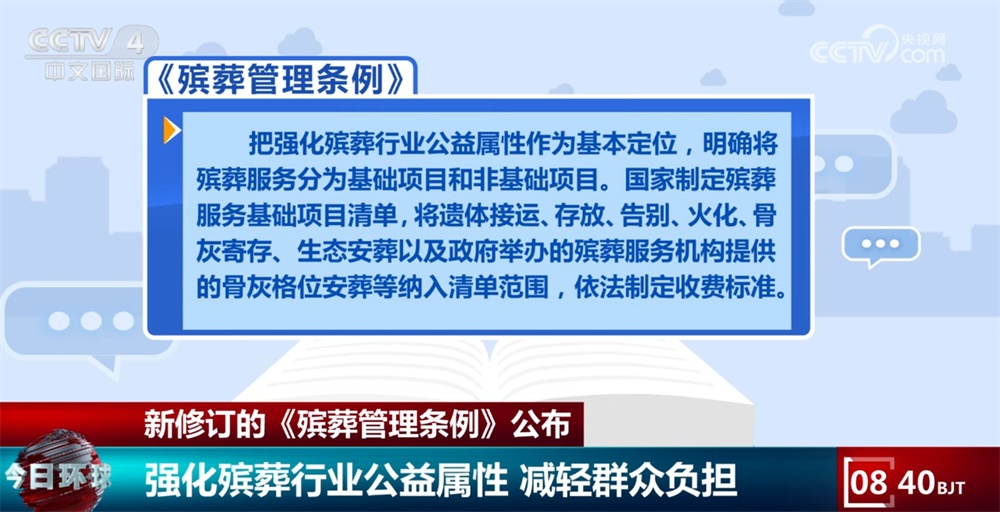
强化公益属性 减轻群众负担 新修订的《殡葬管理条例》“新”在哪?
Yang Shi Wang· 2026-01-07 20:26
Core Viewpoint - The newly revised "Funeral Management Regulations" aims to enhance the public welfare aspect of the funeral industry, reduce the financial burden on families, and clarify service charges, set to take effect on March 30, 2026 [1][2][12]. Group 1: Strengthening Public Welfare in the Funeral Industry - The revised regulations emphasize the public welfare nature of the funeral industry, categorizing services into basic and non-basic projects, with a national list of basic services established [1][4]. - Basic services include body transportation, storage, farewell ceremonies, cremation, ash storage, ecological burial, and government-provided burial services [4][12]. - New funeral service institutions must be non-profit and government-run, prohibiting the establishment of for-profit funeral service entities [2][12]. Group 2: Clear Fee Structure and Management - The regulations implement a clear management system for funeral service fees, ensuring transparency on what services incur charges and their respective costs [3][4]. - A national list of basic service items will be created, with local governments allowed to add items based on regional needs, while prohibiting charges for services not on the list [4][5]. - Price monitoring and strict management will be enforced to prevent excessive charges, with penalties for unauthorized fee increases [4][10][12]. Group 3: Promoting Ecological Burial Practices - The regulations encourage the adoption of ecological burial methods, such as sea burials, tree burials, and grassland burials, to meet public demand for environmentally friendly options [6][7]. - Local governments are incentivized to provide subsidies for implementing ecological burial practices [6][7]. - The regulations advocate for burial methods that occupy less land and promote the use of environmentally friendly funeral products [7][12]. Group 4: Comprehensive Regulatory Framework - The revised regulations clarify the responsibilities of various government departments in overseeing the funeral industry, ensuring a comprehensive regulatory framework [9][10]. - Local governments are required to create a regulatory checklist covering all aspects of funeral activities, utilizing modern technology for monitoring compliance [10][12]. - Social oversight is encouraged, with mechanisms in place for addressing public concerns regarding funeral services [10][12].
上海46岁独居女子过世 遗产不能买墓地?最新消息:法院指定虹口区民政局任遗产管理人
Mei Ri Jing Ji Xin Wen· 2025-12-25 00:46
Core Viewpoint - The case of a 46-year-old woman, Jiang, who passed away alone in Shanghai, raises significant concerns regarding the management of her estate, particularly in the absence of immediate family and a will [1][5]. Group 1: Estate Management Announcement - The Shanghai Hongkou District Civil Affairs Bureau announced its role as the estate manager for Jiang, as all her legal heirs had predeceased her, and she left no will or inheritance agreement [2]. - Individuals with a caregiving relationship to Jiang or those with claims against her estate are invited to submit written materials to the Civil Affairs Bureau within three months of the announcement [3][2]. - The announcement specifies that any objections to the Civil Affairs Bureau's role must also be submitted in writing, including identification and reasons for the objection [2][3]. Group 2: Medical and Financial Circumstances - Jiang was hospitalized due to a brain hemorrhage, and her distant relative, Mr. Wu, signed for her medical treatment and initially covered some medical expenses [10][9]. - The accumulated medical expenses reached over 210,000 yuan, with Mr. Wu unable to cover the costs, leading to complications regarding the repayment from Jiang's estate [10][12]. - Legal advice indicated that Mr. Wu, as a distant relative, had no legal claim to Jiang's estate to recover the medical expenses incurred during her treatment [10][15]. Group 3: Funeral Arrangements and Legal Implications - The local community committee has taken on the role of temporary guardian during Jiang's treatment, emphasizing the need for urgent medical care without the ability to access her funds [15][12]. - The Civil Affairs Bureau has indicated that Jiang's estate will be managed according to legal procedures, with any remaining assets potentially allocated for public welfare after settling debts [16][17]. - There is a discussion regarding the appropriateness of using Jiang's estate for funeral expenses, with the Civil Affairs Bureau clarifying that such costs could be covered if deemed reasonable [17][16].

天价墓地,何时完结?
商业洞察· 2025-06-19 08:16
Core Viewpoint - The article discusses innovative funeral practices in Japan as a response to high funeral costs, highlighting unique services like "balloon funerals" and "space burials" that cater to adventurous individuals [2][3][6]. Group 1: Innovative Funeral Services - Balloon Kobo offers "balloon funerals," where ashes are sent into a hydrogen balloon to explode at 50KM altitude, costing around 12,000 RMB [3]. - SPACE NTK collaborates with SpaceX for "space burials," launching ashes in capsules into orbit, with prices ranging from 25,000 to 500,000 RMB [3]. - Celestis provides "moon burials" for 94,000 RMB, allowing individuals to have a lunar-themed farewell [6]. Group 2: Traditional Funeral Costs - Traditional Japanese funerals are influenced by Chinese culture, with significant costs associated with burial plots and Buddhist ceremonies. In 2024, burial plots in Tokyo are expected to cost between 50,000 to 100,000 RMB [6]. - The average funeral cost in Japan is 66,300 RMB, with burial plots accounting for 40%-50% of total expenses [10]. - In China, the average funeral cost is 41,000 RMB, with burial plots making up 50%-70% of expenses, particularly high in urban areas [10][11]. Group 3: Market Dynamics - The funeral industry is characterized by a scarcity of burial plots, leading to higher prices compared to real estate. This scarcity results in a more stable price increase for burial plots [13][19]. - Fushouyuan, a leading funeral service provider, has seen a price increase of 1.9% for burial plots despite a decrease in sales volume, indicating strong demand for funeral services [11][17]. - The article notes that the funeral industry has become a lucrative business, with significant profit margins due to the emotional nature of the services and the lack of price negotiation in death-related expenses [22][24]. Group 4: Changing Perceptions and Trends - There is a growing acceptance of the funeral industry among younger generations, with more individuals considering careers in this field as societal attitudes shift [33][36]. - Innovative funeral products and services are emerging, such as eco-burials and personalized memorials, reflecting changing consumer preferences [32][38]. - The concept of "end-of-life planning" is gaining traction, with individuals proactively organizing their funerals, which is seen as a form of personal expression and autonomy [39].
天价墓地,何时完结?
远川研究所· 2025-06-05 20:05
Group 1 - The article discusses innovative funeral practices in Japan, such as "balloon funerals" and "space burials," which are alternatives to traditional burial methods due to high funeral costs [1][2][3] - Balloon funerals involve sending ashes in a hydrogen balloon to explode at 50 kilometers altitude, costing around 12,000 RMB, while space burials can range from 25,000 to 500,000 RMB [1][2] - Traditional Japanese funerals are influenced by Chinese culture, with significant costs associated with burial plots and Buddhist ceremonies, with burial plots in Tokyo costing between 50,000 to 100,000 RMB [4][5] Group 2 - The average funeral costs in various countries are highlighted, with Japan at 66,300 RMB and China at 41,000 RMB, where burial plots account for 50-70% of the total costs [10][6] - The article notes that the high costs of funerals in China are comparable to those in Japan, with the average funeral expense being 45.4% of the annual salary [6][9] - The article emphasizes the increasing demand for innovative funeral services as traditional burial methods become more expensive and less accessible [1][2][3] Group 3 - The article mentions the emergence of new funeral products, such as "life crystals" made from ashes, and the trend of eco-friendly burials, which are becoming more popular among younger generations [36][37][50] - The concept of "end-of-life planning" or "shukatsu" in Japan encourages individuals to prepare for their own funerals, reflecting a shift in societal attitudes towards death [54][55] - The funeral industry is evolving with younger professionals entering the field, driven by changing perceptions and the desire for personalized services [40][43][51]